
You have been diagnosed with a DVT blood clot in your leg. You have started your medicines. Now you want to know: when will this clot go away?
Most DVT blood clots shrink gradually over weeks to months. Symptoms like pain and swelling usually start improving within days to a couple of weeks, and many clots largely dissolve within about 3 to 6 months. Some clots never fully disappear and leave behind scar tissue inside the vein.
This guide explains what affects the timeline, how treatment helps, when a clot may need to be removed by an Interventional Radiologist, and the warning signs you must never ignore.
What Is a DVT Blood Clot?
Deep vein thrombosis (DVT) is a blood clot that forms in a deep vein, most often in the calf, thigh or pelvis. It blocks normal blood flow back to the heart and can cause:
- Swelling of one leg, usually the calf or whole leg
- Pain or tenderness, often felt like a cramp
- Warmth and redness over the area
- Heaviness or tightness in the leg
The biggest danger is that a piece of the clot can break off and travel to the lungs. This is called pulmonary embolism (PE) and is a medical emergency.
Also Read: Leg Pain or Something Serious? How to Spot DVT Before It Becomes Life-Threatening
Do Blood Thinners Dissolve the Clot?
This surprises many people: blood thinners do not directly dissolve a DVT blood clot.
Blood thinners (anticoagulants) do two important jobs:
- They stop the clot from getting bigger
- They prevent new clots from forming
While this happens, your body’s own natural clot-dissolving system slowly breaks down the existing clot. That is why the process takes weeks to months, not days.
In some cases, the clot can be actively removed or dissolved faster using minimally invasive procedures done by an Interventional Radiologist — explained later in this guide.
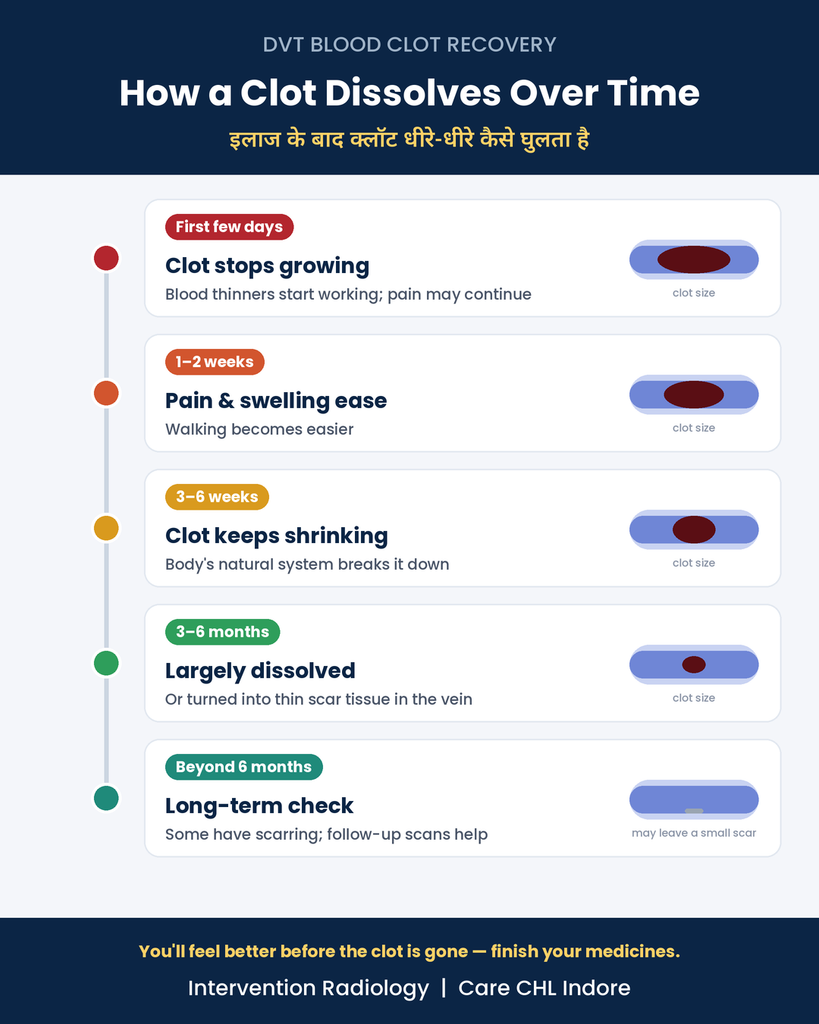
DVT Blood Clot Dissolving Timeline
Every patient is different, but recovery usually follows this pattern:
| Time after starting treatment | What usually happens |
|---|---|
| First few days | Blood thinners start working; the clot stops growing. Pain may still be present. |
| 1–2 weeks | Pain and swelling usually begin to improve. Walking becomes easier. |
| 3–6 weeks | The clot gradually shrinks as the body breaks it down. Swelling keeps reducing. |
| 3–6 months | Many clots are largely dissolved, or have turned into thin scar tissue in the vein. |
| Beyond 6 months | Some people have leftover scarring; a few develop long-term leg symptoms. |
Key takeaway: Feeling better comes before the clot is fully gone. Keep taking your medicines for the full course, even if your leg feels normal.
Also Read: DVT Explained: Early Signs of Deep Vein Thrombosis You Should Never Ignore
Does a DVT Blood Clot Ever Fully Dissolve?
Sometimes yes, sometimes not completely.
- Smaller clots, especially in the calf, often dissolve completely.
- Larger clots in the thigh or pelvis may only partly dissolve. The rest can harden into scar tissue that sticks to the vein wall.
- This scar can damage the valves inside the vein, which may lead to post-thrombotic syndrome — long-term leg swelling, heaviness, skin darkening and, in some cases, ulcers.
This is one reason why early and proper treatment matters so much.
What Affects How Fast a Clot Dissolves?
- Size and location: Calf clots usually clear faster than thigh or pelvic clots.
- How early treatment starts: The sooner treatment begins, the better the outcome.
- Taking medicines correctly: Missing doses can let the clot grow or new clots form.
- Underlying cause: Clots after surgery or injury often clear well. Clots linked to cancer, clotting disorders or long-term immobility may take longer or come back.
- Movement: Walking, as advised by your doctor, helps blood flow and recovery.
- General health: Age, weight, smoking and other illnesses can slow healing.
How Long Will I Need Blood Thinners?
Most people take blood thinners for at least 3 months. Your doctor may advise a longer course if the clot had no clear cause, if you have had clots before, or if a risk factor such as cancer continues. Never stop your medicines on your own.
Also Read: Understanding Deep Vein Thrombosis(DVT): Causes, Symptoms, and Treatment Options
When Can a DVT Clot Be Removed Faster?
For most people, blood thinners alone are enough. But for some patients, an Interventional Radiologist can remove or dissolve the clot directly. This is usually considered when:
- The clot is large, especially in the thigh or pelvic veins (iliofemoral DVT)
- Symptoms are severe — major swelling, pain, or a bluish leg
- The clot is recent, usually within the first couple of weeks
- There is a high risk of long-term leg damage (post-thrombotic syndrome)
- Rarely, the leg’s blood flow is seriously threatened
How Interventional Radiology Treats DVT
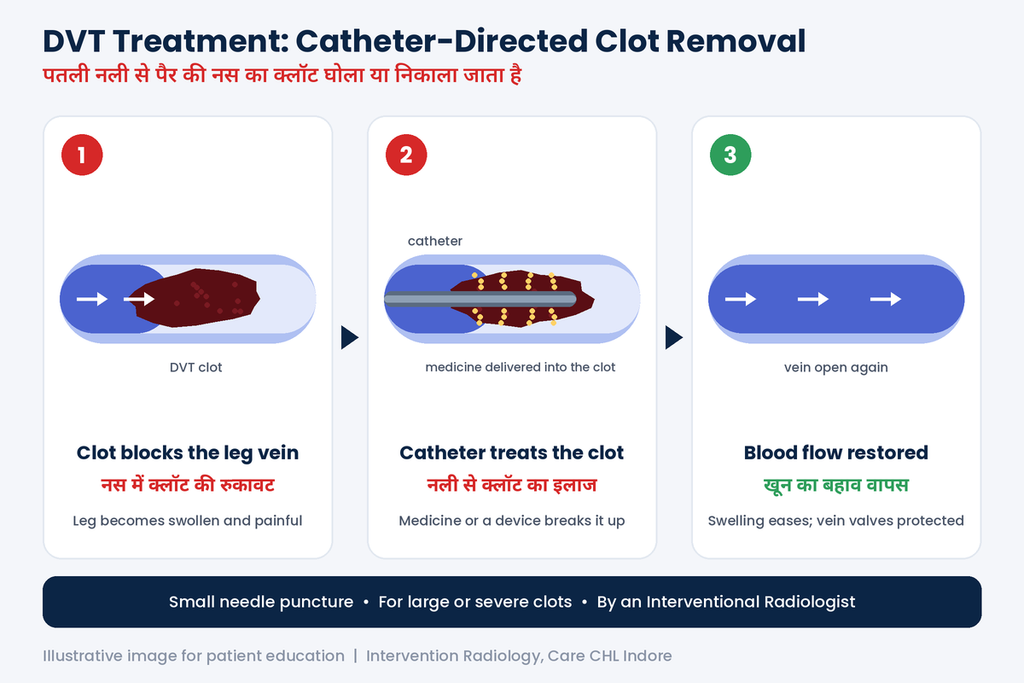
These are minimally invasive procedures done through a small needle puncture, usually behind the knee or in the groin:
- Catheter-directed thrombolysis: A thin catheter is placed inside the clot and clot-dissolving medicine is delivered directly into it, so it works faster and in a smaller dose than medicine given through a regular vein.
- Mechanical thrombectomy: Special devices break up and suck out the clot, often in a single session.
- Venous angioplasty and stenting: If a narrowing in the vein caused or worsened the clot, a balloon and stent may be used to keep the vein open.
- IVC filter: In patients who cannot take blood thinners, a small filter may be placed in the main vein to help stop clots from reaching the lungs. It is often removed later.
The aim is to restore blood flow quickly, relieve symptoms faster, and protect the vein valves to reduce long-term problems. Your doctor will decide if you need these procedures based on your scans and health.
Tips to Support Recovery
- Take blood thinners exactly as prescribed. Do not skip or double doses.
- Walk as advised — gentle movement helps blood flow.
- Raise your leg when resting to reduce swelling.
- Wear compression stockings if your doctor recommends them.
- Drink enough water and avoid sitting still for long periods.
- Do not massage the swollen leg.
- Tell every doctor and dentist that you are on blood thinners.
- Go for follow-up Doppler scans as advised to check how the clot is clearing.
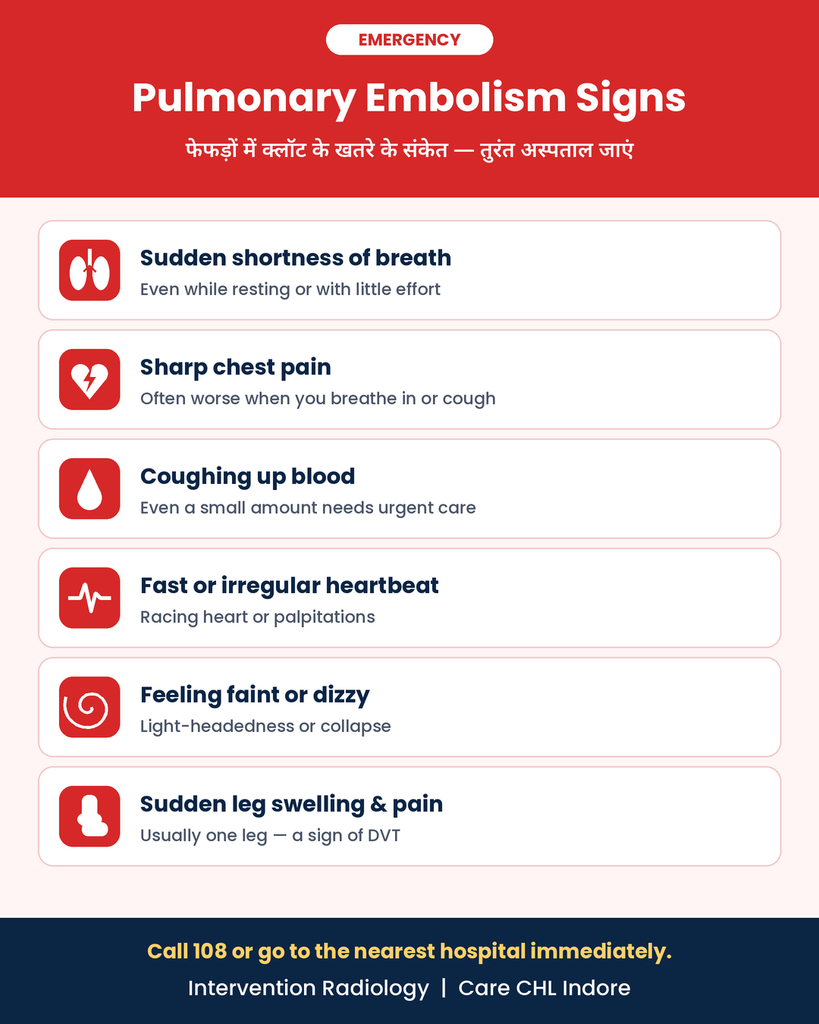
Emergency Warning Signs: Call 108 or Go to the Hospital Immediately
These may be signs of a pulmonary embolism (clot in the lungs):
- Sudden shortness of breath
- Sharp chest pain, especially when breathing in
- Coughing up blood
- Fast or irregular heartbeat
- Feeling faint, dizzy or collapsing
Also seek urgent care if your leg suddenly becomes much more swollen, very painful, pale, bluish or cold, or if you have heavy bleeding while on blood thinners.
DVT Blood Clot Treatment in Indore at Care CHL Indore
If you have a DVT blood clot — or swelling and pain in one leg that has not been checked — the Intervention Radiology Indore team at Care CHL Indore can help with Doppler evaluation and advanced, minimally invasive clot treatment when needed.
Dr. Alok Kumar Udiya, Interventional Radiologist, works with physicians and vascular teams to choose the right treatment for each patient — from careful monitoring on blood thinners to catheter-directed clot removal for large or severe clots.
Frequently Asked Questions
How long does a DVT blood clot take to dissolve? Most clots shrink over weeks to months. Symptoms often improve within 1–2 weeks, and many clots largely dissolve within about 3 to 6 months.
Do blood thinners dissolve DVT clots? Not directly. They stop the clot from growing and prevent new clots, while the body slowly breaks down the existing clot.
Can a DVT clot be removed quickly? In selected patients with large or severe clots, an Interventional Radiologist can remove or dissolve the clot using catheter-based procedures.
Can I walk with a DVT blood clot? In most cases, walking is encouraged once treatment has started, as it helps blood flow. Follow your doctor’s advice.
What if the clot does not fully dissolve? Some clots leave scar tissue in the vein. This can cause long-term leg swelling or heaviness, which can be managed with compression and, in some cases, procedures.
How long do I need to take blood thinners? Usually at least 3 months. Your doctor may advise longer depending on the cause and your risk of another clot.
Where can I get DVT treatment in Indore? DVT evaluation and treatment are available at Care CHL Indore through the Intervention Radiology team led by Dr. Alok Kumar Udiya, Interventional Radiologist.
Conclusion
A DVT blood clot does not disappear overnight. With proper treatment, most people feel better within a couple of weeks, while the clot itself gradually shrinks over the following months. Taking medicines correctly, staying active and going for follow-up scans make a big difference.
For large or severe clots, minimally invasive clot removal can speed up recovery and help protect your leg in the long run.
Diagnosed with a DVT blood clot or worried about leg swelling? Consult the Intervention Radiology team at Care CHL Indore.
Disclaimer: This article is for general awareness only and is not a substitute for medical advice. If you have signs of a pulmonary embolism, seek emergency care immediately.