
Your ultrasound report says “fibroadenoma, 1.8 cm”. Or maybe “3.2 cm”. The first question most women ask is: “Does it need to be removed?”
The answer depends largely on size — but not only on size. Many small fibroadenomas can be safely watched, while larger, growing or troublesome ones are usually removed. Today, many can be removed without open surgery.
This guide explains the sizes of fibroadenoma that usually need removal, other reasons removal may be advised, and the options available at each size.
What Is a Fibroadenoma?
A fibroadenoma is a benign (non-cancerous) breast lump made of gland and connective tissue. It is one of the most common breast lumps in women aged 15 to 35, though it can occur at any age.
A typical fibroadenoma:
- Feels smooth, firm and rubbery
- Moves easily under the skin (often called a “breast mouse”)
- Is usually painless
- May grow slightly during pregnancy or with hormonal changes, and often shrinks after menopause
Fibroadenomas do not turn into cancer in the vast majority of cases. But because other lumps can feel similar, every new breast lump should be checked by a doctor.
Also Read: Say Goodbye to Breast Lumps: The Minimally Invasive Way to Treat Fibroadenomas
How Is a Fibroadenoma Measured?
Fibroadenoma size is measured on a breast ultrasound. The report usually gives three measurements in millimetres or centimetres (for example, 22 × 14 × 12 mm). Doctors usually use the longest measurement when deciding on removal.
Ultrasound also shows the lump’s shape, edges and blood flow. If anything looks unusual, a needle biopsy is done to confirm the diagnosis before any decision about removal.
Tip: Keep all your ultrasound reports. Comparing sizes over time is one of the most useful ways to decide whether a fibroadenoma needs removal.
Sizes of Fibroadenoma: When Is Removal Advised?
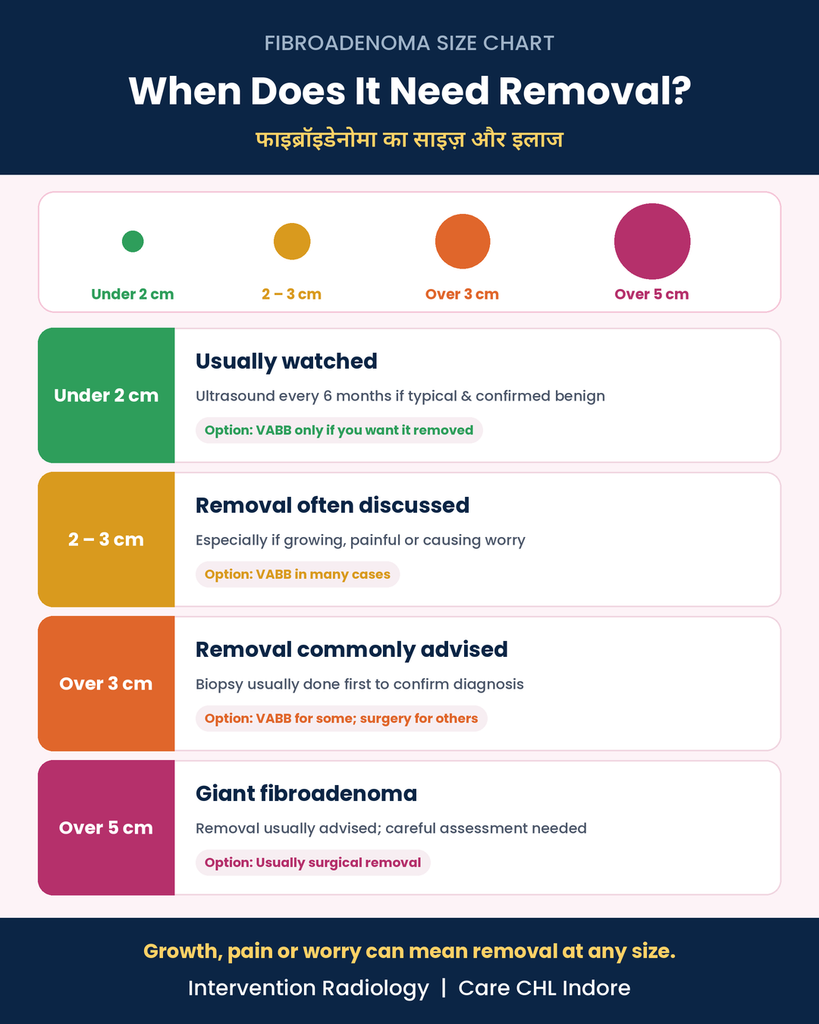
There is no single rule for every woman, but doctors commonly use size as a starting guide:
| Fibroadenoma size | What usually happens | Common removal option if needed |
|---|---|---|
| Less than 2 cm | Usually watched with ultrasound if it looks typical and is confirmed benign | VABB, if removal is wanted |
| 2 to 3 cm | Removal is often discussed, especially if growing, painful or causing worry | VABB in many cases |
| More than 3 cm | Removal is commonly advised | VABB for some lumps; surgery for others |
| More than 5 cm (giant fibroadenoma) | Removal is usually advised | Usually surgical removal |
Less than 2 cm: Most small, typical fibroadenomas confirmed as benign can be safely monitored with an ultrasound every 6 months for 1–2 years. If they stay stable, routine checks continue.
2 to 3 cm: This is the “discussion zone”. Your doctor will consider growth, symptoms, your age and your preference. Many women in this range choose removal, often with VABB.
More than 3 cm: Larger fibroadenomas are more likely to be noticed, cause discomfort or change the shape of the breast. Removal is commonly advised, and a biopsy is usually done first to confirm the diagnosis.
More than 5 cm (giant fibroadenoma): These are usually removed, as they can change breast shape and need careful assessment to rule out other similar-looking lumps.
Also Read: Breast Fibroadenoma Treatment Without Surgery: A Minimally Invasive Guide

Reasons for Removal Beyond Size
Even a small fibroadenoma may be removed if:
- It is growing. A noticeable increase in size on follow-up scans is one of the most important reasons for removal.
- The biopsy is unclear, or the lump looks unusual on ultrasound.
- It causes pain or discomfort.
- It changes the shape of the breast or is easily visible.
- You are anxious about living with the lump. Peace of mind is a valid reason.
- You are planning a pregnancy. Fibroadenomas can grow during pregnancy and breastfeeding.
- You have a strong family history of breast disease and prefer removal.
- There are many lumps or a new lump appears after age 35–40, needing closer evaluation.
Does a Fibroadenoma Always Need Removal?
No. Many fibroadenomas never cause problems and some shrink on their own over time. Removal is a choice made together with your doctor, based on size, growth, symptoms and your comfort.
Fibroadenoma Removal Options by Size
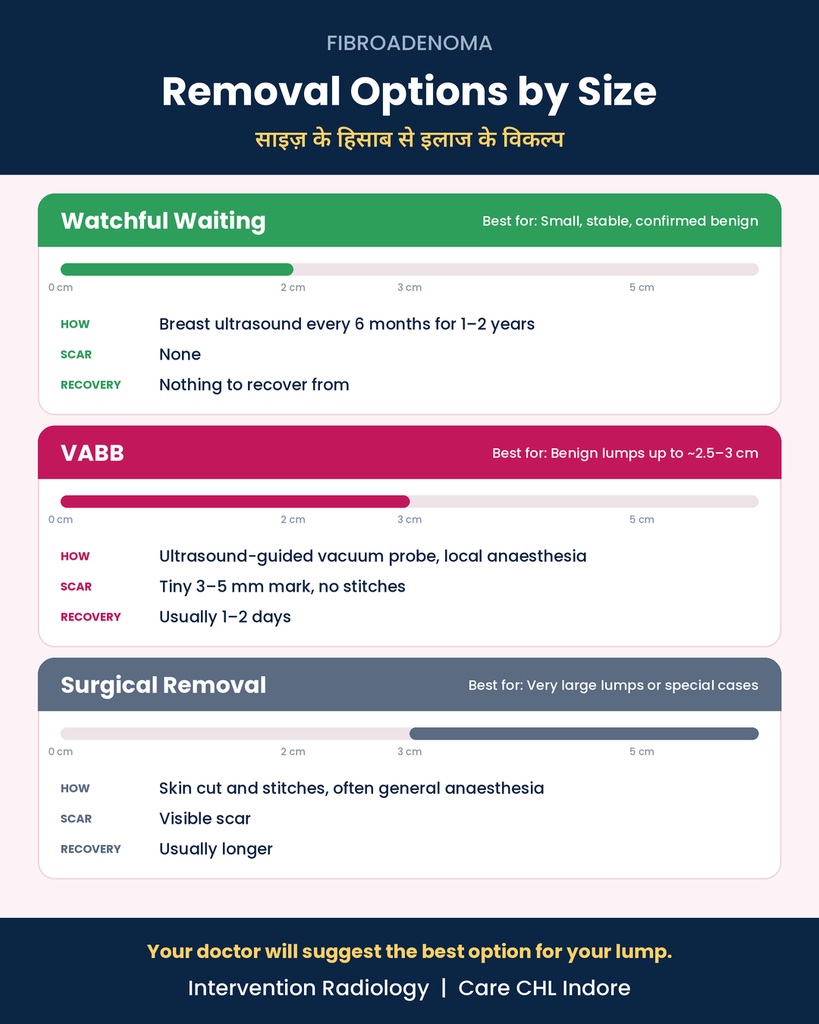
1. Watchful waiting (active monitoring) Best for small, stable, biopsy-confirmed fibroadenomas. You have a breast ultrasound every 6 months for 1–2 years. If the lump grows or symptoms appear, removal is reconsidered.
2. VABB (vacuum-assisted breast biopsy/excision) Suitable for many fibroadenomas up to about 2.5–3 cm, depending on shape and location.
- Done by an Interventional Radiologist under ultrasound guidance
- Local anaesthesia, through a 3–5 mm nick
- No stitches, almost no scar
- Most women go home within a few hours and return to routine in 1–2 days
3. Surgical removal (excision) Usually advised for very large or giant fibroadenomas, lumps with uncertain biopsy results, or when VABB is not suitable. It involves a skin cut, stitches and a visible scar, and is often done under general anaesthesia.
| Option | Best suited for | Scar | Recovery |
|---|---|---|---|
| Watchful waiting | Small, stable, confirmed benign lumps | None | Not applicable |
| VABB | Benign lumps up to ~2.5–3 cm | Tiny, often hard to see | 1–2 days |
| Surgery | Very large lumps or special cases | Visible | Usually longer |
What If You Choose to Wait?
If you and your doctor decide to monitor the fibroadenoma:
- Get a follow-up ultrasound as advised, usually every 6 months at first.
- Check your breasts once a month, ideally a week after your period.
- Note any change in size, shape, pain or skin over the lump.
- See your doctor sooner if the lump grows quickly, becomes hard or fixed, or if you notice nipple discharge or skin changes.
Also Read: Best Doctor for Fibroadenoma Removal Near Me
Can a Fibroadenoma Come Back After Removal?
A fibroadenoma that has been completely removed rarely comes back in the same place. However, new fibroadenomas can develop elsewhere in the breast, especially in younger women. Regular follow-up helps catch any new lump early.
Fibroadenoma Evaluation and Removal in Indore at Care CHL Indore
Whether your fibroadenoma is small and needs monitoring, or larger and needs removal, the Intervention Radiology Indore team at Care CHL Indore can help you decide the right path.
Dr. Alok Kumar Udiya, Interventional Radiologist, reviews your ultrasound and biopsy reports, explains the options clearly, and offers ultrasound-guided VABB for suitable fibroadenomas — working with breast surgeons when surgery is the better choice.
Frequently Asked Questions
What size of fibroadenoma needs removal? Removal is commonly advised for fibroadenomas larger than 3 cm, and often discussed for those between 2 and 3 cm. Smaller ones may be removed if they grow, cause pain or worry.
Can a 2 cm fibroadenoma be left alone? Often, yes — if it looks typical on ultrasound, is confirmed benign and stays stable on follow-up scans.
How fast do fibroadenomas grow? Most grow very slowly or stay the same size. A noticeable increase on follow-up scans is a reason to consider removal.
Can a fibroadenoma turn into cancer? This is very rare. Most fibroadenomas remain benign throughout life.
Can a fibroadenoma be removed without surgery? Yes. Many fibroadenomas up to about 2.5–3 cm can be removed with VABB through a tiny nick, without stitches.
What is a giant fibroadenoma? A fibroadenoma larger than about 5 cm. These are usually removed surgically.
Does a fibroadenoma grow during pregnancy? It can, because of hormonal changes. Women planning a pregnancy may choose removal beforehand.
Where can I get fibroadenoma removal in Indore? It’s evaluation and VABB removal are available at Care CHL Indore through the Intervention Radiology team led by Dr. Alok Kumar Udiya, Interventional Radiologist.
Conclusion
Size matters when deciding whether a fibroadenoma needs removal — but it is not the only factor. Small, stable fibroadenomas can often be watched, while larger, growing or troublesome ones are usually removed.
The good news is that many fibroadenomas can now be removed with VABB, without surgery, stitches or a noticeable scar.
Unsure whether your fibroadenoma needs removal? Consult the Intervention Radiology team at Care CHL Indore.
Disclaimer: This article is for general awareness only and is not a substitute for medical advice. Size guidelines vary by individual case. Please consult your doctor for advice specific to your condition.