
Your doctor looks at your scan and says, “We should do a biopsy.” In that moment, many people hear only one word: cancer.
The fear is completely natural. But here is the important truth:
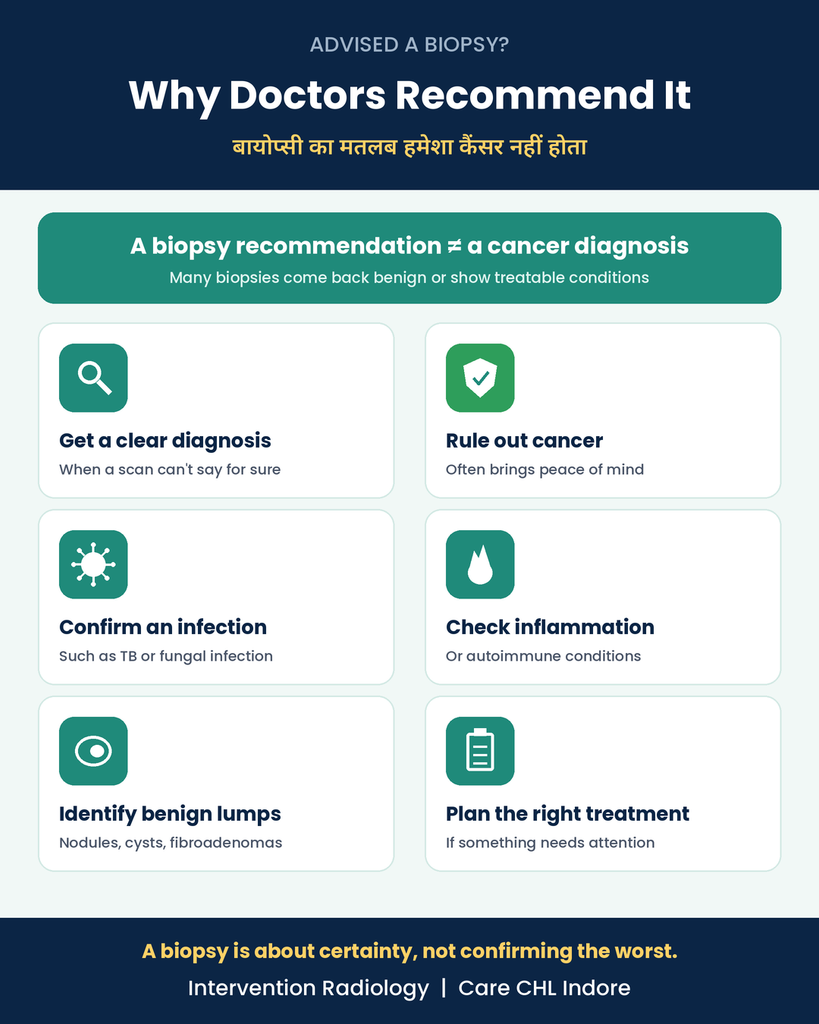
A biopsy recommendation does not mean you have cancer. A biopsy is a test to find out exactly what something is. Many biopsies come back benign (not cancer), or show an infection or inflammation that can be treated easily.
This guide explains why doctors recommend a biopsy, how it is done, what the results can mean, and how to cope while you wait.
What Is a Biopsy?
A biopsy means taking a small sample of tissue or cells from the body so it can be examined under a microscope by a pathologist.
Scans like ultrasound, CT and MRI show the shape, size and location of an abnormal area. But they cannot always tell what it is made of. A biopsy gives the final answer.
Why Do Doctors Recommend a Biopsy?
A biopsy is advised for many reasons — and ruling out cancer is only one of them:
- To get a clear diagnosis when a scan shows a lump, nodule or shadow that cannot be identified for sure
- To rule out cancer so you can stop worrying and avoid unnecessary treatment
- To confirm an infection such as tuberculosis or a fungal infection, which needs very different treatment
- To check for inflammation or autoimmune conditions
- To identify benign lumps like fibroadenomas, thyroid nodules or cysts, and decide whether they need treatment
- To plan the right treatment if a disease is found — including special tests that guide targeted medicines
- To check a known condition that has changed on follow-up scans
In simple words: a biopsy is about getting certainty, not confirming the worst.
Also Read: Getting a CT-Guided Lung Biopsy in Indore: A Complete Patient Guide
Why Not Just Treat Without a Biopsy?
Many conditions look similar on scans. A lung shadow could be TB, pneumonia, an old scar or a tumour. A neck lump could be a harmless nodule or something that needs surgery. Treating without knowing could mean the wrong medicine, unnecessary surgery, or missed time. A biopsy prevents guesswork.
Common Types of Biopsy
| Type of biopsy | How it is done | Often used for |
|---|---|---|
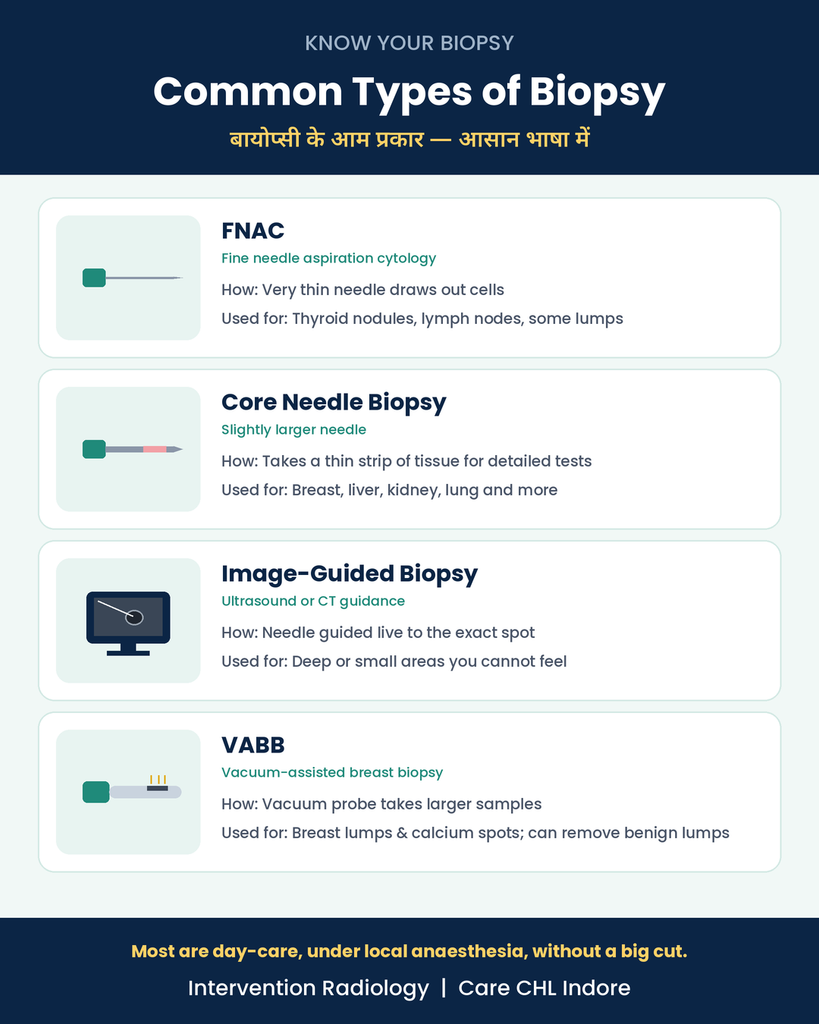
| FNAC (fine needle aspiration cytology) | Very thin needle draws out cells | Thyroid nodules, lymph nodes, some lumps |
| Core needle biopsy | Slightly larger needle takes a thin strip of tissue | Breast, liver, kidney, lung and other organs |
| Image-guided biopsy | Needle guided by ultrasound or CT | Deep or small areas that cannot be felt |
| Vacuum-assisted biopsy (VABB) | Vacuum probe takes larger samples | Breast lumps and tiny calcium spots |
| Endoscopic biopsy | Sample taken through a camera tube | Stomach, intestine, airways |
| Surgical biopsy | Part or all of a lump removed in surgery | When needle biopsy is not possible or not enough |
Today, most biopsies are done with a needle under image guidance — without surgery, without a big cut, and usually as a day-care procedure.
How Does an Interventional Radiologist Do a Biopsy?
An Interventional Radiologist is a specialist who uses ultrasound, CT and other imaging to guide needles precisely to the right spot. This makes biopsies more accurate and safer.
A typical image-guided biopsy looks like this:
- Review: Your scans and blood tests are checked. You are told whether to pause blood thinners.
- Positioning: You lie comfortably on the ultrasound or CT table.
- Planning: The doctor finds the safest path to the target area on the screen.
- Local anaesthesia: The skin is numbed. You stay awake.
- Sampling: A thin needle is guided to the area and a few small samples are taken while the doctor watches on the screen.
- Finishing: A small bandage is applied. No stitches are usually needed.
- Observation: You rest for a short time and usually go home the same day.
Most biopsies take 15–60 minutes, depending on the area. Most people feel pressure rather than sharp pain.
Also Read: Where to Get Vacuum Assisted Biopsy Done in Indore | Complete Guide for Patients
Is a Biopsy Safe?
Image-guided biopsies are safe, commonly done procedures. Possible side effects include mild pain, bruising and minor bleeding at the needle site. Specific risks depend on the organ — for example, a lung biopsy carries a small risk of an air leak. Your doctor will explain the risks for your case before the procedure.
What Can Biopsy Results Show?
Results usually take a few days to about a week. Special tests can take longer. The report can show:
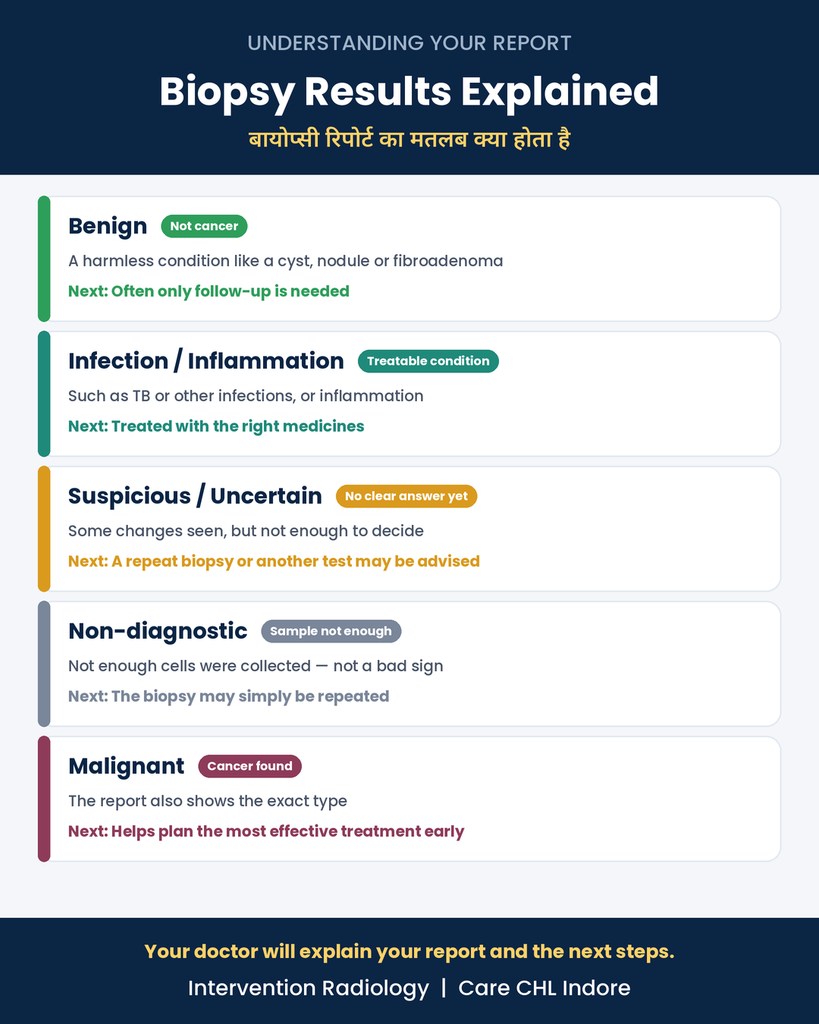
- Benign (not cancer): A harmless condition, such as a fibroadenoma, benign thyroid nodule or cyst. Often only follow-up is needed.
- Infection or inflammation: Such as tuberculosis or other infections, which can be treated with medicines.
- Malignant (cancer): If cancer is found, the biopsy also shows its type, which helps doctors plan the most effective treatment. Finding it early through a biopsy often means more treatment options.
- Suspicious or uncertain: The sample shows some changes but not a clear answer. A repeat biopsy or another test may be advised.
- Non-diagnostic: Not enough cells were collected to decide. This does not mean anything is wrong; the biopsy may simply be repeated.
Your treating doctor will explain the report and the next steps clearly.
Common Biopsy Myths
Myth: “If the doctor wants a biopsy, they already know it’s cancer.” Fact: Doctors recommend biopsies to find out — not because they already know. A biopsy is often the step that rules cancer out.
Myth: “A biopsy can spread cancer.” Fact: This is extremely rare. The benefit of an accurate diagnosis is far greater than this very small risk.
Myth: “A biopsy is a big, painful operation.” Fact: Most biopsies today are done with a thin needle under local anaesthesia, and you go home the same day.
Myth: “It’s better to wait and watch than do a biopsy.” Fact: For some findings, watching is fine. But when a biopsy is advised, delaying it can delay treatment if something needs attention.
Also Read: What is Vacuum Assisted Biopsy for Breast Fibroadenoma? | Intervention Radiology Indore
Coping While You Wait for Results
Waiting can be the hardest part. A few things can help:
- Remember that many biopsy results are benign.
- Ask when and how you will get your results, so you are not left guessing.
- Avoid searching symptoms online late at night — it often increases anxiety.
- Keep to your daily routine and stay active.
- Talk to a family member or friend about how you feel.
- Write down your questions for the doctor.
If worry is affecting your sleep or daily life, tell your doctor. Support is available.
Questions to Ask Your Doctor
- Why do I need this biopsy, and what are you looking for?
- Which type of biopsy will I have, and how long will it take?
- Do I need to stop any medicines before it?
- What are the risks for me?
- When and how will I get the results?
- What happens next if the result is benign, uncertain or abnormal?
Image-Guided Biopsy in Indore at Care CHL Indore
If your doctor has advised a biopsy, the Intervention Radiology Indore team at Care CHL Indore performs image-guided biopsies of the lung, thyroid, breast, liver, kidney, lymph nodes, bones and other organs using ultrasound and CT guidance.
Dr. Alok Kumar Udiya, Interventional Radiologist, focuses on accurate sampling, patient comfort and clear communication — working closely with your treating doctor and the pathology team so you get answers as quickly as possible.
Frequently Asked Questions
Does a biopsy recommendation mean I have cancer? No. A biopsy is a test to find out what an abnormal area is. Many biopsies come back benign or show infection or inflammation.
Why would a doctor recommend a biopsy if it’s not cancer? To get a clear diagnosis, rule out cancer, confirm infections like TB, identify benign lumps, or plan the right treatment.
Is a biopsy painful? Most image-guided biopsies are done under local anaesthesia. You may feel pressure and mild soreness afterwards, which settles quickly.
Can a biopsy spread cancer? This is extremely rare. The benefit of an accurate diagnosis is far greater than this very small risk.
How long do biopsy results take? Usually a few days to about a week. Special tests may take longer.
What if my biopsy result is unclear? Sometimes the sample is not enough or the result is uncertain. Your doctor may advise a repeat biopsy or another test. This does not mean something is wrong.
Where can I get an image-guided biopsy in Indore? Image-guided biopsies are available at Care CHL Indore through the Intervention Radiology team led by Dr. Alok Kumar Udiya, Interventional Radiologist.
What is the cost of a biopsy in Indore? Cost depends on the organ, type of biopsy, lab tests needed and insurance cover. Please contact Care CHL Indore directly for an estimate.
Conclusion
Hearing the word “biopsy” can be scary, but it is not a diagnosis of cancer. It is a simple, safe step to find out exactly what is going on — and very often, the answer is reassuring.
If something does need treatment, a biopsy helps your doctors choose the right path early. Either way, a biopsy replaces uncertainty with clarity.
Advised a biopsy? Consult the Intervention Radiology team at Care CHL Indore for a safe, accurate, image-guided biopsy.
Disclaimer: This article is for general awareness only and is not a substitute for medical advice. Please consult your doctor for advice specific to your condition.