
Your chest CT shows a “spot” or “nodule” on the lung. The doctor says a biopsy is needed. Suddenly, there are many questions. Is it cancer? Will it hurt? Is it safe?
A CT-guided lung biopsy is a safe, minimally invasive test that takes a tiny tissue sample from the lung through a thin needle — without surgery. It is usually done under local anaesthesia, and most patients go home the same day.
This guide explains everything about getting a CT-guided lung biopsy in Indore: why it is done, how to prepare, what happens during the procedure, risks, recovery and results.
What Is a CT-Guided Lung Biopsy?
A lung biopsy means taking a small piece of tissue from the lung to examine it under a microscope.
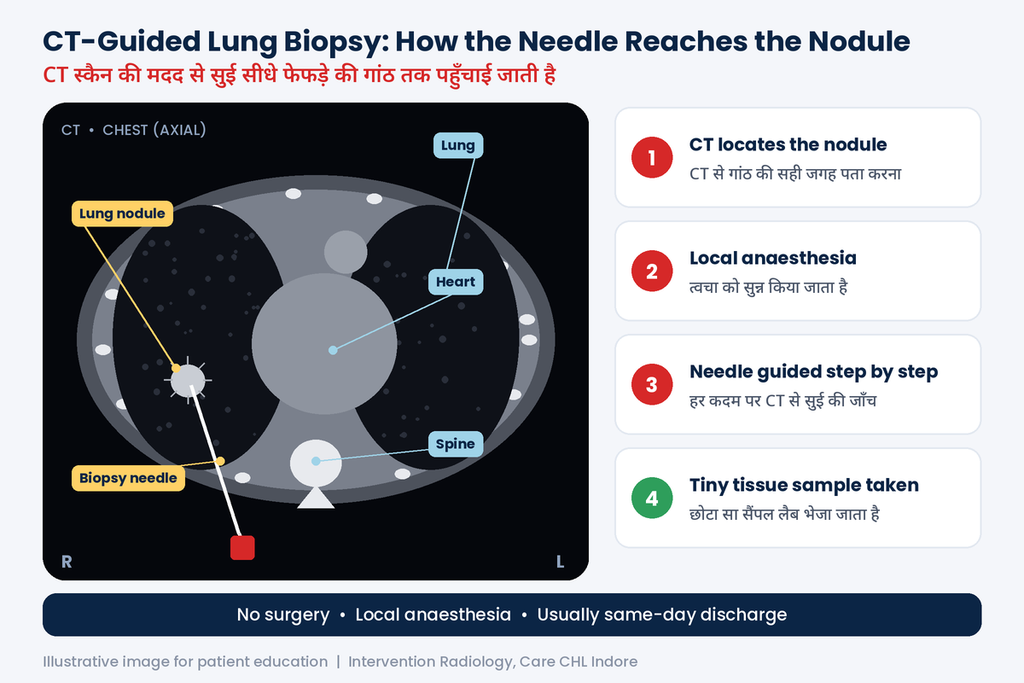
In a CT-guided lung biopsy, an Interventional Radiologist uses CT scan images to guide a thin needle through the chest wall directly into the abnormal area. The CT shows the exact position of the needle at every step, so the sample is taken from the right spot.
It is also called a percutaneous lung biopsy or CT-guided FNAC/core biopsy of the lung.
Also Read: Image-guided Biopsy: Accurate Diagnosis with Advanced Technology
Why Would You Need a Lung Biopsy?
Scans can show that something is wrong, but they cannot always say exactly what it is. A biopsy gives a clear diagnosis. Doctors may advise a lung biopsy in Indore for:
- A lung nodule or mass seen on X-ray or CT that looks suspicious
- Suspected lung cancer, to confirm the diagnosis and find the exact type
- Molecular or genetic testing of a tumour, which helps choose targeted therapy
- Suspected infection such as tuberculosis or fungal infection that is not clear from other tests
- A nodule that is growing on follow-up scans
- Suspected spread of cancer from another organ to the lung
A confirmed diagnosis helps your doctor plan the right treatment instead of guessing.
Also Read: Back Pain That Won’t Go Away? It Could Be a Spine Tumor
How to Prepare for a CT-Guided Lung Biopsy
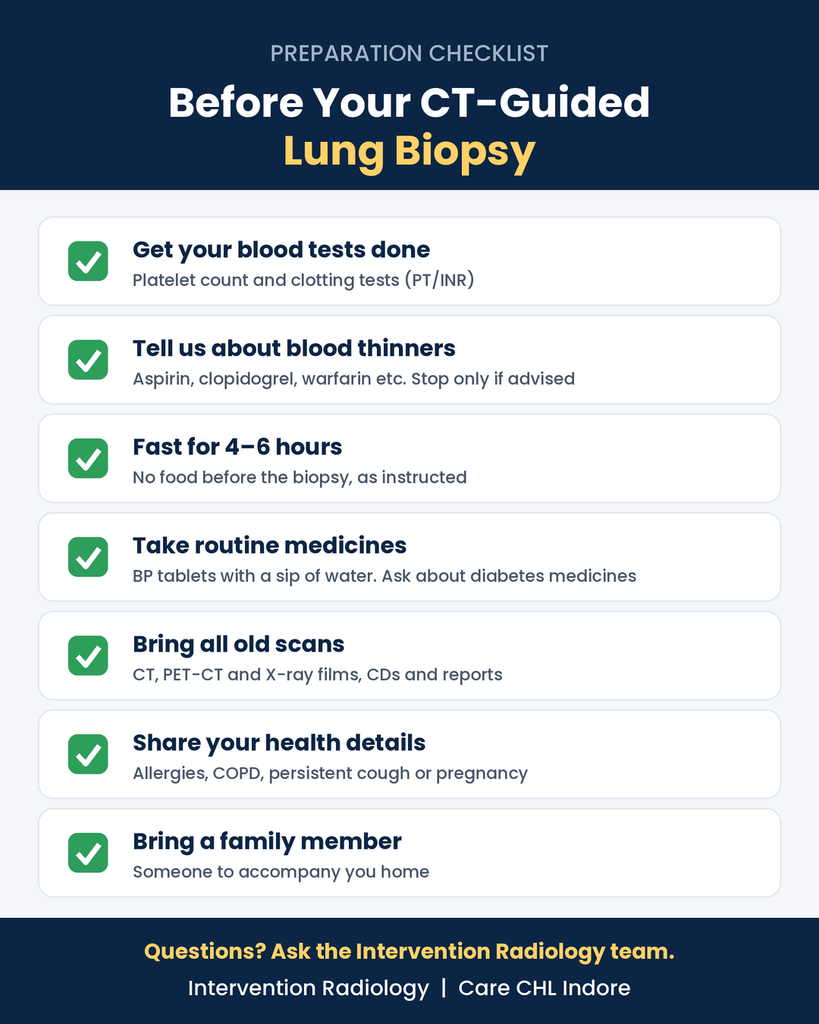
Good preparation makes the procedure safer and smoother. Your care team will give exact instructions, but usually:
- Blood tests: Platelet count and clotting tests (PT/INR) are checked a few days before.
- Blood thinners: Tell the doctor if you take aspirin, clopidogrel, warfarin or newer blood thinners. You may need to stop them for a few days — only as advised. Never stop them on your own.
- Fasting: You may be asked not to eat for 4–6 hours before the biopsy.
- Other medicines: BP and most routine medicines can usually be taken with a sip of water. Ask about diabetes medicines.
- Old reports: Bring all previous CT, PET-CT and X-ray films or CDs.
- Tell the team if you have allergies, severe COPD, a cough you cannot control, or if you might be pregnant.
- Bring a family member to accompany you home.
Also Read: Interventional Radiology in Breast Cancer: A Modern, Minimally Invasive Approach to Treatment
What Happens During the Procedure: Step by Step
- Consent and check-up: The doctor explains the procedure, risks and benefits, and you sign a consent form.
- Positioning: You lie on the CT table — on your back, stomach or side, depending on where the nodule is.
- Planning scan: A few CT images are taken to find the safest path to the lesion. A small mark is made on the skin.
- Local anaesthesia: The skin and chest wall are numbed with an injection. You stay awake.
- Needle placement: A thin needle is advanced in small steps. CT images confirm the needle position each time.
- Breathing instructions: You will be asked to hold your breath briefly and stay still at certain moments.
- Sample collection: Two to four small tissue samples are usually taken and sent to the lab.
- Final check: The needle is removed, a small dressing is applied, and a final CT checks the lung.
The whole procedure usually takes about 30–60 minutes. Most patients feel pressure rather than sharp pain.
After the Biopsy: Recovery
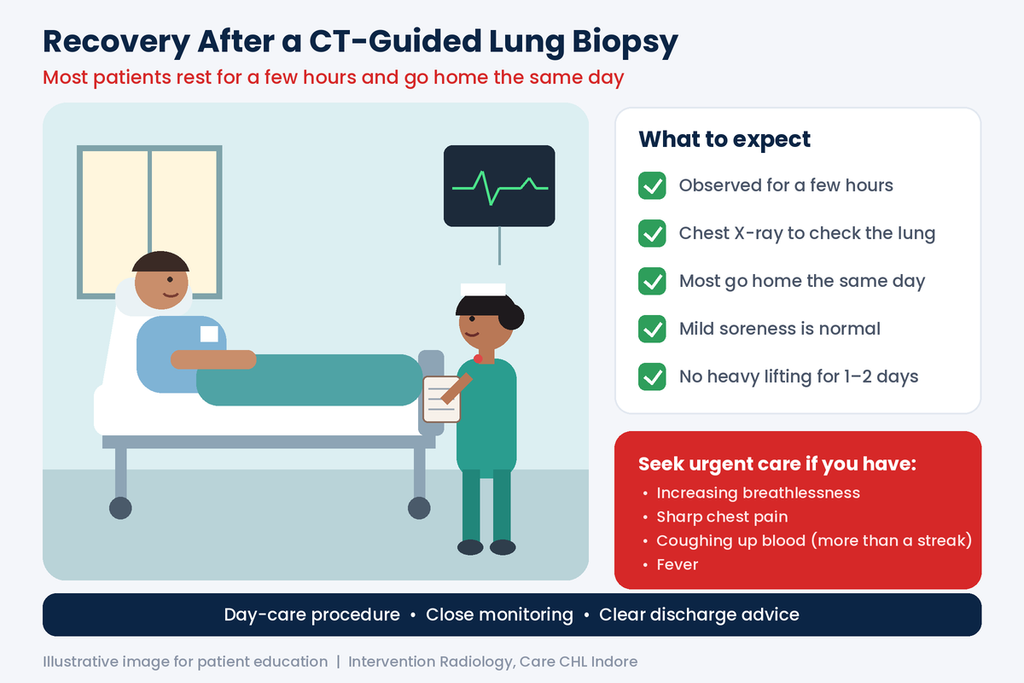
- You are observed for a few hours, and a chest X-ray is usually done to check for air leak.
- Most patients go home the same day.
- A little soreness at the needle site is normal for a day or two.
- Coughing up a small streak of blood once or twice can happen and usually settles on its own.
- Avoid heavy lifting, strenuous exercise and long travel for a day or two, or as advised.
- Ask your doctor before flying — air travel is usually avoided for a short period after a lung biopsy.
Seek urgent care if you have increasing breathlessness, sharp chest pain, coughing up more than a small amount of blood, or fever.
Is a CT-Guided Lung Biopsy Safe? Risks Explained
CT-guided lung biopsy is a well-established and commonly done procedure. Like any medical procedure, it has some risks. Knowing them helps you stay calm and alert.
- Pneumothorax (air leak): The most common complication. Air leaks around the lung and may cause mild breathlessness. Most cases are small and settle on their own. A small number of patients need a tube to remove the air.
- Minor bleeding: A little bleeding in the lung or coughing up a small amount of blood can occur and usually stops by itself.
- Pain at the needle site: Usually mild and short-lived.
- Rare complications: Serious bleeding, infection or air embolism are rare.
Your risk depends on the nodule’s size and location, your lung health, and whether you have conditions like emphysema. The doctor will discuss your personal risk before the procedure.
Who may not be suitable? Patients with uncorrected bleeding problems, very poor lung function, severe pulmonary hypertension, or those unable to lie still or follow breathing instructions may need a different approach.
How Accurate Is It?
CT-guided lung biopsy has a high diagnostic accuracy in published studies, especially for nodules larger than about 1 cm. Sometimes the sample is not enough for a clear answer. In that case, the biopsy may be repeated or another test may be advised.
CT-Guided Biopsy vs Other Options
| Method | How it is done | Best suited for |
|---|---|---|
| CT-guided lung biopsy | Thin needle through the chest wall, local anaesthesia | Nodules near the outer part of the lung |
| Bronchoscopy / EBUS | Flexible tube through the mouth into the airways, sedation | Central lesions and lymph nodes in the chest |
| Surgical biopsy | Keyhole or open surgery under general anaesthesia | When other methods fail or surgery is planned anyway |
Your doctor chooses the method based on where the lesion is and your overall health.
When Will You Get the Results?
Results usually take a few days to about a week. If special tests like immunohistochemistry (IHC) or molecular markers are needed, it can take longer.
The report goes to your treating doctor — usually a pulmonologist or oncologist — who will explain the next steps.
CT-Guided Lung Biopsy in Indore at Care CHL Indore
If you need a lung biopsy in Indore, the Intervention Radiology Indore team at Care CHL Indore offers CT-guided biopsies with a focus on safety, accuracy and patient comfort.
The procedure is performed by Dr. Alok Kumar Udiya, Interventional Radiologist, who works closely with pulmonologists, oncologists and pathologists so that your sample leads to a clear diagnosis and a timely treatment plan.
Frequently Asked Questions
Is a CT-guided lung biopsy painful? The area is numbed with local anaesthesia, so most patients feel only pressure and mild discomfort. Some soreness afterwards is normal and settles in a day or two.
How long does a CT-guided lung biopsy take? The procedure usually takes 30–60 minutes, followed by a few hours of observation.
Can I go home the same day after a lung biopsy? Most patients go home the same day after a few hours of monitoring and a normal chest X-ray.
Can a biopsy spread cancer? This is a common worry. The risk of spreading cancer cells along the needle path is extremely rare, and the benefit of an accurate diagnosis is far greater.
Where can I get a CT-guided lung biopsy in Indore? CT-guided lung biopsy is available at Care CHL Indore through the Intervention Radiology team led by Dr. Alok Kumar Udiya, Interventional Radiologist.
What is the cost of a lung biopsy in Indore? Cost depends on the type of biopsy, lab tests needed and insurance coverage. Please contact Care CHL Indore directly for an estimate.
Does a lung nodule always mean cancer? No. Many lung nodules are harmless or caused by old infections like TB. A biopsy helps find out for sure.
When can I return to normal activities? Most people resume light daily activities within a day or two. Avoid heavy lifting and ask your doctor before flying.
Conclusion
Hearing that you need a lung biopsy can be stressful. But a CT-guided lung biopsy is a quick, minimally invasive and commonly done test that gives your doctors the answers they need to plan the right treatment.
Getting a CT-guided lung biopsy in Indore by an experienced Interventional Radiologist means accurate sampling, careful monitoring and a faster path to treatment.
Need a lung biopsy? Consult the Intervention Radiology team at Care CHL Indore.
Disclaimer: This article is for general awareness only and is not a substitute for medical advice. Please consult your doctor for advice specific to your condition.