
It is 6 a.m. Your father went to bed fine last night. Now he cannot lift his right arm, and his words come out slurred.
You are scared, and one question fills your mind: can a stroke during sleep be treated?
Yes. In many cases, a wake-up stroke can be treated — if the patient reaches a stroke-ready hospital quickly. Modern brain imaging and clot-removal procedures have changed what doctors can do, even when no one knows exactly when the stroke began.
This guide explains what a wake-up stroke is, how it is treated, and what your family must do in the first few minutes.
What Is a Wake-Up Stroke?
A wake-up stroke is a stroke that happens while a person is asleep. The patient goes to bed normal and wakes up with stroke symptoms.
Studies suggest that roughly 1 in 5 ischemic strokes is a wake-up stroke. An ischemic stroke happens when a clot blocks blood flow to part of the brain.
The biggest problem is time. Doctors use a “last known well” time to decide treatment. This is the last moment the person was seen without symptoms.
For a wake-up stroke, the last known well time is usually when the person went to sleep. That could be 6, 8 or even 10 hours earlier.
Also Read: Blocked Neck Artery: Causes, Symptoms, Stroke Risk & Treatment Explained
Why Do Strokes Happen During Sleep or Early Morning?
Stroke risk is naturally higher in the early morning hours. Several things play a role:
- Morning BP surge: Blood pressure rises sharply as the body prepares to wake up.
- Dehydration: Many people drink no water for 7–8 hours at night, which thickens the blood.
- Sleep apnea: Repeated pauses in breathing lower oxygen and strain blood vessels.
- Atrial fibrillation (AF): An irregular heartbeat can form clots that travel to the brain.
- Missed medicines: Skipping night-time BP or blood-thinner tablets raises risk.
- Diabetes, high cholesterol and smoking: These damage blood vessels over time.
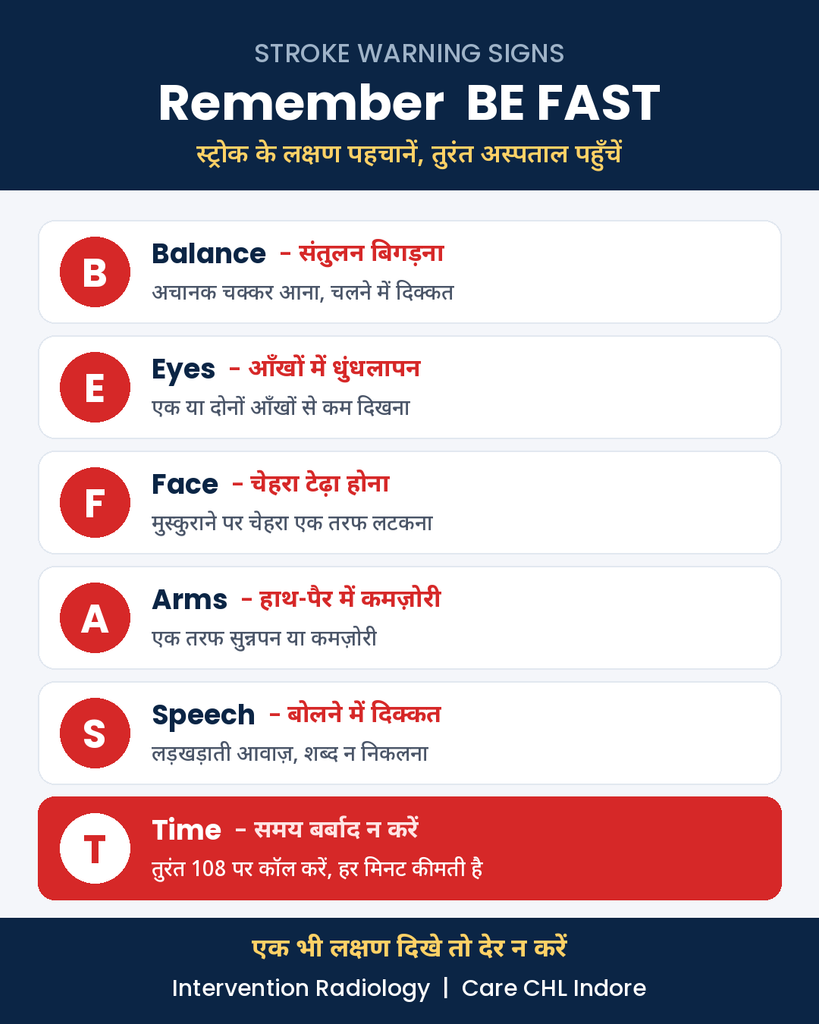
Stroke Symptoms in the Morning: The BE FAST Checklist
If someone wakes up “not right”, check these signs immediately:
- B – Balance: Sudden dizziness, trouble standing or walking.
- E – Eyes: Blurred, double or lost vision in one or both eyes.
- F – Face: One side of the face droops when they smile.
- A – Arms: One arm or leg is weak, numb or drifts down.
- S – Speech: Slurred speech, wrong words, or cannot understand you.
- T – Time: Call for help now. Note when the person was last seen normal.
Even one sign is enough to treat it as an emergency. Do not wait to see if it gets better.
Why Was Wake-Up Stroke Once Considered “Untreatable”?
The main clot-busting medicine for stroke works best within 4.5 hours of onset. After that, the risk of brain bleeding goes up.
With a wake-up stroke, no one knows the onset time. So for many years, doctors counted from bedtime. Most patients fell outside the 4.5-hour window and were not given clot-removing treatment.
This meant many patients who could have been helped received only supportive care.
Also Read: Who is the Best Neuro Doctor for Stroke Treatment
How Modern Imaging Changed Everything
Today, doctors no longer rely only on the clock. They look at the brain itself.
The new rule is simple: treat the tissue, not just the time.
Two types of scans make this possible:
- MRI DWI-FLAIR mismatch: The DWI sequence shows a stroke within minutes. The FLAIR sequence shows it only after about 4.5 hours. If the stroke appears on DWI but not on FLAIR, it is likely recent. This helps estimate the stroke’s age.
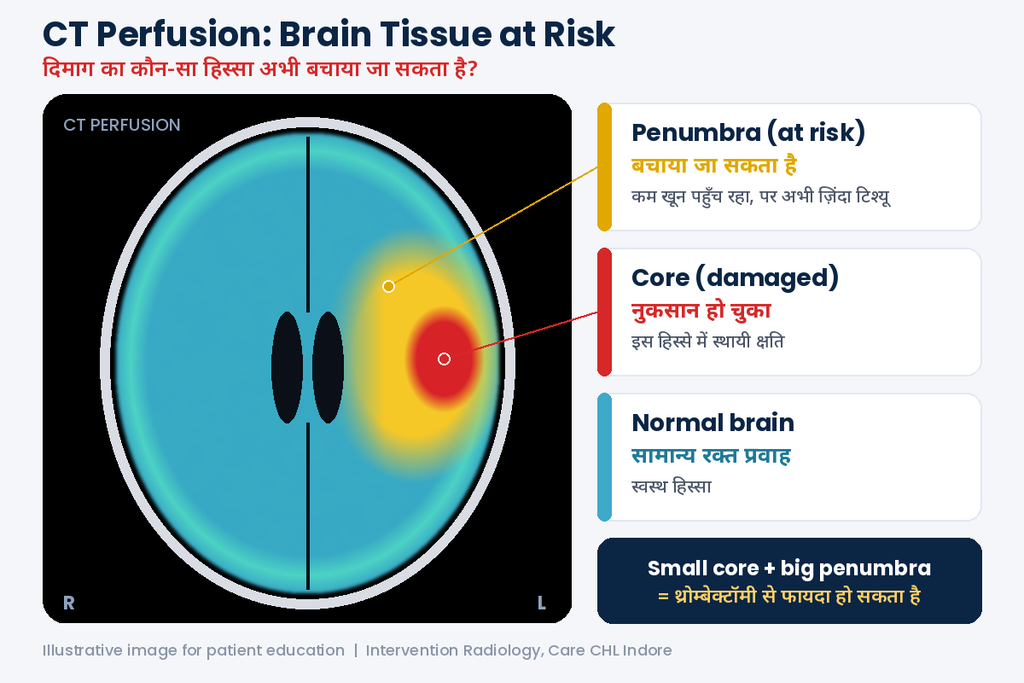
- CT perfusion: This scan shows how much brain is already damaged (the core) and how much is still at risk but can be saved (the penumbra). A small core with a large area at risk means treatment may help.
These scans let doctors find patients who still have brain tissue worth saving — even many hours after symptoms began.
Wake-Up Stroke Treatment Options
The right treatment depends on the scan results, the size and location of the clot, and the patient’s overall health.
1. Clot-dissolving medicine (thrombolysis)
This medicine is given through a vein to dissolve the clot. The WAKE-UP trial, published in 2018, showed that patients with an unknown onset time can benefit from it when the MRI shows a DWI-FLAIR mismatch.
In simple words: if the MRI suggests the stroke is recent, the medicine may still be given, even without a known start time.
2. Mechanical thrombectomy
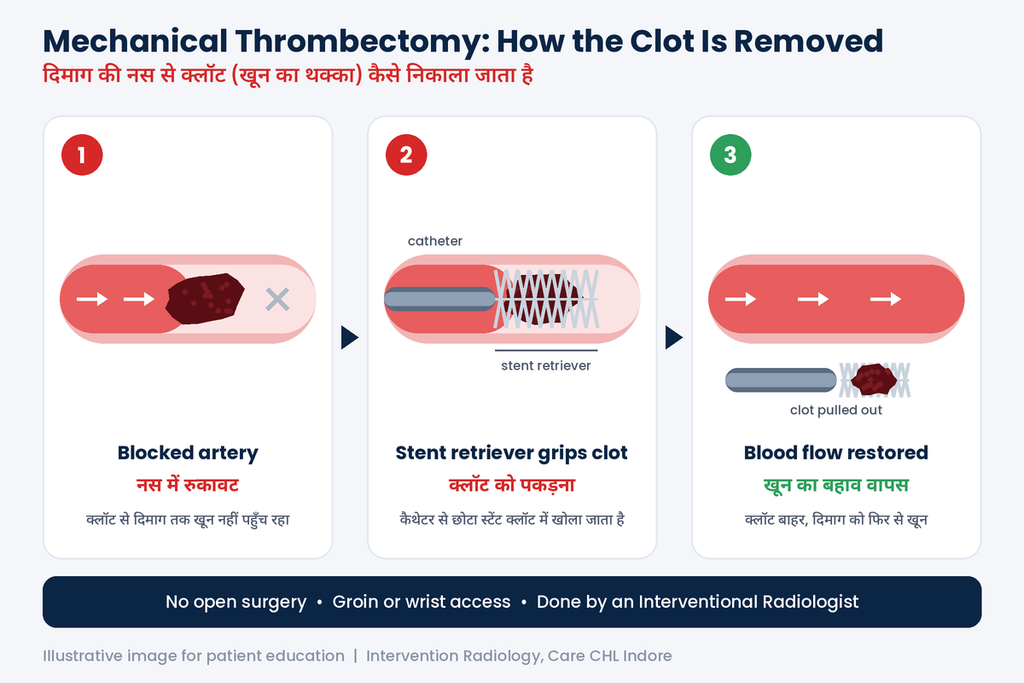
This is a minimally invasive procedure done by an Interventional Radiologist. A thin tube is guided into the blocked brain artery, and the clot is pulled out.
It is used for large vessel blockages — the most dangerous type of ischemic stroke. Two major trials changed practice:
- DAWN trial: Showed benefit in selected patients treated 6 to 24 hours after last known well.
- DEFUSE-3 trial: Showed benefit in selected patients treated 6 to 16 hours after last known well, using perfusion imaging.
Because of these trials, many wake-up stroke patients may now be eligible for thrombectomy within a 24-hour stroke window, based on imaging.
3. Supportive care and rehabilitation
If the patient is not eligible for clot removal, care focuses on stabilising BP, sugar and breathing, preventing another stroke, and starting physiotherapy early.
| Treatment | Typical time window | Who may be eligible |
|---|---|---|
| Thrombolysis (clot-dissolving medicine) | Up to 4.5 hours, or unknown onset with MRI DWI-FLAIR mismatch | Patients with no major bleeding risk and a recent-looking stroke on MRI |
| Mechanical thrombectomy | Up to 24 hours in selected patients | Patients with a large vessel blockage and a small damaged core on CT/MRI |
| Supportive care + rehab | Any time | All stroke patients |
Role of Interventional Radiology in Stroke Care
An Interventional Radiologist treats diseases from inside the blood vessels, using live X-ray guidance instead of open surgery.
Here is how mechanical thrombectomy works, in simple steps:
- The patient is taken to the cath lab after CT or MRI confirms a large clot.
- A small puncture is made in the groin or wrist. No skull opening is needed.
- A thin catheter is guided through the arteries up to the brain.
- A stent retriever or suction catheter grips or sucks out the clot.
- Blood flow returns to the brain, often within minutes of clot removal.
- The patient is monitored closely in the ICU or stroke unit.
The procedure usually takes 30 to 90 minutes. Every minute counts, because brain cells are lost quickly when blood flow stops.
Also Read: Advanced Non-Surgical Brain Stroke Treatment in Indore: Safe & Effective Care
Stroke Treatment in Indore: Intervention Radiology at Care CHL Indore
For families in Indore and across Madhya Pradesh, fast access to brain stroke treatment can change the outcome.
The Intervention Radiology Indore team at Care CHL Indore offers image-guided stroke care, including mechanical thrombectomy for eligible patients. The team is led by Dr. Alok Kumar Udiya, Interventional Radiologist.
When a wake-up stroke patient arrives, the team works with emergency doctors and neurologists to scan the brain quickly, check eligibility, and move to the cath lab if thrombectomy is advised.
What Families Should Do Immediately
Do this:
- Call an ambulance (108) or drive straight to a stroke-ready hospital such as Care CHL Indore.
- Note the last time the person was seen normal — for example, “went to bed at 11 p.m.”
- Note if anyone saw them awake and normal during the night, such as a bathroom trip at 3 a.m. This can change the treatment window.
- Carry a list of current medicines, especially blood thinners, and recent reports.
- Keep the patient lying on their side if they are drowsy or vomiting.
Do NOT do this:
- Do not wait to “see if it improves”.
- Do not give water, food or tablets — swallowing may be affected and they can choke.
- Do not try home remedies, oil massage or pricking fingers.
- Do not go to a clinic without CT/MRI facilities. It wastes precious time.
Recovery and Prevention After a Wake-Up Stroke
Recovery depends on how much brain was affected and how fast treatment started. Many patients improve with physiotherapy, speech therapy and occupational therapy.
To lower the risk of another stroke:
- Take BP, sugar, cholesterol and blood-thinner medicines exactly as prescribed.
- Get checked for sleep apnea if you snore loudly or feel sleepy in the day.
- Get an ECG or Holter test to look for atrial fibrillation.
- Drink enough water, and avoid heavy alcohol before sleep.
- Quit smoking and tobacco in every form.
- Keep regular follow-ups with your doctor.
Frequently Asked Questions
Can you have a stroke in your sleep and not know it? Yes. Some people have small strokes during sleep with mild symptoms that are missed. A larger stroke usually causes clear signs on waking, such as weakness, slurred speech or face droop.
How long after a wake-up stroke can treatment be given? It depends on imaging. Clot-dissolving medicine may be given if MRI shows a recent stroke. Mechanical thrombectomy may be possible up to 24 hours in selected patients with a large vessel blockage.
Is thrombectomy available in Indore? Yes. Mechanical thrombectomy is available at Care CHL Indore through its Intervention Radiology team.
Who treats stroke with thrombectomy in Indore? Thrombectomy is done by a trained Interventional Radiologist. At Care CHL Indore, Dr. Alok Kumar Udiya, Interventional Radiologist, provides this treatment for eligible stroke patients.
Is mechanical thrombectomy safe? It is a well-established, minimally invasive procedure. Like any procedure, it has some risks, such as bleeding or vessel injury. Your doctor will explain the benefits and risks for your specific case.
What is the cost of stroke treatment in Indore? Cost depends on the type of treatment, devices used, ICU stay and insurance coverage. Please contact Care CHL Indore directly for an estimate.
Can a wake-up stroke happen again? Yes, if risk factors are not controlled. Regular medicines, BP control and treating sleep apnea or AF lower the risk.
Conclusion
A stroke during sleep is frightening, but it is no longer a hopeless situation. Thanks to modern imaging and mechanical thrombectomy, many wake-up stroke patients can still be treated — if they reach the right hospital fast.
Suspect a stroke? Visit Care CHL Indore immediately.
Disclaimer: This article is for general awareness only and is not a substitute for medical advice. Stroke is an emergency. If you notice stroke symptoms, seek immediate medical care.