
You had your varicose veins treated. Your legs felt lighter, the bulging veins were gone, and you thought the problem was over. Now, a few years later, you can see new blue, twisted veins on your calf or thigh. So the question comes up: how many times can varicose veins be removed? Is there a limit? Is it safe to go through treatment again?
This is one of the most common questions patients ask at Intervention Radiology Indore. The short answer is reassuring. In this guide, Dr. Alok Kumar Udiya, Interventional Radiologist at Care CHL Indore, explains why varicose veins can come back, how often each treatment can be repeated, what decides whether a second or third treatment is right for you, and what you can do to keep your legs healthy for longer.
The quick answer
There is no fixed number of times varicose veins can be removed. Most varicose vein treatments can be repeated safely when new problem veins appear, as long as a Doppler ultrasound shows a vein that needs treatment and your overall health allows it.
A few points matter more than the count:
- A treated vein usually does not come back. What returns is most often a different vein that has become weak over time.
- Each new vein is judged on its own. Your doctor treats what the scan shows today, not what was done years ago.
- Minimally invasive treatments are easier to repeat. Laser, radiofrequency, glue and foam treatments are done through a needle puncture, often as day care, with no large cuts.
- The goal is control, not a one-time cure. Varicose veins are a long-term (chronic) condition, much like high blood pressure or diabetes, and they are managed over years.
Also Read: Spider Veins vs Varicose Veins: How to Tell the Difference
What are varicose veins?
Varicose veins are swollen, twisted veins, usually in the legs, that you can see bulging under the skin. Leg veins carry blood back up to the heart against gravity. To do this, they have small one-way valves that stop blood from flowing backwards.
When these valves become weak or damaged, blood leaks back down and pools in the vein. This is called venous reflux (or venous insufficiency). The pressure stretches the vein wall, and over time the vein becomes enlarged and twisted.
Common symptoms include:
- Heavy, aching or tired legs, worse at the end of the day
- Swelling around the ankles
- Itching or burning over the veins
- Night cramps and restless legs
- Skin darkening near the ankle
- In advanced cases, hard skin and a slow-healing wound (venous ulcer)
If you are not sure whether your veins are varicose or the smaller thread-like kind, read our guide on spider veins vs varicose veins.
Why do varicose veins come back after removal?
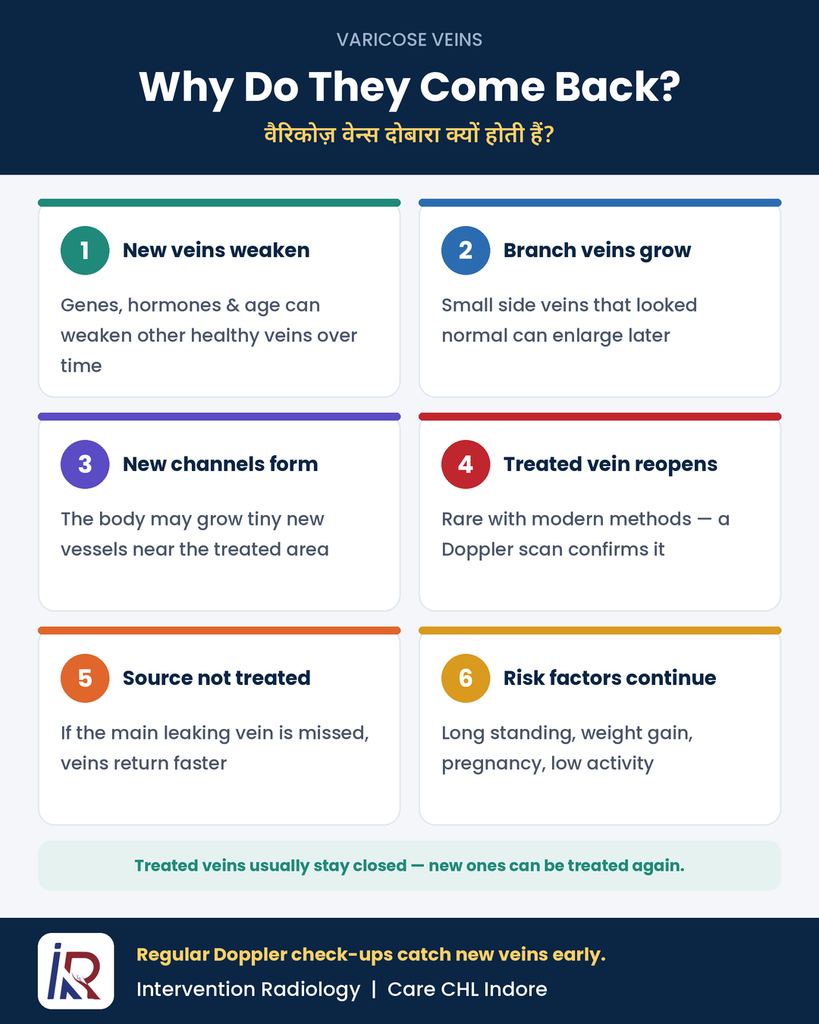
Many patients feel the first treatment “failed” when they see new veins. In most cases, that is not true. Here is what usually happens.
1. New veins become weak over time. The tendency to develop varicose veins comes from your genes, your job, your weight and your hormones. Treatment removes or closes the veins that are bad today. It cannot stop other healthy veins from weakening in the future.
2. Untreated branch veins grow larger. Smaller side branches that looked normal at the first treatment can enlarge later.
3. The body forms new channels (neovascularisation). After a vein is closed or removed, the body sometimes grows small new vessels around the area. These can slowly become varicose.
4. A treated vein reopens (recanalisation). Rarely, a vein closed with heat or glue opens up again. This is uncommon with modern techniques, and a Doppler scan can confirm it.
5. The full source of reflux was not mapped. If only the visible veins are treated and the leaking main vein (the source) is left behind, the problem returns faster. This is why a detailed Doppler ultrasound before every treatment matters so much.
6. Risk factors continue. Standing or sitting for long hours, weight gain, pregnancy, hormone changes, lack of exercise and a family history all keep putting pressure on leg veins.
For a deeper look at this topic, read our blog on why varicose veins can return after laser treatment.
Also Read: Why Varicose Veins Can Return After Laser Treatment
How many times can varicose veins be removed? Treatment by treatment
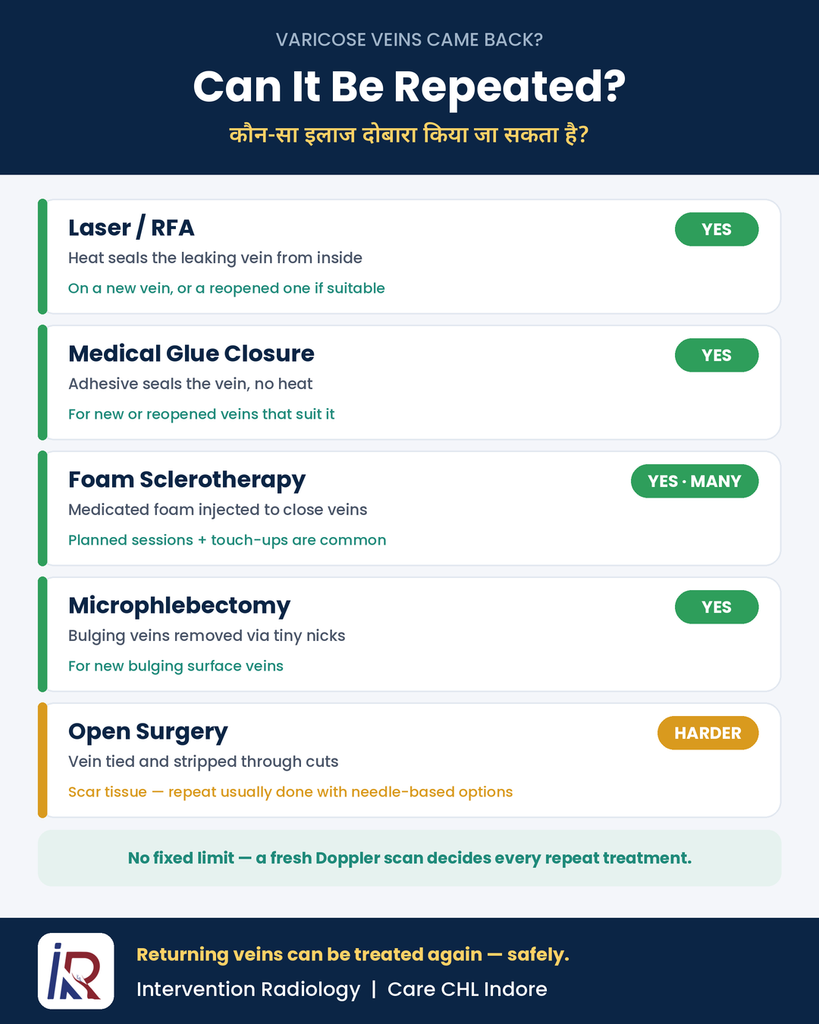
The answer depends on which treatment is used and which vein needs it. The table below gives a simple overview. Your Interventional Radiologist will decide what suits your scan.
| Treatment | How it works | Can it be repeated? | Typical notes on repeating |
|---|---|---|---|
| Endovenous laser ablation (EVLA) | A thin laser fibre inside the vein seals it with heat | Yes, on a different vein, or on the same vein if it has reopened and is still suitable | Needs a fairly straight vein of the right size |
| Radiofrequency ablation (RFA) | A catheter seals the vein with controlled heat | Yes, on the same basis as laser | Done through a needle puncture under local anaesthesia |
| Medical glue (cyanoacrylate) closure | A small amount of medical adhesive seals the vein | Yes, for new or reopened veins that suit it | No heat, so fewer numbing injections |
| Foam sclerotherapy | A medicated foam is injected to close the vein | Yes, many times; it is often given in planned sessions | Good for branch veins and veins too twisted for a catheter |
| Liquid sclerotherapy | A liquid medicine closes very small veins | Yes, many sessions are common | Mainly for spider and small reticular veins |
| Ambulatory phlebectomy | Bulging surface veins are removed through tiny nicks | Yes, for new bulging veins | Often combined with ablation |
| Open surgery (ligation and stripping) | The main vein is tied and pulled out through cuts | Repeat surgery is harder because of scar tissue | Today most repeat cases are managed with minimally invasive options instead |
Laser and radiofrequency ablation
These thermal (heat-based) treatments are the most common first choice for a leaking main vein such as the great saphenous vein in the thigh. Once a vein is closed well, it usually turns into a thin cord that the body slowly absorbs.
If a different vein starts leaking later, such as the small saphenous vein at the back of the calf or an accessory vein, it can be treated with the same method. If the treated vein reopens and its size and path are still suitable, it can also be closed again.
Medical glue closure
Glue closure is useful when heat is not ideal, for example in veins close to a nerve or in patients who want fewer injections. It can be used for a new vein in a later treatment, and in selected cases for a vein that has reopened.
Sclerotherapy (foam or liquid)
Sclerotherapy is the most “repeatable” option. Many patients need two to four sessions to clear a group of veins, and a touch-up session every year or two is common. It is ideal for leftover branch veins, recurrent veins after surgery and twisted veins that a catheter cannot pass through.
Phlebectomy
Phlebectomy removes bulging surface veins through cuts so small they usually need no stitches. If new bulging veins appear later, the same procedure can be done again in that area.
Open surgery
With open surgery, the main vein is removed. It cannot come back, but the area heals with scar tissue, and new veins can grow through it. Operating again in a scarred groin or behind the knee carries a higher risk of wound problems and nerve injury. That is why recurrent veins after old surgery are now usually treated with foam sclerotherapy, laser, RFA or glue, guided by ultrasound, instead of a second open operation.
Is there a limit to how many times you can have varicose vein treatment?
There is no official number. In practice, the real limits are:
- Whether there is a suitable vein left to treat. A vein that has already been removed cannot be removed again. The question is always about the vein the scan shows now.
- Whether the deep veins are healthy. The deep veins must be able to carry blood well before surface veins are closed. A past DVT blood clot may change the plan.
- Your general health. Uncontrolled diabetes, severe heart disease, pregnancy, an active infection or poor blood supply to the legs may mean treatment should wait.
- Whether treatment will actually help. If symptoms are mild and the vein is small, compression stockings and lifestyle changes may be enough for now.
Many patients have two, three or more treatment sessions spread over several years. Each one is planned on its own, from a fresh Doppler ultrasound.
Is repeat varicose vein treatment safe?
For most patients, yes. Modern minimally invasive treatments are done through a needle puncture under local anaesthesia, usually take under an hour, and let you walk out the same day. Having one of these treatments before does not make the next one much riskier.
As with any procedure, there are some possible side effects. Most are mild and short-lived:
- Bruising, tenderness or a pulling feeling along the treated vein
- Brown staining of the skin over a treated vein, which usually fades over months
- Small lumps of trapped blood that may need a simple drain at follow-up
- Temporary numbness or tingling in a small patch of skin
- Rarely, a blood clot in a deep vein, which is why a follow-up scan is done
Repeat open surgery is the exception. Scar tissue makes a second operation more difficult, so the safer route is usually ultrasound-guided treatment from inside the vein.
Who decides if you need treatment again, and how?
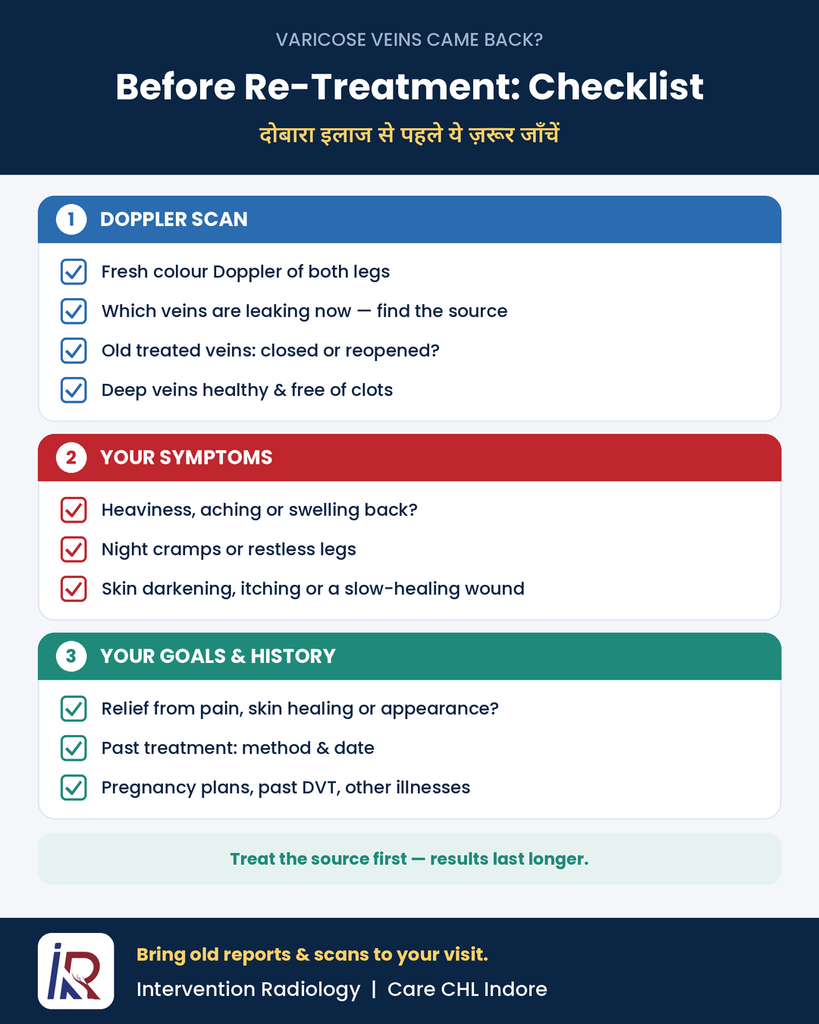
A repeat treatment is decided by your symptoms and your scan, not by how the leg looks alone. At Intervention Radiology Indore, the process usually follows these steps:
- Detailed history. When and how you were treated before, what symptoms you have now, and your goals: relief from pain and heaviness, healing of skin changes, or a better appearance.
- Colour Doppler ultrasound. This scan maps every leaking vein in the leg, checks the deep veins, and shows whether old treated veins are closed or have reopened.
- Finding the source. The doctor looks for the point where blood is leaking backwards. Treating the source first gives longer-lasting results.
- A personalised plan. This may be laser, RFA, glue, foam sclerotherapy, phlebectomy, or a mix, sometimes spread over two or three sessions.
- Follow-up scans. A check-up scan after the procedure confirms that the vein is closed and the deep veins are clear.
Also Read: Top 7 Myths About Varicose Veins You Should Stop Believing
Signs you may need varicose vein treatment again
Book a review with an Interventional Radiologist if you notice:
- New bulging or twisted veins after your earlier treatment
- Heaviness, aching or swelling that has come back
- Night cramps or restless legs that have returned
- Itching, darkening or hardening of the skin near the ankle
- A wound near the ankle that is slow to heal
- Bleeding from a vein on the leg
Go to an emergency department straight away if one leg becomes suddenly swollen, painful, warm and red, or if you have chest pain or sudden breathlessness. These can be signs of a blood clot.
When repeat treatment may not be the right choice
Sometimes your doctor will advise waiting or choosing a different approach:
- Pregnancy. Veins often improve after delivery, so treatment is usually planned a few months later.
- An active or recent deep vein clot. This is treated first.
- Poor blood supply to the legs (arterial disease). This needs to be checked, as both conditions can exist together. Read more about poor blood circulation in the legs.
- Very small veins with no symptoms. Here the choice is cosmetic, and compression and lifestyle changes are also reasonable.
- Unrealistic expectations. No treatment can promise that no new vein will ever appear. An honest plan is about control, comfort and healthy skin.
How long do results last after repeat treatment?
The vein that has been closed or removed usually stays treated. How long your legs stay free of new veins depends on your genes, weight, job, activity level and whether the full source of reflux was treated. Many people go several years before needing a small touch-up, and some never need another session.
A yearly or two-yearly check, especially if you have a strong family history or stand all day at work, helps catch new reflux early. Small problems are quicker and easier to treat than large ones.
How to reduce the chance of varicose veins coming back
You cannot change your genes, but daily habits make a real difference:
- Walk every day. The calf muscle pumps blood up the leg. Aim for 30 minutes most days.
- Avoid standing or sitting still for long. Every 30–45 minutes, walk around or do ankle pumps (move your feet up and down 15–20 times).
- Raise your legs. Rest with your feet above heart level for 15–20 minutes, once or twice a day.
- Wear compression stockings if advised. Use the pressure class and size your doctor recommends, especially on long working days and journeys.
- Keep a healthy weight. Extra weight puts more pressure on leg veins.
- Avoid tight belts and very tight clothing around the waist and groin.
- Keep your follow-up visits. A scan every year or two catches new leaking veins early.
Varicose vein treatment at Care CHL Indore
At Intervention Radiology Indore, varicose vein care at Care CHL Indore is led by Dr. Alok Kumar Udiya, Interventional Radiologist. As an Interventional Radiologist, he uses imaging such as Doppler ultrasound to guide treatment from inside the vein, through a needle puncture instead of large cuts.
What patients can expect:
- A detailed colour Doppler mapping of both legs before any decision
- A clear explanation of which veins need treatment now and which can wait
- Minimally invasive options: laser ablation, radiofrequency ablation, glue closure, foam sclerotherapy and phlebectomy, as suited to each vein
- Care for patients whose veins have returned after earlier laser or open surgery
- Day-care procedures under local anaesthesia, with walking encouraged the same day
- Planned follow-up scans
Book a consultation with Dr. Alok Kumar Udiya at Care CHL Indore to find out whether your returning veins need treatment, and which option suits you best.
Frequently asked questions
1. How many times can varicose veins be removed? There is no fixed limit. Varicose veins can be treated again whenever a Doppler scan shows a new or reopened vein that needs treatment and your health allows it. Most minimally invasive treatments can be safely repeated.
2. Can the same varicose vein come back after laser treatment? A vein closed well by laser usually stays closed. Rarely it can reopen. More often, the new veins you see are different veins that have weakened over time.
3. Is it safe to have laser treatment for varicose veins a second time? Yes, for most people. A second laser or radiofrequency treatment is usually done on a different vein, or on a reopened vein if it is still suitable, under local anaesthesia as day care.
4. How many sclerotherapy sessions are safe? Sclerotherapy can be repeated many times. Most patients need a few sessions spaced several weeks apart, with occasional touch-ups later. Your doctor decides the gap and dose for each session.
5. Can varicose veins come back after surgery? Yes. New veins can grow in the area or other veins can weaken. Repeat open surgery is harder because of scarring, so these veins are usually treated with ultrasound-guided foam, laser, radiofrequency or glue.
6. Why did my varicose veins come back after treatment? Common reasons are new veins weakening over time, untreated branch veins growing, new small vessels forming, a vein reopening, or ongoing risk factors such as long standing, weight gain and pregnancy.
7. Do I need a new Doppler scan before repeat treatment? Yes. A fresh colour Doppler ultrasound is essential. It shows which veins are leaking now and checks the deep veins, so the right vein is treated.
8. How long after the first treatment can I have another one? It depends on the plan. Staged treatments may be done a few weeks apart. For veins that return later, treatment can be done whenever the scan and symptoms show it is needed.
9. Will my varicose veins be gone forever after treatment? The treated veins usually are. But varicose veins are a long-term condition, so new veins may appear over the years. Healthy habits and regular check-ups help keep them under control.
10. Where can I get repeat varicose vein treatment in Indore? You can consult Dr. Alok Kumar Udiya, Interventional Radiologist at Intervention Radiology Indore, Care CHL Indore, for Doppler assessment and minimally invasive treatment of recurrent varicose veins.
Conclusion
So, how many times can varicose veins be removed? As many times as you genuinely need it, safely and with the right plan. Varicose veins are a long-term condition. Treatment closes the problem veins of today, but other veins can weaken in the future. The good news is that modern needle-based treatments are easy to repeat, need no large cuts, and let you get back to daily life quickly.
The key is a careful Doppler scan, treatment of the true source of the leak, and regular follow-up. If your veins have come back, or your legs feel heavy and swollen again, don’t ignore it.
Consult Dr. Alok Kumar Udiya, Interventional Radiologist at Intervention Radiology Indore, Care CHL Indore, for a personalised varicose vein assessment.
Disclaimer: This article is for general information only and is not a substitute for medical advice. Please consult a qualified doctor for diagnosis and treatment of your condition.