
You had laser treatment for varicose veins. Your legs felt lighter, the swelling went down, and the bulging veins faded. But a year or two later, you notice new blue, twisted veins again.
Did the laser treatment fail? Not usually. Laser treatment closes the faulty vein it treats very effectively. But varicose veins are a long-term condition, and new or missed leaky veins can cause them to appear again over time.
The good news: recurrent varicose veins can be checked with a simple scan and treated again, often with minimally invasive methods.
This guide explains why varicose veins can return after laser treatment, how to spot it early, and how to lower the chances.
What Are Varicose Veins?
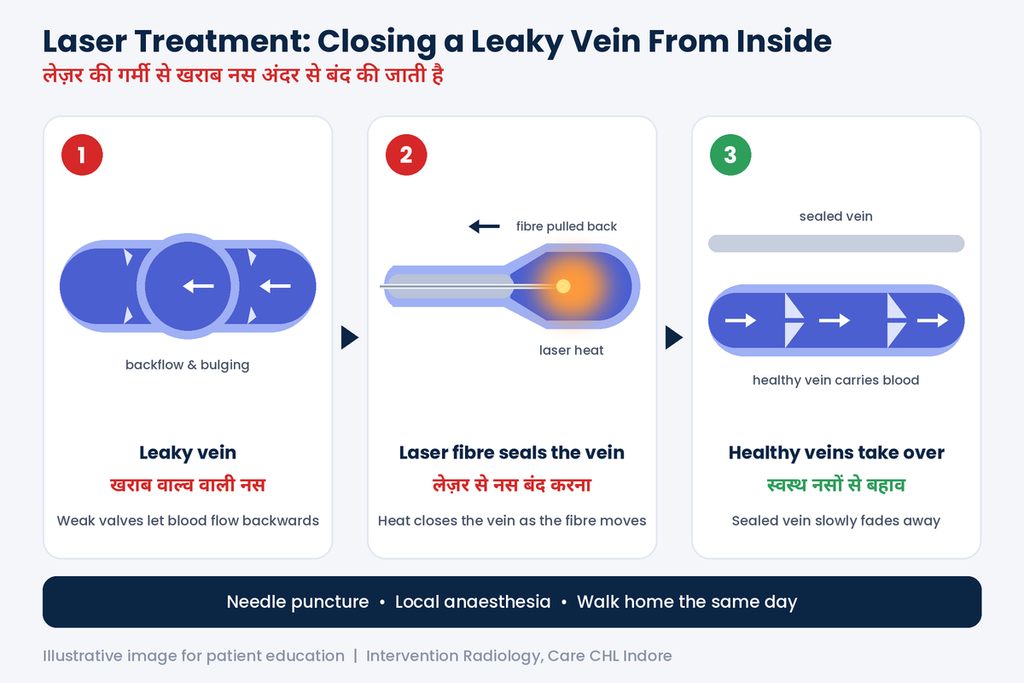
Veins in the legs have tiny one-way valves that help blood flow back up to the heart. When these valves become weak, blood leaks backwards and pools in the legs. The veins then stretch, twist and bulge — these are varicose veins.
Common symptoms include heavy or aching legs, swelling around the ankles, night cramps, itching, skin darkening near the ankle and, in advanced cases, ulcers.
Also Read: Top 7 Myths About Varicose Veins You Should Stop Believing
How Does Laser Treatment Work?
Laser treatment for varicose veins (also called endovenous laser ablation) is a minimally invasive procedure done by an Interventional Radiologist:
- The leaky main vein is mapped with a Doppler ultrasound.
- Under local anaesthesia, a thin laser fibre is passed into the vein through a needle puncture.
- Laser heat seals the faulty vein from inside.
- Blood automatically reroutes through healthy veins.
- Most patients walk out the same day and return to routine work within a day or two.
The treated vein usually stays closed for good. So when veins come back, the reason is often somewhere else — as explained below.
Why Varicose Veins Can Return After Laser Treatment
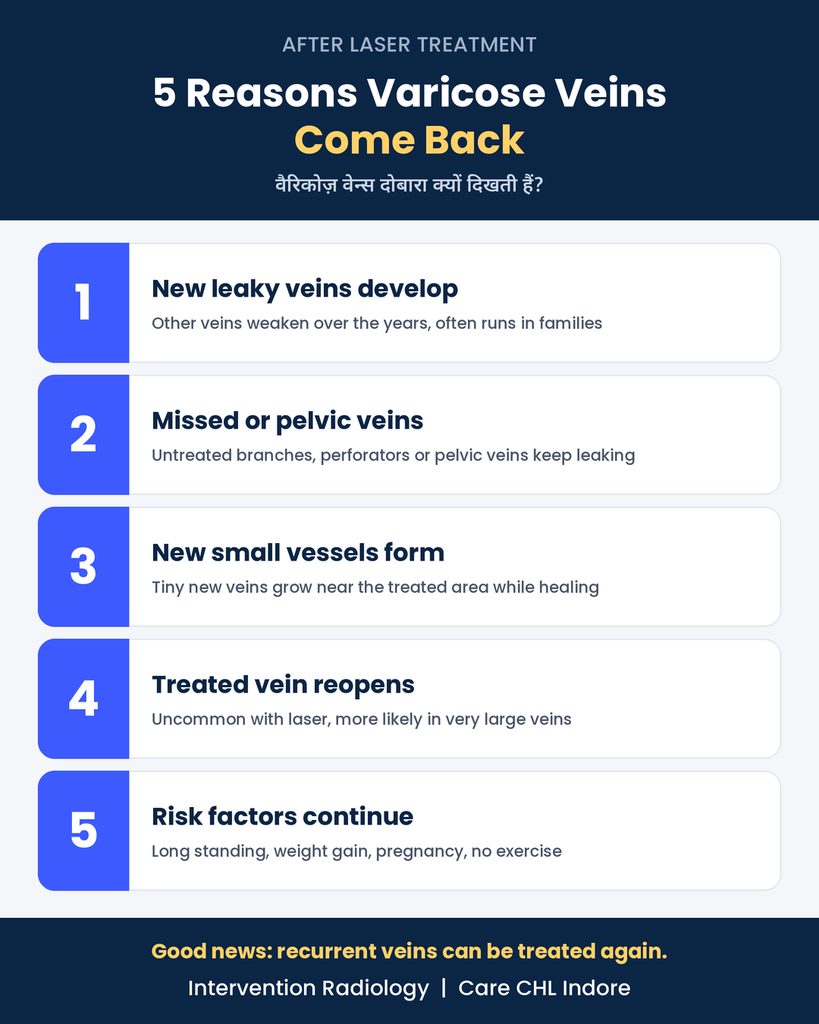
1. New leaky veins develop over time Varicose veins are a long-term tendency, especially if they run in your family. Even after a successful laser treatment, other veins in the leg can develop weak valves over the years. This is the most common reason for new varicose veins.
2. Some leaky veins were not treated The leg has many connected veins — the main surface veins, their side branches, and “perforator” veins that link surface veins to deeper ones. If a leaky branch or perforator was missed or left for later, it can keep feeding varicose veins.
3. New small vessels grow near the treated area (neovascularisation) As the body heals, tiny new veins can sometimes form near the area where the treated vein joined the deep vein. Over time, these can enlarge and leak.
4. The treated vein reopens (recanalisation) This is less common with laser treatment, but occasionally a sealed vein partly reopens, especially if it was very large.
5. Pelvic vein problems In some women, especially after multiple pregnancies, leaky veins in the pelvis can feed varicose veins in the inner thigh, back of the thigh or around the private area. These need a different evaluation.
6. Lifestyle and risk factors continue Long hours of standing or sitting, weight gain, pregnancy, lack of exercise, and not wearing compression stockings when advised can all increase pressure in the leg veins.
| Reason | What happens | Can it be prevented or treated? |
|---|---|---|
| New leaky veins | Other veins weaken over the years | Lifestyle care slows it; treatable when found |
| Missed or untreated veins | Branches or perforators keep leaking | Thorough Doppler mapping before treatment helps |
| Neovascularisation | Tiny new veins form near treated site | Can be treated with foam or other methods |
| Recanalisation | Treated vein partly reopens | Uncommon; can be treated again |
| Pelvic vein reflux | Pelvic veins feed leg veins | Needs special evaluation and treatment |
| Ongoing risk factors | High pressure in leg veins | Exercise, weight control, stockings as advised |
Key takeaway: In most cases, returning veins are not a failure of laser treatment but a sign that the condition continues or that another vein needs attention.
Also Read: How to Get Rid of Varicose Veins Without Surgery — A Complete Guide
Early Signs That Varicose Veins Are Coming Back
- New visible blue or twisted veins on the thigh or calf
- Heaviness, aching or tiredness in the legs returning by evening
- Swelling around the ankles
- Night cramps or restless legs
- Itching or darkening of skin near the ankle
If you notice these, book a check-up early. Small recurrences are easier to treat.
Varicose Veins vs Spider Veins: Know the Difference
Not every new vein is a varicose vein. Spider veins are tiny red or purple lines on the skin. They are mostly a cosmetic concern and are not caused by the main vein that was lasered. Varicose veins are larger, bulging and often cause symptoms. A Doppler scan helps tell them apart.
How to Lower the Chances of Varicose Veins Returning
Before treatment
- Get a detailed Doppler ultrasound so that all leaky veins are mapped, not just the main one.
- Ask your doctor whether side branches or perforators also need treatment.
After treatment
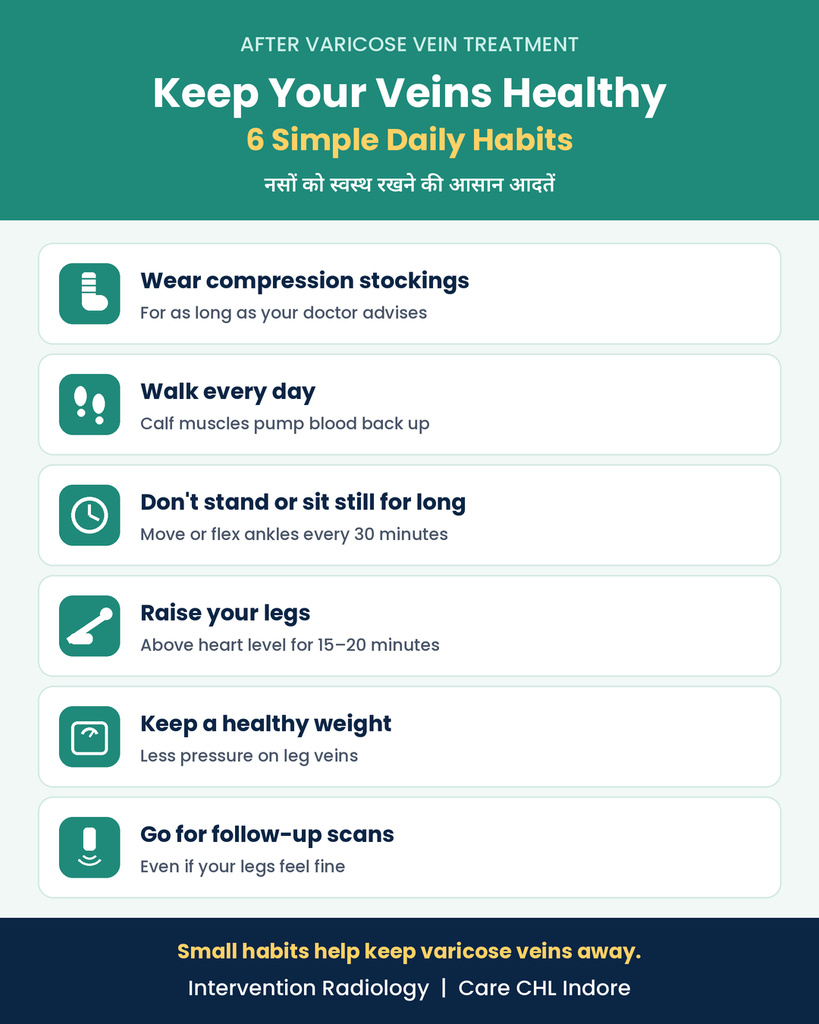
- Wear compression stockings for as long as your doctor advises.
- Walk daily — calf muscles act like a pump for leg veins.
- Avoid standing or sitting still for long hours. Move or flex your ankles every 30 minutes.
- Raise your legs above heart level for 15–20 minutes when resting.
- Keep a healthy weight and avoid constipation.
- Go for follow-up scans as advised, even if you feel fine.
How Recurrent Varicose Veins Are Treated
The first step is a fresh Doppler ultrasound to find exactly which vein is leaking. Then your Interventional Radiologist may suggest:
- Repeat laser treatment for another main vein that has become leaky
- Foam sclerotherapy — a medicine foam injected into smaller or twisted veins to close them
- Microphlebectomy — removal of bulging surface veins through tiny nicks in the skin
- Pelvic vein evaluation and embolisation if pelvic veins are feeding the leg veins
Most of these are day-care procedures done under local anaesthesia, with a quick return to routine activities.
Also Read: Varicose Veins Symptoms: Early Signs, Causes & When to See a Doctor
Varicose Vein Laser Treatment in Indore at Care CHL Indore
Whether you are considering laser treatment for the first time or your varicose veins have come back, the Intervention Radiology Indore team at Care CHL Indore can help.
Dr. Alok Kumar Udiya, Interventional Radiologist, uses detailed Doppler mapping to plan treatment for each leg, aiming to treat all the leaky veins that matter — and offers options for recurrent varicose veins when they appear.
Frequently Asked Questions
Can varicose veins come back after laser treatment? Yes, in some people. The treated vein usually stays closed, but new or missed leaky veins can cause varicose veins to appear again over time.
Does it mean my laser treatment failed? Usually not. Most recurrences are due to other veins weakening or untreated branches, not the treated vein reopening.
How soon can varicose veins return after laser treatment? It varies. Some people never have a recurrence, while others notice new veins after a few years, especially if risk factors continue.
Can recurrent varicose veins be treated again? Yes. After a Doppler scan, options include repeat laser treatment, foam sclerotherapy or removal of surface veins through tiny cuts.
Do compression stockings help prevent recurrence? They support the leg veins and can reduce symptoms and swelling. Wear them as long as your doctor advises.
Is laser treatment still a good option for varicose veins? Yes. Laser treatment is minimally invasive, has a quick recovery and works well for closing faulty veins. Good planning and follow-up help keep results lasting.
Where can I get treatment for recurrent varicose veins in Indore? Treatment is available at Care CHL Indore through the Intervention Radiology team led by Dr. Alok Kumar Udiya, Interventional Radiologist.
What is the cost of laser treatment for varicose veins in Indore? Cost depends on how many veins and legs need treatment, the methods used and insurance cover. Please contact Care CHL Indore directly for an estimate.
Conclusion
Varicose veins coming back after laser treatment can be disappointing, but it is rarely the end of the road. Most recurrences happen because varicose veins are a long-term condition, or because another vein has started leaking.
With a proper Doppler scan, the right treatment and simple daily habits, your legs can stay lighter and healthier for longer.
Varicose veins back after laser treatment? Consult the Intervention Radiology team at Care CHL Indore.
Disclaimer: This article is for general awareness only and is not a substitute for medical advice. Please consult your doctor for advice specific to your condition.