
Heavy periods, pelvic pressure, frequent urination, tiredness from blood loss: fibroids can take over daily life. When you hear that they can be treated without surgery, through a tiny pinhole, it sounds almost too good to be true. So the natural next question is: is uterine fibroid embolisation risky?
It is a fair and important question. Every medical procedure has some risk, and you deserve an honest answer before you decide. In this guide, Dr. Alok Kumar Udiya, Interventional Radiologist at Intervention Radiology Indore, Care CHL Indore, explains:
- How safe uterine fibroid embolisation (UFE) really is
- The common, expected side effects and how they are managed
- The rare risks and how often they happen
- What UFE means for fertility, periods and menopause
- How UFE compares with surgery
- Who should and should not have UFE
The quick answer
Uterine fibroid embolisation is considered a safe, well-established, minimally invasive treatment for fibroids. It has been performed worldwide for over 25 years. Most women have only short-term, expected side effects such as cramping pain, mild fever and tiredness for a few days.
Serious complications are uncommon. Compared with open surgery such as hysterectomy or open myomectomy, UFE usually means:
- No large cut and no stitches on the abdomen
- No general anaesthesia in most cases
- Much less blood loss, and almost never a need for transfusion
- A short hospital stay, often one night
- A faster return to normal life, usually within 1–2 weeks
That does not mean UFE has no risk. The rest of this article explains each one clearly, so you can make an informed choice.
What is uterine fibroid embolisation?
Uterine fibroid embolisation (UFE), also called uterine artery embolisation (UAE), is a procedure that shrinks fibroids by cutting off their blood supply. It is done by an Interventional Radiologist, a specialist who treats conditions from inside the blood vessels using imaging guidance.
Here is how it works:
- A small pinhole is made in the skin at the wrist or groin, under local anaesthesia.
- A thin, flexible tube (catheter) is guided into the arteries that feed the uterus, using live X-ray imaging.
- Tiny particles, smaller than grains of sand, are injected. They block the small vessels that feed the fibroids.
- Starved of blood, the fibroids shrink and soften over the following months. The healthy uterus keeps its blood supply through other small vessels.
The uterus is not removed. The procedure usually takes about an hour, and you are awake but relaxed with mild sedation.
Also Read: Uterine Fibroid Embolisation vs Myomectomy: Which Is Right for You?
Why UFE is considered safe
Several things make uterine fibroid embolisation a low-risk option for suitable patients:
- Minimally invasive: there is no abdominal incision, so there is no large wound to heal or get infected.
- No general anaesthesia: avoiding a full anaesthetic lowers risk, especially for women with other health problems.
- Very little blood loss: important for women who are already anaemic from heavy periods.
- Targeted treatment: all fibroids in the uterus are treated in one session, without cutting the uterus.
- Well studied: UFE is backed by long-term research and is recognised as a standard treatment option for symptomatic fibroids.
Common side effects of uterine fibroid embolisation
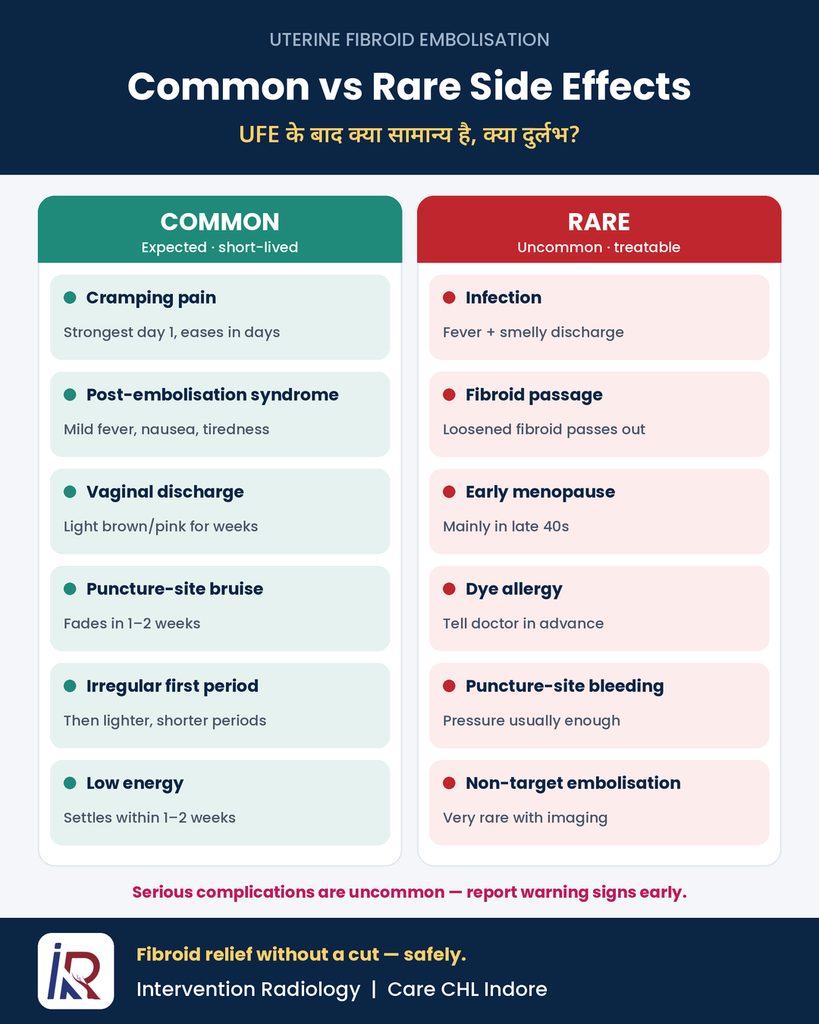
These are expected after UFE. They show the treatment is working, as the fibroids lose their blood supply. They are usually short-lived and well controlled with medicines.
1. Pelvic pain and cramping
Cramping pain, similar to strong period pain, is the most common side effect. It is usually strongest in the first 6–24 hours and settles over a few days. You will be given good pain relief, often through a drip or a pain pump in hospital, then tablets at home.
2. Post-embolisation syndrome
Many women experience a group of symptoms called post-embolisation syndrome in the first week:
- Mild fever
- Nausea or reduced appetite
- Tiredness and a general “flu-like” feeling
- Ongoing mild pelvic ache
This is the body’s normal response to the fibroids breaking down. It is not an infection and usually settles within 3–7 days with rest, fluids and prescribed medicines.
3. Vaginal discharge
A light brown, pink or watery discharge is common for a few weeks, sometimes longer, as fibroid tissue breaks down. A small pad is enough. Discharge that becomes foul-smelling, yellow-green or comes with fever should be reported (see warning signs below).
4. Bruising at the puncture site
A small bruise at the wrist or groin is common and fades in one to two weeks. A large, painful swelling is uncommon and should be checked.
5. Changes in periods
The first one or two periods after UFE may be irregular. Most women then notice periods that are lighter and shorter than before. Read more in our blog on how your periods may change after fibroid embolisation.
Also Read: Uterine Fibroid Embolisation Cost in Indore: What You Pay For and Why
Rare risks and complications of UFE
These are uncommon, but you should know about them before your procedure. Your Interventional Radiologist will discuss them with you in detail.
| Risk | What it means | How common | How it is managed |
|---|---|---|---|
| Infection of the uterus or fibroid | Fever, pain and smelly discharge days to weeks later | Uncommon | Antibiotics; very rarely, surgery |
| Fibroid passage (expulsion) | A fibroid near the lining loosens and passes through the vagina | Uncommon; more likely with fibroids just under the lining | Often passes on its own; sometimes a minor procedure to remove it |
| Early menopause | Periods stop permanently after UFE | Rare under 45; risk rises closer to natural menopause age | Discussed before treatment, especially for women in their late 40s |
| Allergy to contrast dye | Rash, itching or, very rarely, a severe reaction | Rare | Tell your doctor about allergies; medicines can be given beforehand |
| Problems at the puncture site | Larger bleeding, a blood collection or artery injury | Rare | Pressure, observation, rarely a small procedure |
| Non-target embolisation | Particles reaching an organ they were not meant for | Very rare | Careful imaging during the procedure lowers this risk |
| Blood clot in the leg (DVT) | Clot from lying still after the procedure | Rare | Early walking and fluids |
| Need for further surgery | Symptoms not improving enough, or a complication | Small minority over the years | Repeat UFE, myomectomy or hysterectomy, as advised |
A hysterectomy is needed because of a complication of UFE only very rarely. This is one reason UFE is chosen by many women who want to keep their uterus.
Is UFE painful?
The procedure itself is not painful. You get local anaesthesia at the puncture site and medicine to help you relax. Most women feel only a little pressure.
Pain begins after the procedure, as the fibroids lose their blood supply. This is the most common reason women stay in hospital overnight. With modern pain control, most patients describe it as manageable, and it settles quickly over the first few days.
Also Read: How Your Periods May Change After Fibroid Embolisation
Does UFE affect fertility and pregnancy?
This is one of the most important questions for younger women.
- Pregnancy after UFE is possible, and many women have had healthy babies after the procedure.
- However, research on pregnancy after UFE is more limited than for surgery. Some studies suggest a slightly higher chance of pregnancy complications, such as miscarriage or problems with the placenta.
- For women who definitely want to get pregnant in the near future, a myomectomy (surgical removal of fibroids) is often discussed first, depending on the size, number and position of the fibroids.
- For women who want to keep their uterus but are not planning pregnancy soon, or who are not good candidates for surgery, UFE can be a very good option.
The right choice is personal. It should be made together with your gynaecologist and Interventional Radiologist. Read our comparison of uterine fibroid embolisation vs myomectomy for more detail.
Can UFE cause early menopause?
In women under about 45, the risk of UFE bringing on menopause is low. The risk increases for women closer to their natural menopause age, usually the late 40s, as the ovaries already have fewer eggs.
Your doctor will consider your age, symptoms and, if needed, hormone blood tests before the procedure. For many women in their late 40s, the benefit of quick symptom relief still outweighs this risk.
UFE vs surgery: which is riskier?
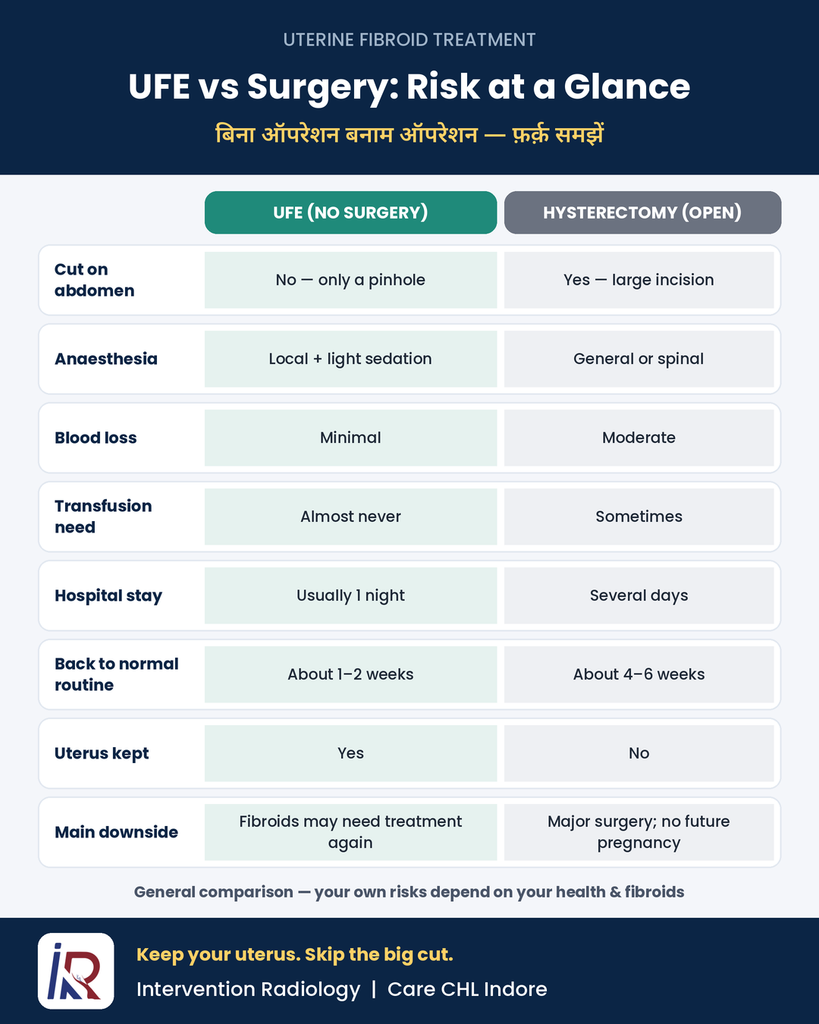
Every treatment has its own risks. The table below gives a general comparison of what to expect. Your own risks depend on your health and fibroids.
| Factor | Uterine fibroid embolisation | Hysterectomy (open) | Myomectomy (open) |
|---|---|---|---|
| Cut on the abdomen | No, only a pinhole | Yes | Yes |
| Anaesthesia | Local + sedation | General or spinal | General or spinal |
| Blood loss | Minimal | Moderate | Moderate to high |
| Uterus kept | Yes | No | Yes |
| Hospital stay | Usually 1 night | Several days | Several days |
| Back to normal routine | About 1–2 weeks | About 4–6 weeks | About 4–6 weeks |
| Main downside | Fibroids may return or need further treatment over the years | Major surgery; no future pregnancy | Fibroids can return; scar on the uterus |
For many women with symptomatic fibroids, UFE offers effective relief with fewer surgical risks and a faster recovery.
Who should not have UFE?
Uterine fibroid embolisation may not be suitable if you:
- Are pregnant
- Have an active pelvic infection
- Have a suspected cancer of the uterus, cervix or ovaries
- Have severe kidney problems or a serious allergy to contrast dye (special precautions may still allow it)
- Have very large, stalk-like (pedunculated) fibroids attached by a thin stalk, in some cases
- Want to get pregnant very soon and are suitable for myomectomy
Before UFE, you will usually have a pelvic MRI and a gynaecology review. These tests confirm that your symptoms are due to fibroids and that UFE is the right choice.
How the risks of UFE are kept low
At Intervention Radiology Indore, safety starts long before the procedure:
- Careful patient selection: MRI, blood tests and gynaecology input to make sure UFE suits you.
- Experienced hands: the procedure is done by a trained Interventional Radiologist.
- Modern imaging: live X-ray guidance with the lowest practical radiation dose.
- Wrist (radial) access where suitable: this allows earlier walking and fewer bleeding problems at the puncture site.
- Strong pain control plan: so post-procedure pain is managed from the very start.
- Clear aftercare and follow-up: written instructions, a contact number and a review visit, with a follow-up MRI if needed.
Recovery after UFE: what is normal and when to call your doctor
Normal in the first 1–2 weeks:
- Cramping that steadily improves day by day
- Mild fever (below about 38°C / 100.4°F) in the first few days
- Tiredness and low appetite
- Light brown or pink discharge
- A small bruise at the puncture site
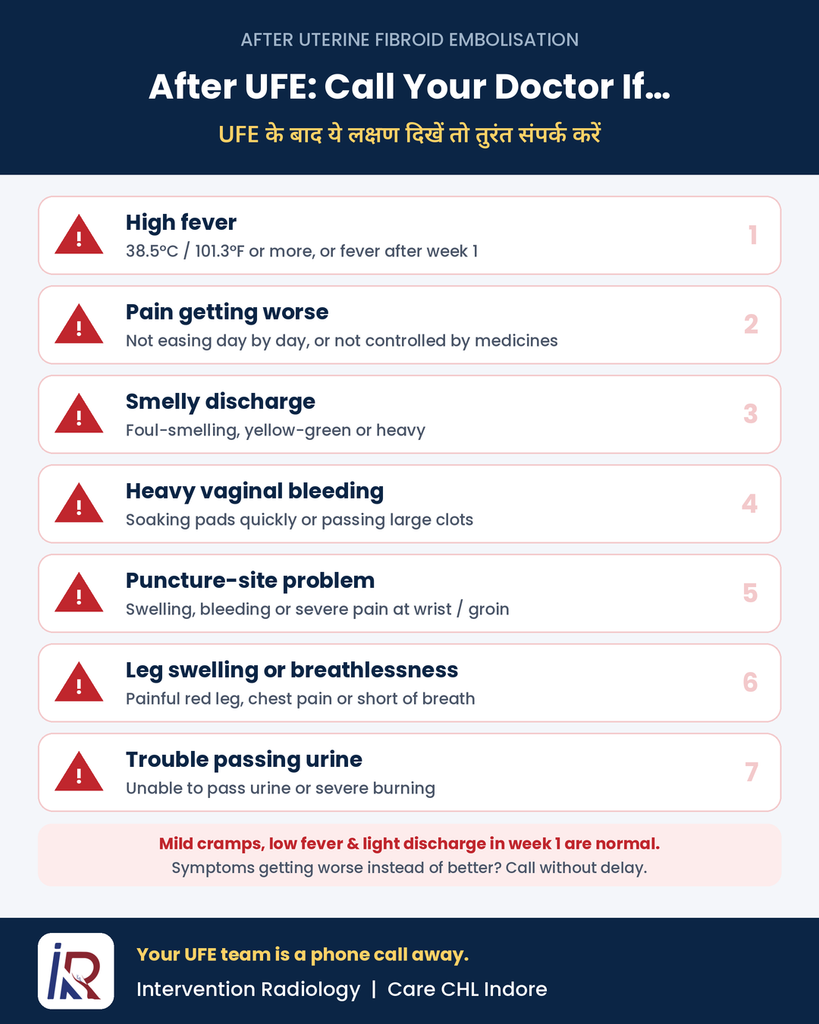
Call your doctor or come to the hospital if you have:
- Fever of 38.5°C (101.3°F) or higher, or fever that starts after the first week
- Pain that gets worse instead of better, or is not controlled by your medicines
- Foul-smelling, yellow-green or heavy discharge
- Heavy vaginal bleeding
- Swelling, bleeding or severe pain at the puncture site
- Pain, swelling or redness in one leg, chest pain or breathlessness
- Difficulty passing urine
For a full picture of results over time, read how to tell if fibroid embolisation was successful.
Uterine fibroid embolisation at Care CHL Indore
At Intervention Radiology Indore, uterine fibroid embolisation is performed at Care CHL Indore by Dr. Alok Kumar Udiya, Interventional Radiologist. His team works closely with gynaecologists to make sure each woman gets the treatment that suits her best.
What patients can expect:
- A detailed consultation, with an honest discussion of benefits and risks
- Review of MRI and blood tests before any decision
- UFE through a wrist or groin pinhole, with no abdominal cut
- A planned pain-control protocol and usually an overnight stay
- Clear written aftercare instructions and follow-up visits
Wondering about costs? Read our guide on UFE cost in Indore.
Book a consultation with Dr. Alok Kumar Udiya at Care CHL Indore to find out whether uterine fibroid embolisation is safe and suitable for you.
Frequently asked questions
1. Is uterine fibroid embolisation risky? UFE is considered a safe, well-established treatment. Most women have only short-term side effects such as cramping, mild fever and tiredness. Serious complications are uncommon.
2. What are the most common side effects of UFE? Pelvic cramping, post-embolisation syndrome (mild fever, nausea, tiredness), vaginal discharge and a small bruise at the puncture site. These usually settle within days to a few weeks.
3. Is UFE safer than hysterectomy? For suitable patients, UFE avoids a major operation, general anaesthesia and a large cut, and recovery is much faster. However, fibroids may need further treatment in some women over the years. Your doctor will help you weigh this up.
4. Can I get pregnant after uterine fibroid embolisation? Yes, pregnancy is possible after UFE. But if you plan to get pregnant soon, myomectomy is often discussed first. Talk to your doctor about your plans.
5. Does UFE cause menopause? The risk is low in women under 45. It is higher in women nearing their natural menopause age.
6. How painful is fibroid embolisation? The procedure itself is not painful. Cramping after the procedure is common, strongest in the first day, and is managed with good pain relief.
7. What is post-embolisation syndrome? It is a normal, short-term response to fibroids breaking down: mild fever, nausea, tiredness and pelvic ache. It usually settles within a week and is not an infection.
8. Can fibroids come back after UFE? Treated fibroids rarely grow back. New fibroids can form over time, especially in younger women. Some women may need further treatment in the future.
9. How long is recovery after UFE? Most women stay in hospital one night and return to light daily activities within a week. Most are back to their normal routine within about 1–2 weeks.
10. Where can I get uterine fibroid embolisation in Indore? You can consult Dr. Alok Kumar Udiya, Interventional Radiologist at Intervention Radiology Indore, Care CHL Indore.
Conclusion
So, is uterine fibroid embolisation risky? Like every procedure, it has some risks. But for most suitable women, UFE is a safe, effective, uterus-sparing way to treat fibroids, without a cut, without general anaesthesia and with a much faster recovery than surgery. Most side effects are expected, short-lived and easy to manage. Serious complications are uncommon.
The key to safety is the right patient, the right tests and the right hands. If fibroids are affecting your life, get an honest opinion about whether UFE suits you.
Consult Dr. Alok Kumar Udiya, Interventional Radiologist at Intervention Radiology Indore, Care CHL Indore, to discuss uterine fibroid embolisation.
Disclaimer: This article is for general information only and is not a substitute for medical advice. Please consult a qualified doctor for diagnosis and treatment of your condition.