
You have been told you have fibroids. Your periods are heavy, you feel tired, and maybe your tummy feels full or swollen. You want treatment — but you also want to keep your uterus.
Two common uterus-saving options are uterine fibroid embolisation (UFE) and myomectomy. Both can relieve fibroid symptoms, but they work very differently.
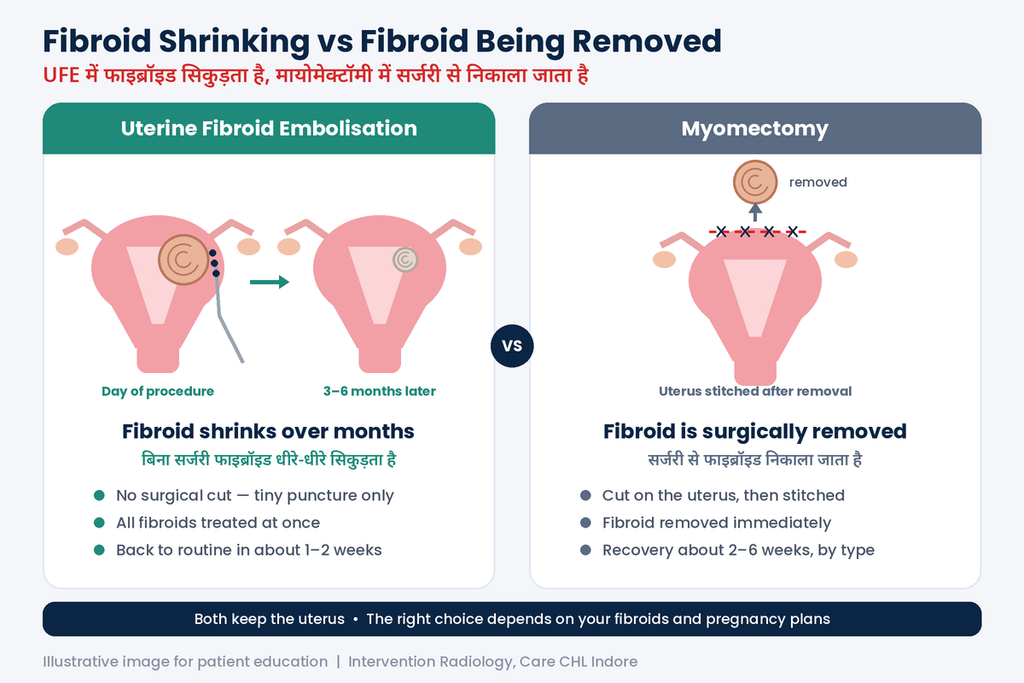
Uterine fibroid embolisation shrinks fibroids by blocking their blood supply through a tiny puncture, without surgery. Myomectomy is surgery that physically removes the fibroids. The right choice depends on your symptoms, the size, number and location of your fibroids, and whether you plan to become pregnant.
This guide compares uterine fibroid embolisation vs myomectomy in simple terms to help you have a better conversation with your doctors.
What Are Uterine Fibroids?
Fibroids are non-cancerous growths of muscle in the wall of the uterus. They are very common, especially in women in their 30s and 40s. They can cause:
- Heavy or long periods, sometimes with clots
- Tiredness and low haemoglobin (anaemia)
- Pelvic pain or pressure
- Frequent urination or constipation
- A swollen or bloated tummy
- Sometimes, difficulty getting pregnant
Also Read: How Your Periods May Change After Fibroid Embolisation
What Is Uterine Fibroid Embolisation (UFE)?
Uterine fibroid embolisation is a minimally invasive procedure done by an Interventional Radiologist.
- A tiny puncture is made at the wrist or groin under local anaesthesia with sedation.
- A thin catheter is guided to the arteries that feed the uterus.
- Tiny particles are injected to block the blood supply to the fibroids.
- Over the next few months, the fibroids shrink and soften, and symptoms improve.
There is no cut on the tummy, all fibroids are treated in one go, and the uterus is preserved.
What Is Myomectomy?
Myomectomy is a surgery done by a gynaecologist to remove fibroids while keeping the uterus. It can be done in three ways:
- Open (abdominal) myomectomy: Through a cut in the lower tummy, usually for large or many fibroids.
- Laparoscopic (keyhole) myomectomy: Through small cuts using a camera, for suitable fibroids.
- Hysteroscopic myomectomy: Through the vagina using a thin telescope, for fibroids that bulge into the uterine cavity. No cuts on the tummy.
The fibroids are cut out and the uterus is stitched back together (except in hysteroscopic myomectomy).
Also Read: Pre-Operative Embolization of Tumors: A Safe Way to Make Surgery Easier and Safer
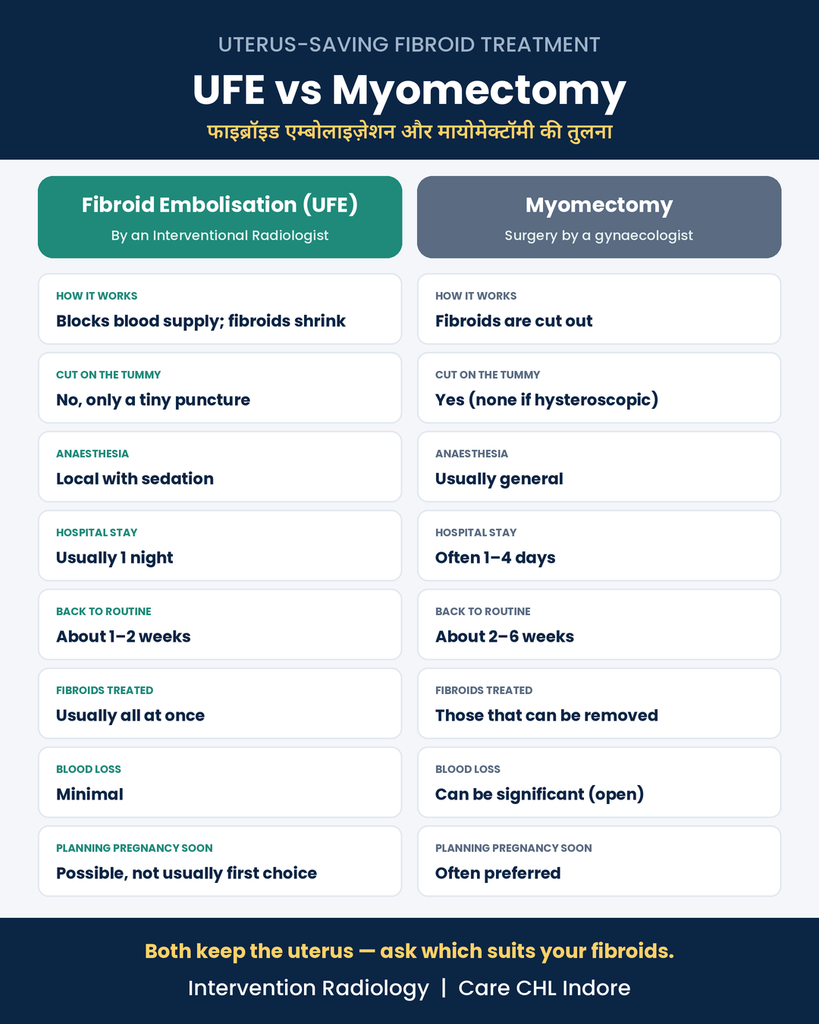
Uterine Fibroid Embolisation vs Myomectomy: Side-by-Side
| Point | Uterine fibroid embolisation | Myomectomy |
|---|---|---|
| Who does it | Interventional Radiologist | Gynaecologist |
| How it works | Blocks blood supply; fibroids shrink | Fibroids are cut out |
| Cut on the tummy | No, only a tiny puncture | Yes for open and keyhole; none for hysteroscopic |
| Anaesthesia | Local with sedation | Usually general anaesthesia |
| Hospital stay | Usually 1 night | Often 1–4 days, depending on type |
| Back to routine | About 1–2 weeks | About 2–6 weeks, depending on type |
| Number of fibroids treated | Usually all at once | Only those the surgeon can remove |
| Blood loss | Minimal | Can be significant in open surgery |
| Uterus preserved | Yes | Yes |
| Planning pregnancy soon | Possible, but usually not the first choice | Often preferred |
| Fibroids come back | Treated fibroids rarely regrow; some need further treatment | New fibroids can grow over time |
Key Differences Explained
1. Removal vs shrinkage Myomectomy removes the fibroids immediately. With UFE, the fibroids stay but shrink over 3–6 months, and symptoms usually improve within the first few cycles.
2. Recovery time UFE has no surgical wound, so most women return to routine work within one to two weeks. Open myomectomy usually needs a longer recovery.
3. Treating many fibroids When there are many fibroids of different sizes, UFE can treat all of them in one procedure. In myomectomy, very small or deep fibroids may be left behind.
4. Bleeding risk Myomectomy can involve heavy bleeding during surgery, especially with large fibroids, and sometimes a blood transfusion. UFE involves very little blood loss.
5. Fertility and pregnancy If you want to become pregnant soon, myomectomy is often the preferred option because more is known about pregnancy after it. Pregnancies after UFE do happen, but it is usually chosen by women who have completed their family or cannot have surgery.
6. Adhesions Surgery can cause internal scar tissue (adhesions) that may affect fertility or cause pain later. UFE does not involve surgical cuts inside the abdomen.
Also Read: Why Varicose Veins Can Return After Laser Treatment
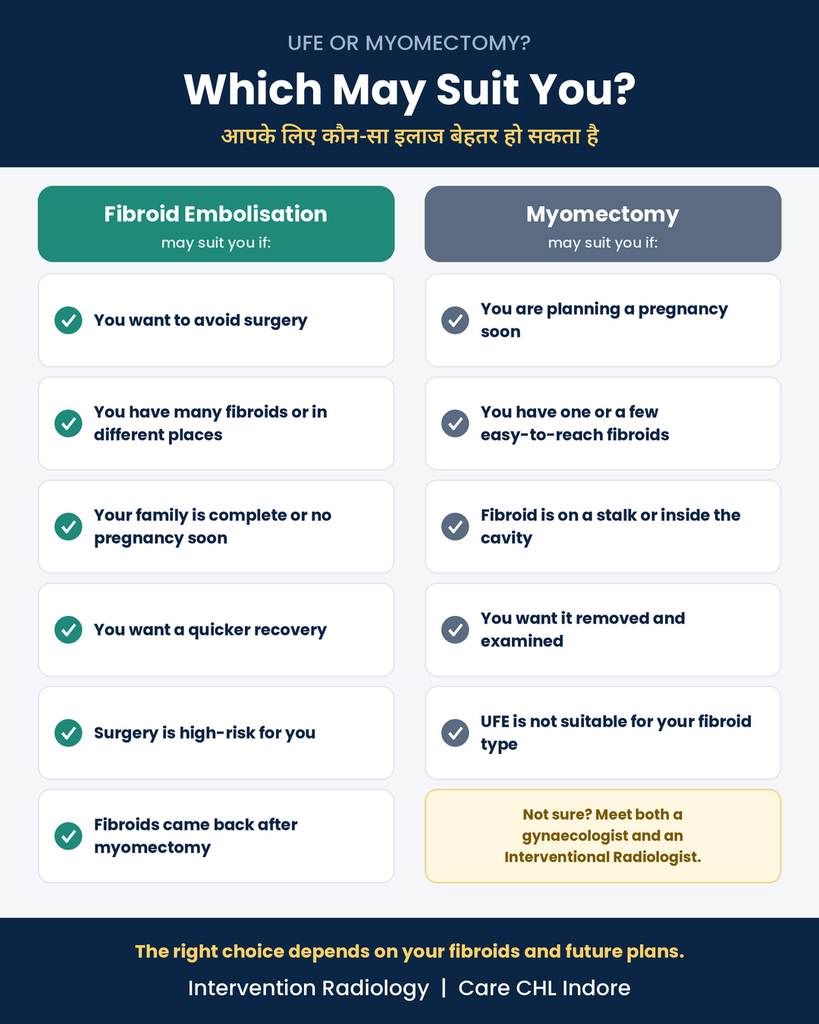
Which Option May Suit You?
Uterine fibroid embolisation may suit you if:
- You want to keep your uterus and avoid surgery
- You have many fibroids, or fibroids in different parts of the uterus
- You have completed your family or are not planning pregnancy soon
- You want a shorter hospital stay and quicker return to work
- You have had previous surgeries, or surgery carries higher risk for you
- Your fibroids have come back after an earlier myomectomy
Myomectomy may suit you if:
- You are planning a pregnancy soon
- You have one or a few fibroids that are easy to reach
- The fibroid hangs on a stalk outside the uterus, or bulges into the cavity (often removed hysteroscopically)
- You want the fibroid physically removed and examined
- Embolisation is not suitable for your type of fibroid
Many women benefit from seeing both a gynaecologist and an Interventional Radiologist before deciding, so all options are explained fairly.
Possible Risks
Uterine fibroid embolisation
- Cramping pain, nausea and mild fever for a few days after (post-embolisation syndrome)
- Vaginal discharge for a few weeks
- Rarely, infection or passing of fibroid tissue
- Small risk of early menopause, mainly in women already close to natural menopause
- Some women may need further treatment in the future
Myomectomy
- Bleeding during surgery, sometimes needing transfusion
- Infection and wound problems
- Internal scar tissue (adhesions)
- Risks of general anaesthesia
- A weakened uterine wall may affect how a future baby is delivered
- New fibroids can grow over time
Questions to Ask Before Choosing
- How many fibroids do I have, and where are they?
- Am I suitable for both UFE and myomectomy?
- Which option is better if I want to get pregnant?
- How long will I be in hospital and off work?
- What are the chances that I will need more treatment later?
- What is the cost of each option and does my insurance cover it?
Uterine Fibroid Embolisation in Indore at Care CHL Indore
If you are weighing uterine fibroid embolisation vs myomectomy, the Intervention Radiology Indore team at Care CHL Indore can help you understand whether UFE is suitable for your fibroids.
Dr. Alok Kumar Udiya, Interventional Radiologist, reviews your MRI and reports, explains the pros and cons of each option honestly, and works closely with gynaecologists so that you get the treatment that best fits your health and future plans.
Frequently Asked Questions
What is the main difference between uterine fibroid embolisation and myomectomy? UFE shrinks fibroids by blocking their blood supply through a tiny puncture, without surgery. Myomectomy is surgery that removes the fibroids.
Which has a faster recovery, UFE or myomectomy? UFE usually has a faster recovery — most women return to routine work in about 1–2 weeks. Open myomectomy can take several weeks.
Which is better if I want to get pregnant? Myomectomy is often preferred for women planning pregnancy soon. Pregnancy after UFE is possible, so discuss your plans with both your gynaecologist and Interventional Radiologist.
Can UFE treat many fibroids at once? Yes. UFE usually treats all fibroids in the uterus in one procedure, regardless of their number.
Do fibroids come back after UFE or myomectomy? Treated fibroids rarely regrow after UFE, though some women need further treatment. After myomectomy, new fibroids can develop over time.
Is UFE an option after a failed myomectomy? Yes. UFE is often a good option when fibroids return after surgery.
Where can I get uterine fibroid embolisation in Indore? Uterine fibroid embolisation is available at Care CHL Indore through the Intervention Radiology team led by Dr. Alok Kumar Udiya, Interventional Radiologist.
What is the cost of UFE compared to myomectomy in Indore? Costs depend on the type of procedure, hospital stay and insurance cover. Please contact Care CHL Indore directly for an estimate.
Conclusion
Uterine fibroid embolisation vs myomectomy is not about which is better for everyone — it is about which is better for you. UFE offers a no-surgery option with a quick recovery and treats all fibroids at once. Myomectomy removes fibroids surgically and is often preferred when pregnancy is planned soon.
The best choice comes from an honest discussion of your symptoms, your fibroids and your future plans.
Exploring uterus-saving fibroid treatment? Consult the Intervention Radiology team at Care CHL Indore to see if uterine fibroid embolisation is right for you.
Disclaimer: This article is for general awareness only and is not a substitute for medical advice. Please consult your doctors for advice specific to your condition.