
You touch your neck while getting ready one morning and feel a small swelling. Or a routine scan mentions a “thyroid nodule”. The first thought for most people is frightening: is this cancer?
If you are asking how to know if a thyroid lump is cancer, you are not alone. It is one of the most common worries we hear at Intervention Radiology Indore. The good news is that most thyroid lumps are harmless. The even better news is that simple, safe tests can tell the difference quickly.
In this guide, Dr. Alok Kumar Udiya, Interventional Radiologist at Care CHL Indore, explains:
- What a thyroid lump is and why it forms
- The warning signs that need a closer look
- How ultrasound shows whether a lump looks harmless or suspicious
- How a small needle test (FNAC) gives the answer
- What happens after your result, whether it is good news or not
The quick answer
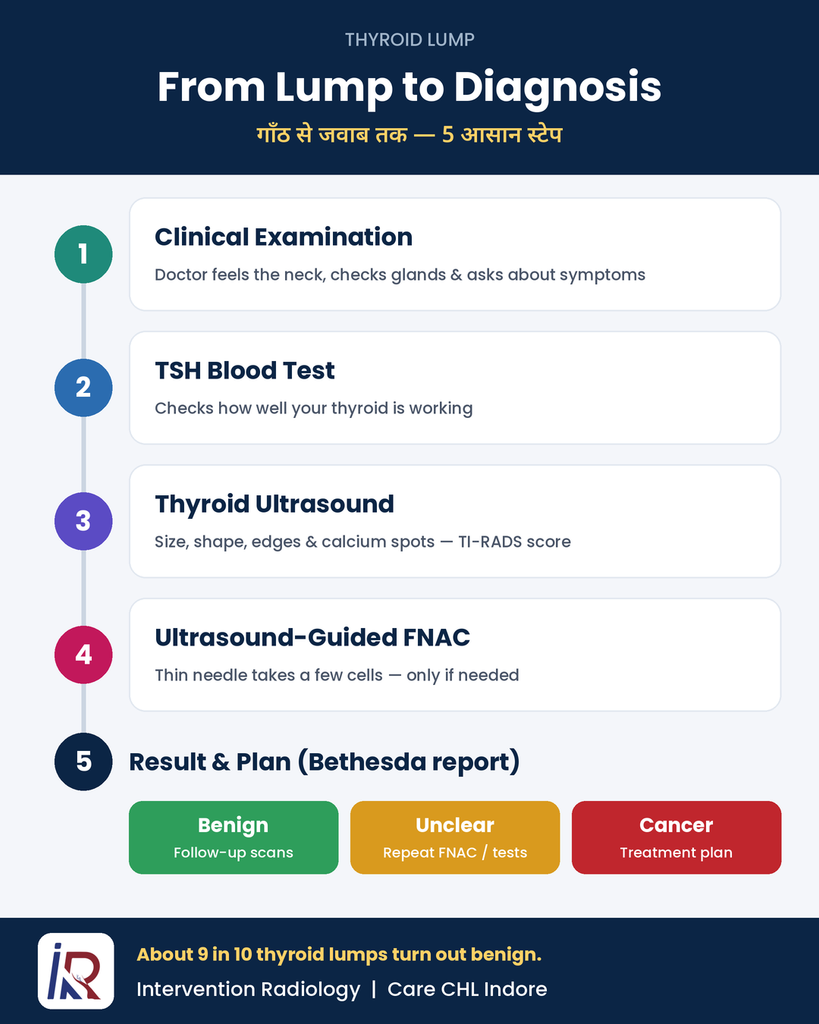
You cannot tell whether a thyroid lump is cancer just by touching it or by how you feel. The only reliable way is a step-by-step check:
- Clinical examination by a doctor
- Blood test (TSH) to see how your thyroid is working
- Thyroid ultrasound to study the lump’s shape, edges and features, often given a TI-RADS score
- Ultrasound-guided fine needle aspiration (FNAC) if the lump looks suspicious or is above a certain size
The large majority of thyroid lumps, roughly nine out of ten, turn out to be benign (not cancer). Even when cancer is found, most thyroid cancers grow slowly and have a very good outlook when treated on time.
Also Read: Can Thyroid Blood Tests Be Normal Even With a Thyroid Lump?
What is a thyroid lump?
The thyroid is a butterfly-shaped gland at the front of the neck, just below the Adam’s apple. It makes hormones that control your metabolism, energy and body temperature.
A thyroid lump (also called a thyroid nodule) is a growth of cells inside this gland. It can be:
- Solid: made of thyroid tissue
- Cystic: filled with fluid
- Mixed: partly solid and partly fluid
You may have a single nodule or several (a multinodular goitre). Many nodules are so small that they are only found by chance on a scan done for another reason.
Common causes of thyroid lumps
Most thyroid lumps have a harmless cause:
- Colloid nodules: overgrowth of normal thyroid tissue, the most common type
- Thyroid cysts: fluid-filled sacs, often from a degenerating nodule
- Multinodular goitre: an enlarged thyroid with several nodules
- Thyroiditis: inflammation of the thyroid, sometimes causing a lump that feels tender
- Iodine deficiency: still a cause of goitre in some areas
- Thyroid adenoma: a non-cancerous growth
A smaller number of lumps are thyroid cancer. The most common type, papillary thyroid cancer, usually grows slowly and responds well to treatment.
For a full overview of causes and treatment options, read our blog on thyroid lump causes and treatment.
Warning signs: when a thyroid lump needs a closer look
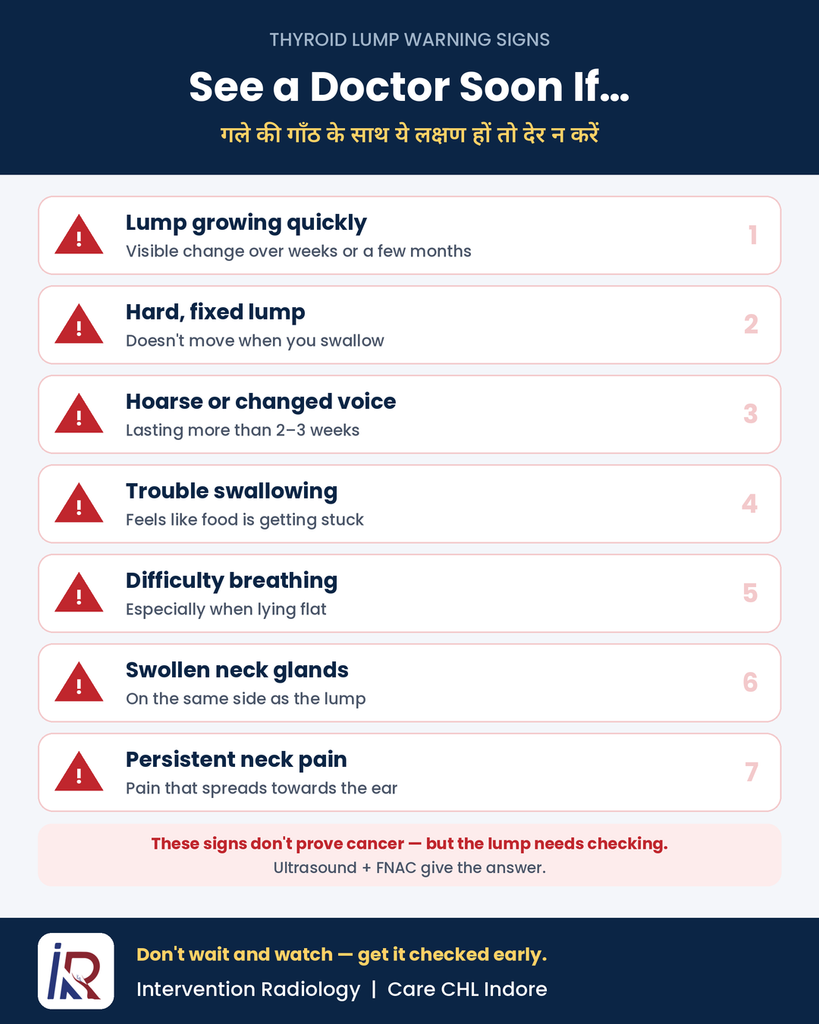
Most thyroid lumps cause no symptoms at all. That is why symptoms alone cannot rule cancer in or out. Still, some signs mean you should see a doctor soon, not “wait and watch” on your own:
- A lump that is growing quickly over weeks or a few months
- A hard, fixed lump that does not move when you swallow
- Hoarseness or a change in voice lasting more than two to three weeks
- Difficulty swallowing or a feeling of food getting stuck
- Difficulty breathing, especially when lying flat
- Swollen lymph nodes (glands) on the same side of the neck
- Persistent pain in the neck that spreads to the ear
These signs do not prove a lump is cancer. Benign goitres and cysts can also press on the windpipe or food pipe. But they mean the lump should be checked without delay.
Who is at higher risk of thyroid cancer?
Your doctor will look more carefully at a thyroid lump if you have any of these risk factors:
- Radiation to the head or neck in childhood, for example for a past cancer
- A family history of thyroid cancer or certain inherited conditions
- Age: a nodule in someone under 20 or over 60 deserves careful assessment
- Male sex: nodules are less common in men, but a higher share of them are cancer
- A previous thyroid cancer in the other side of the gland
Having a risk factor does not mean you have cancer. It simply helps the doctor decide how closely to check.
Also Read: Thyroid Nodules Can Now Be Treated Without Big Surgery: A Simple Guide
Benign vs suspicious thyroid lump: what doctors look for
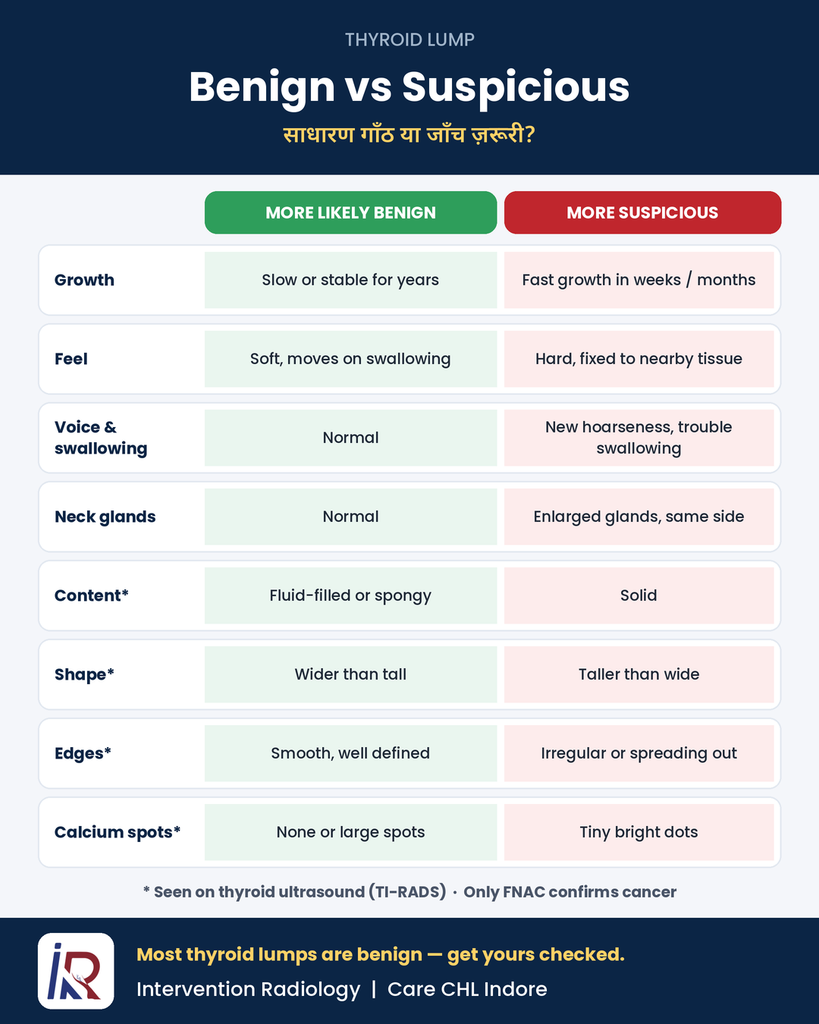
The table below shows typical differences. No single feature is a final answer; the full picture matters.
| Feature | More likely benign | More suspicious |
|---|---|---|
| Growth | Slow or stable over years | Fast growth over weeks or months |
| Feel | Soft or rubbery, moves on swallowing | Hard, fixed to nearby tissue |
| Voice and swallowing | Normal | New hoarseness, swallowing difficulty |
| Neck glands | Normal | Enlarged glands on the same side |
| Ultrasound content | Fluid-filled (cystic) or spongy | Solid |
| Ultrasound brightness | Same as or brighter than thyroid tissue | Very dark (markedly hypoechoic) |
| Shape on ultrasound | Wider than tall | Taller than wide |
| Edges | Smooth, well defined | Irregular, spiky or spreading outside the thyroid |
| Calcium spots | None, or large “comet tail” spots | Tiny bright dots (microcalcifications) |
Thyroid ultrasound and the TI-RADS score
Thyroid ultrasound is the most important first test for any thyroid lump. It is painless, uses no radiation and takes about 15–20 minutes. It shows:
- The exact size and number of nodules
- Whether each nodule is solid, cystic or mixed
- Its shape, edges, brightness and calcium spots
- The lymph nodes in the neck
Many radiologists report these findings as a TI-RADS score. TI-RADS is a points system that sorts a nodule into a level of concern, from TR1 (benign) to TR5 (highly suspicious).
Also Read: Thyroid Surgery vs. Radiofrequency Ablation: A Scar-Free Alternative Explained
| TI-RADS level | What it means | Usual next step |
|---|---|---|
| TR1 | Benign | No biopsy needed |
| TR2 | Not suspicious | No biopsy needed |
| TR3 | Mildly suspicious | FNAC if large; otherwise follow-up scans |
| TR4 | Moderately suspicious | FNAC at a smaller size; follow-up if small |
| TR5 | Highly suspicious | FNAC even when fairly small |
The exact size cut-offs for biopsy depend on the guideline your doctor follows and on your risk factors. Your Interventional Radiologist will explain what your score means for you.
Other tests your doctor may order
- TSH blood test: checks thyroid function. A lump that makes too much hormone (a “hot” nodule) is very rarely cancer.
- Thyroid scan (nuclear scan): sometimes done if TSH is low, to see whether the nodule is “hot” or “cold”.
- Calcitonin or other blood tests: in selected cases.
- CT or MRI: only if a large goitre extends into the chest or presses on the windpipe.
FNAC: the test that gives the answer
If your ultrasound shows a suspicious thyroid lump, the next step is usually an ultrasound-guided fine needle aspiration cytology (FNAC). This is the most reliable way to know whether a thyroid lump is cancer before any surgery.
Being advised a biopsy does not mean the doctor thinks you have cancer. It means the doctor wants a clear answer. Read more in our blog does a biopsy recommendation mean cancer.
How the FNAC is done
- You lie on your back with a small pillow under your shoulders.
- The skin is cleaned. Local anaesthetic may be used, though many patients do not need it.
- Using live ultrasound, the Interventional Radiologist guides a very thin needle, thinner than a blood-test needle, into the exact part of the nodule.
- A few cells are drawn out. This is usually repeated two to four times for enough sample.
- A small pressure dressing is applied.
The whole procedure takes about 15–30 minutes. You go home the same day and can usually return to normal work the next day.
Why ultrasound guidance matters
A needle placed “by feel” can miss a small nodule or take cells from the wrong part. Ultrasound guidance lets the doctor:
- Target the most suspicious part of the lump
- Avoid blood vessels, the windpipe and nerves
- Sample small nodules that cannot be felt
- Reduce the chance of a “non-diagnostic” (not enough cells) result
Is thyroid FNAC painful or risky?
Most patients describe it as a mild pinch or pressure, similar to a blood test. Side effects are minor: a small bruise, slight swelling or neck soreness for a day or two. Serious problems are very rare.
There is no evidence that a needle biopsy spreads cancer in the thyroid.
Understanding your FNAC result: the Bethesda system
Thyroid FNAC reports are usually given a Bethesda category from I to VI. This tells you how likely the lump is to be cancer and what to do next.
| Bethesda category | What it means | Usual next step |
|---|---|---|
| I – Non-diagnostic | Not enough cells to decide | Repeat FNAC under ultrasound |
| II – Benign | Not cancer | Follow-up ultrasound; treat only if it causes symptoms |
| III – Atypia of undetermined significance | Unclear changes | Repeat FNAC, molecular tests or surgery, as advised |
| IV – Follicular neoplasm | A growth whose nature cannot be told on cells alone | Usually surgery to remove part of the thyroid for a final answer |
| V – Suspicious for malignancy | Probably cancer | Surgery is usually advised |
| VI – Malignant | Cancer | Surgery and a treatment plan with your specialist team |
What happens next?
If your thyroid lump is benign
Most people fall into this group. Your doctor may advise:
- Follow-up ultrasound after 1–2 years, then less often if the lump is stable
- Treatment only if needed, for example if the lump is large, causes pressure, or affects your appearance
- Minimally invasive options for selected benign nodules, such as ultrasound-guided radiofrequency ablation (RFA) or cyst aspiration with ethanol injection, which shrink the nodule without surgery or a neck scar
If the result is unclear
An unclear result (Bethesda III or IV) is common and is not a cancer diagnosis. A repeat FNAC, an extra test on the sample, or surgery to remove part of the thyroid will give the final answer.
If the lump is cancer
Hearing the word cancer is never easy. But most thyroid cancers, especially papillary cancer, grow slowly and are highly treatable. Treatment is usually surgery, sometimes followed by radioactive iodine and thyroid hormone tablets. Your care team will guide you through each step.
Self-check: what you can do at home
A quick neck check in front of a mirror can help you notice a new thyroid lump early:
- Tilt your head back slightly.
- Take a sip of water and swallow.
- Watch the lower front of your neck, below the Adam’s apple and above the collarbone.
- Look for any bulge that moves up and down as you swallow.
If you see or feel a lump, don’t panic and don’t ignore it. Book a check-up. A self-check helps you notice a lump; it cannot tell you whether the lump is cancer.
Thyroid lump evaluation at Care CHL Indore
At Intervention Radiology Indore, thyroid lumps are assessed at Care CHL Indore by Dr. Alok Kumar Udiya, Interventional Radiologist. An Interventional Radiologist uses imaging to diagnose and treat conditions through a needle, so the scan and the biopsy are done by the same expert hands.
What patients can expect:
- High-resolution thyroid and neck ultrasound with a clear TI-RADS report
- Ultrasound-guided FNAC, done as a quick day-care procedure
- Clear explanation of your report in simple language, in Hindi or English
- Guidance on follow-up, or referral to the right specialist when surgery is needed
- Minimally invasive options for suitable benign nodules
Book a consultation with Dr. Alok Kumar Udiya at Care CHL Indore if you have noticed a thyroid lump or your scan report mentions a thyroid nodule.
Frequently asked questions
1. How do you know if a thyroid lump is cancer? You cannot tell by touch or symptoms alone. A thyroid ultrasound shows whether the lump looks benign or suspicious, and an ultrasound-guided FNAC biopsy confirms whether it is cancer.
2. Are most thyroid lumps cancerous? No. Roughly nine out of ten thyroid lumps are benign. Even so, every new lump should be checked by a doctor.
3. What does a cancerous thyroid lump feel like? It may feel hard, fixed and irregular, and may grow quickly. But many cancerous nodules feel no different from benign ones, which is why ultrasound and FNAC are needed.
4. Can a thyroid lump be cancer if it doesn’t hurt? Yes. Most thyroid cancers are painless. Pain is not a reliable sign either way.
5. What TI-RADS score is worrying? TR4 (moderately suspicious) and TR5 (highly suspicious) nodules usually need an FNAC, depending on size. TR1 and TR2 nodules are not suspicious.
6. Is thyroid FNAC painful? Most people feel only a mild pinch or pressure. It takes 15–30 minutes and you go home the same day.
7. Can a benign thyroid nodule turn into cancer? It is uncommon for a benign nodule to become cancer. Follow-up ultrasounds are advised to check that it stays stable.
8. What does a Bethesda II result mean? Bethesda II means the nodule is benign. Usually only follow-up ultrasound is needed, unless the lump causes symptoms.
9. Can blood tests detect thyroid cancer? A TSH test checks thyroid function but cannot diagnose most thyroid cancers. Ultrasound and FNAC are the key tests.
10. Where can I get a thyroid lump checked in Indore? You can consult Dr. Alok Kumar Udiya, Interventional Radiologist at Intervention Radiology Indore, Care CHL Indore, for thyroid ultrasound and ultrasound-guided FNAC.
Conclusion
So, how do you know if a thyroid lump is cancer? Not by guessing, waiting or searching symptoms online, but with a simple step-by-step check: examination, a TSH blood test, a thyroid ultrasound and, when needed, an ultrasound-guided FNAC. Most thyroid lumps turn out to be harmless. When cancer is found early, it is usually very treatable.
If you have noticed a lump in your neck, or your scan mentions a thyroid nodule, get it checked. A clear answer brings peace of mind.
Consult Dr. Alok Kumar Udiya, Interventional Radiologist at Intervention Radiology Indore, Care CHL Indore, for expert thyroid lump evaluation.
Disclaimer: This article is for general information only and is not a substitute for medical advice. Please consult a qualified doctor for diagnosis and treatment of your condition.