
You notice thin red or purple lines on your thighs. Or maybe twisted blue veins bulging on your calves. Are they the same thing? Should you worry?
Many people use “spider veins” and “varicose veins” to mean the same thing. They are related, but they are not the same. Spider veins are tiny, flat and mostly a cosmetic concern. Varicose veins are larger, bulging and often cause symptoms — and they can lead to skin problems if ignored.
This guide explains spider veins vs varicose veins in simple terms: how they look, why they happen, when they need attention, and how each is treated.
What Are Spider Veins?
Spider veins (medical name: telangiectasias) are tiny, widened blood vessels just under the skin.
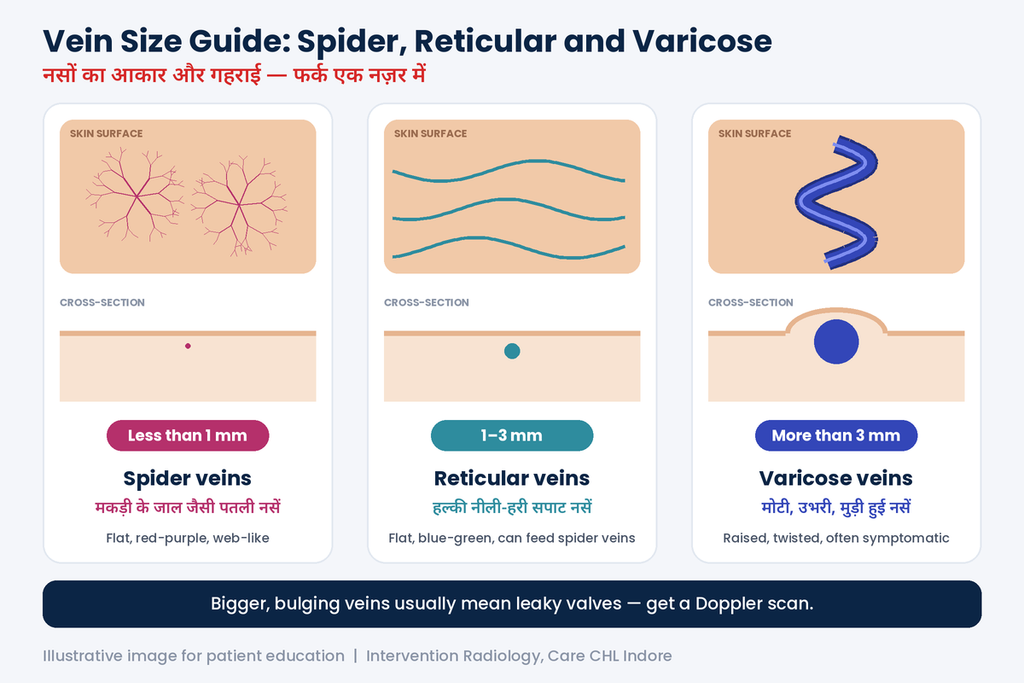
- Size: Very small — usually less than 1 mm wide
- Look: Thin red, purple or blue lines, often in a web, branch or sunburst pattern
- Feel: Flat; they do not bulge above the skin
- Where: Commonly on the thighs, calves, ankles and sometimes the face
- Symptoms: Usually none. Some people feel mild itching or burning
Slightly larger, flat blue-green veins (about 1–3 mm) are called reticular veins. They often sit near spider veins and can “feed” them.
Also Read: Why Varicose Veins Can Return After Laser Treatment
What Are Varicose Veins?
Varicose veins are enlarged, twisted veins caused by weak or damaged valves inside the leg veins.
- Size: Larger — usually more than 3 mm wide
- Look: Blue or dark purple, rope-like and twisted
- Feel: Raised and bulging above the skin, especially when standing
- Where: Mostly on the calves, back of the knee and inner thigh
- Symptoms: Heaviness, aching, swelling, night cramps, itching, and tired legs by evening
Leg veins have tiny one-way valves that push blood back up to the heart. When these valves weaken, blood leaks backwards and pools in the veins, which stretch and twist over time. This backward flow is called venous reflux.
Spider Veins vs Varicose Veins: Key Differences
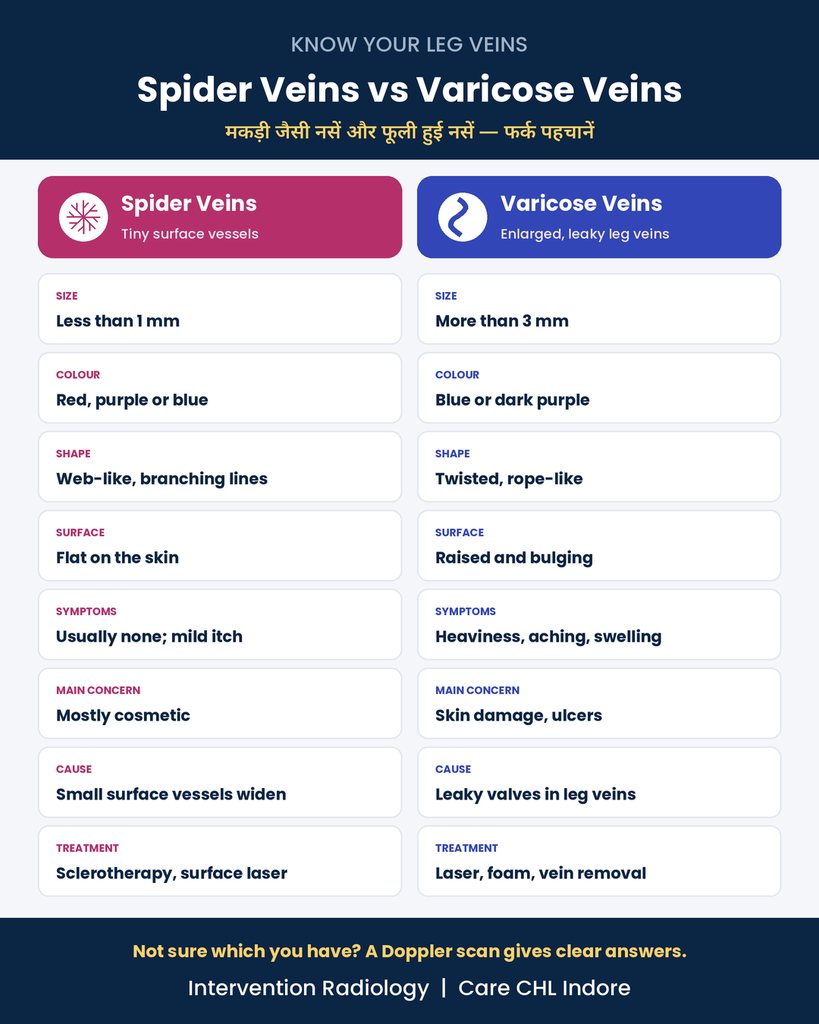
| Feature | Spider veins | Varicose veins |
|---|---|---|
| Size | Less than 1 mm | More than 3 mm |
| Colour | Red, purple or blue | Blue or dark purple |
| Shape | Web-like, branching lines | Twisted, rope-like |
| Surface | Flat on the skin | Raised and bulging |
| Common location | Thighs, calves, ankles, face | Calves, back of knee, inner thigh |
| Symptoms | Usually none; mild itch or burning | Heaviness, aching, swelling, cramps |
| Main concern | Mostly cosmetic | Can cause skin damage and ulcers |
| Usual cause | Small surface vessels widen | Leaky valves in larger leg veins |
| Main treatment | Sclerotherapy, surface laser | Laser or other ablation, foam, vein removal |
What Causes Spider Veins and Varicose Veins?
Both share many of the same risk factors:
- Family history — the strongest factor; vein problems often run in families
- Being a woman — hormones make vein walls more relaxed
- Pregnancy — extra blood volume and pressure on pelvic veins
- Long hours of standing or sitting — teachers, shopkeepers, nurses, drivers, office workers
- Age — valves and vein walls weaken over time
- Excess weight — adds pressure on leg veins
- Hormonal medicines — in some women
- Sun exposure — mainly for spider veins on the face
Also Read: Laser vs. RFA vs. Sclerotherapy: Varicose Vein Guide
Are Spider Veins Harmless?
Most spider veins are harmless and are treated for appearance. But they are not always “just cosmetic”.
Spider veins can sometimes be a sign of a deeper problem. If you have many spider veins along with leg heaviness, ankle swelling, night cramps or skin darkening near the ankle, there may be hidden venous reflux in the larger veins underneath.
In such cases, treating only the surface spider veins often gives short-lived results, because the source of the problem remains. A simple Doppler ultrasound can find out what is happening beneath the skin.
Can Spider Veins Turn Into Varicose Veins?
Spider veins do not “grow” into varicose veins. But both can appear together, and both can share the same underlying cause. If you have spider veins and risk factors like family history or long hours of standing, keep an eye out for bulging veins or leg symptoms.
How Are They Diagnosed?
- Physical examination while you stand, so the veins fill up
- Venous Doppler ultrasound — a painless scan that shows whether the valves are leaking, which veins are affected, and how blood is flowing
A Doppler scan is strongly advised if you have varicose veins, leg symptoms, or many spider veins that keep coming back. It helps plan the right treatment for the right vein.
Treatment for Spider Veins
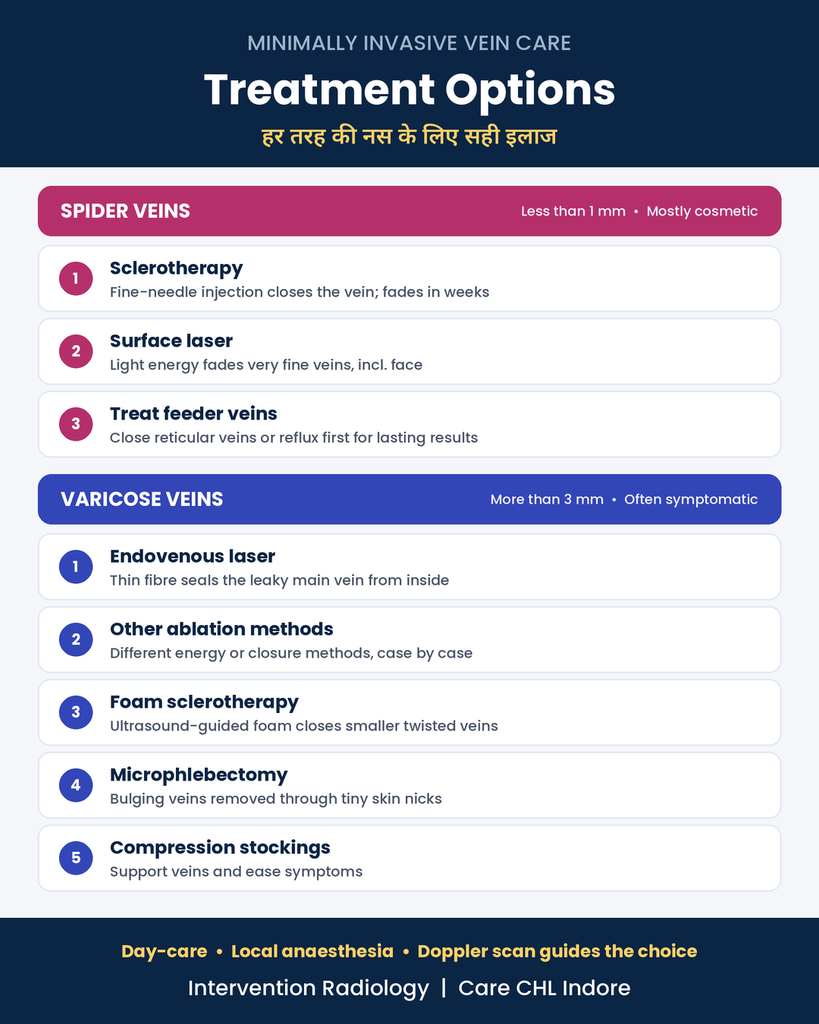
- Sclerotherapy: A very fine needle is used to inject a medicine into the spider veins. The veins close and fade over a few weeks. Several sessions may be needed.
- Surface laser: Light energy is used on the skin to fade very fine spider veins, especially on the face.
- Treating feeder veins: If reticular veins or deeper reflux feed the spider veins, these are treated first for longer-lasting results.
Also Read: How to Get Rid of Varicose Veins Without Surgery — A Complete Guide
Treatment for Varicose Veins
Varicose veins are usually treated by an Interventional Radiologist using minimally invasive methods:
- Endovenous laser treatment: A thin laser fibre seals the leaky main vein from inside through a needle puncture.
- Other thermal or non-thermal ablation: Different energy sources or medical closure methods may be used to seal the faulty vein, depending on the case.
- Foam sclerotherapy: A medicine foam is injected under ultrasound guidance to close smaller or twisted varicose veins.
- Microphlebectomy: Bulging surface veins are removed through tiny nicks in the skin.
- Compression stockings: Help control symptoms and support the veins.
Most of these are day-care procedures under local anaesthesia, with a quick return to routine activities.
Tips to Prevent or Slow Down Vein Problems
- Walk daily — calf muscles pump blood back to the heart.
- Avoid standing or sitting still for long; flex your ankles every 30 minutes.
- Raise your legs above heart level for 15–20 minutes when resting.
- Keep a healthy weight.
- Wear compression stockings if advised, especially during long standing hours.
- Protect your skin from excess sun to reduce spider veins on the face.
When Should You See a Doctor?
See a vein specialist if you have:
- Bulging, twisted veins on your legs
- Leg heaviness, aching or swelling that gets worse by evening
- Night cramps or restless legs
- Itching, darkening or hardening of skin near the ankle
- A wound near the ankle that is slow to heal
- Many spider veins that keep coming back after treatment
Seek urgent care if a vein suddenly becomes painful, red and hard, if a varicose vein bleeds, or if one leg suddenly swells and hurts — these need prompt evaluation.
Spider Vein and Varicose Vein Treatment in Indore at Care CHL Indore
Whether you have spider veins, varicose veins or both, the Intervention Radiology Indore team at Care CHL Indore can help identify the cause with a Doppler scan and plan the right treatment.
Dr. Alok Kumar Udiya, Interventional Radiologist, offers minimally invasive options such as laser treatment, foam sclerotherapy and sclerotherapy for spider veins, with a focus on treating the root cause for longer-lasting results.
Frequently Asked Questions
What is the main difference between spider veins and varicose veins? Spider veins are tiny, flat, red or purple lines under the skin. Varicose veins are larger, bulging, twisted veins that often cause aching, heaviness or swelling.
Are spider veins dangerous? Usually not. Most are a cosmetic concern. But many spider veins with leg symptoms can point to hidden vein problems underneath.
Do spider veins turn into varicose veins? No, but both can appear together and share the same causes.
Do I need a Doppler scan for spider veins? Not always. It is advised if you also have leg symptoms, varicose veins, or spider veins that keep coming back after treatment.
Can varicose veins be treated without surgery? Yes. Laser treatment, foam sclerotherapy and microphlebectomy are minimally invasive options done as day-care procedures.
Can spider veins come back after treatment? Treated veins usually fade for good, but new spider veins can appear over time, especially if risk factors continue.
Where can I get spider vein and varicose vein treatment in Indore? Treatment is available at Care CHL Indore through the Intervention Radiology team led by Dr. Alok Kumar Udiya, Interventional Radiologist.
What is the cost of vein treatment in Indore? Cost depends on the type and number of veins, the treatment chosen and insurance cover. Please contact Care CHL Indore directly for an estimate.
Conclusion
Spider veins vs varicose veins comes down to size, symptoms and what lies beneath. Spider veins are small and mostly cosmetic. Varicose veins are larger, often symptomatic, and usually point to leaky valves that need proper treatment.
If you are unsure which one you have — or if your legs feel heavy and tired — a simple Doppler scan can give clear answers.
Worried about spider veins or varicose veins? Consult the Intervention Radiology team at Care CHL Indore.
Disclaimer: This article is for general awareness only and is not a substitute for medical advice. Please consult your doctor for advice specific to your condition.