
You noticed a small swelling in the front of your neck. Or a scan done for something else showed a “thyroid nodule“. Your doctor ordered thyroid blood tests — and the report came back completely normal.
So is everything fine? Not necessarily.
Yes, thyroid blood tests can be completely normal even when you have a thyroid lump. In fact, most people with a thyroid lump have normal thyroid blood tests. A normal report does not mean the lump is harmless — and it does not mean it is dangerous either. It simply means the lump needs a different kind of test.
This guide explains why, which tests actually check a thyroid lump, and what treatment options are available.
What Do Thyroid Blood Tests Actually Check?
The thyroid is a butterfly-shaped gland in the front of the neck. It makes hormones that control your metabolism, energy, weight and heart rate.
Thyroid blood tests usually include:
- TSH (thyroid-stimulating hormone) — the main screening test
- T3 and T4 — the thyroid hormones themselves
- Thyroid antibodies — in some cases, to check for autoimmune thyroid disease
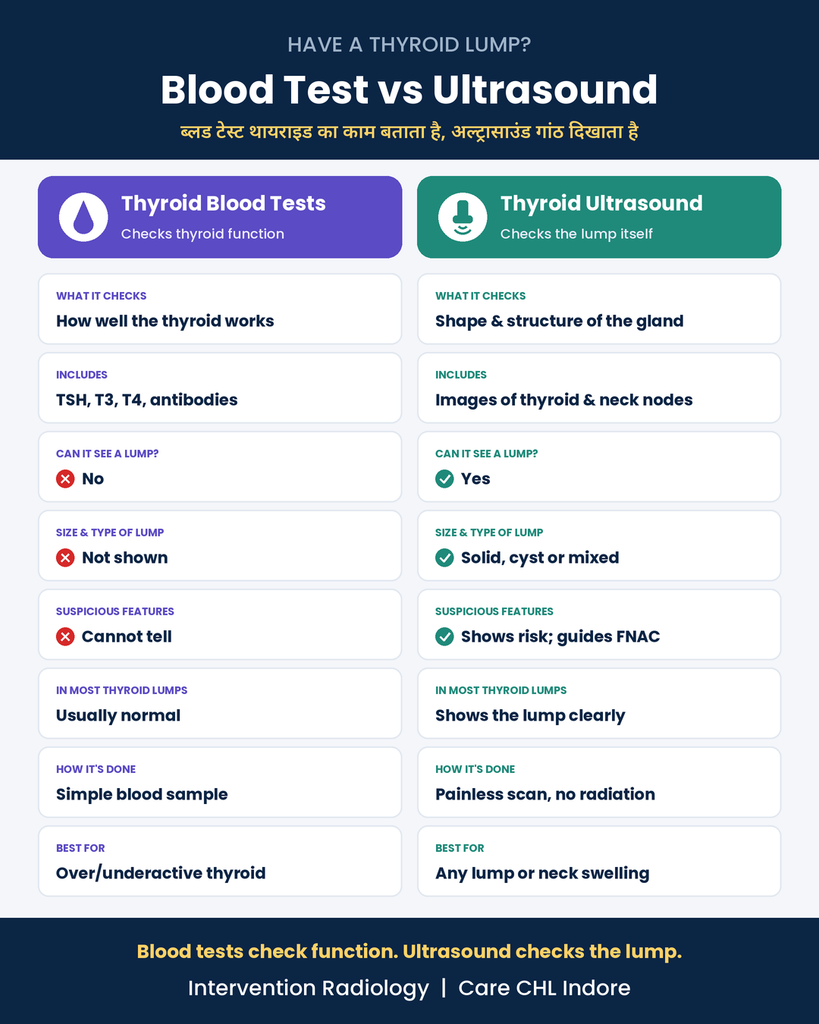
These tests tell you how well the thyroid is working — whether it is making too much hormone (hyperthyroidism), too little (hypothyroidism), or the right amount.
They do not tell you about the shape or structure of the thyroid. They cannot see a lump, measure its size, or tell whether it is harmless or suspicious.
What Is a Thyroid Lump?
A thyroid lump, or thyroid nodule, is an abnormal growth inside the thyroid gland. It can be solid, fluid-filled (a cyst), or a mix of both.
Thyroid lumps are very common, especially in women and with age. Many are found by chance on ultrasound or CT scans done for other reasons. The large majority of thyroid lumps are benign (not cancer). But a small number can be cancerous, which is why each lump needs proper evaluation.
Also Read: Thyroid Nodules Can Now Be Treated Without Big Surgery: A Simple Guide
Why Are Thyroid Blood Tests Normal Even With a Lump?
Think of the thyroid as a factory. Blood tests check how much product (hormone) the factory is sending out. A lump is like an extra room built inside the factory.
As long as the rest of the factory keeps producing the right amount of hormone, the blood test stays normal — even if there is a lump inside.
That is why:
- Most benign thyroid nodules do not change hormone levels.
- Thyroid cysts (fluid-filled lumps) usually do not affect hormone levels.
- Most thyroid cancers also have normal thyroid blood tests. So a normal TSH does not rule out cancer.
When Can a Thyroid Lump Change Blood Tests?
Sometimes, a lump does affect hormone levels:
- “Hot” (overactive) nodule: The lump itself makes extra hormone. TSH becomes low and T3/T4 may be high. These nodules are usually benign.
- Multinodular goitre: Many nodules together can sometimes make too much hormone.
- Hashimoto’s thyroiditis: An autoimmune condition that can cause both an underactive thyroid and nodular changes.
If your TSH is low, your doctor may advise a thyroid scan to check whether the lump is overactive.
Also Read: Thyroid Surgery vs. Radiofrequency Ablation: A Scar-Free Alternative Explained
Thyroid Lump vs Thyroid Blood Tests: Quick Comparison
| Type of lump | Thyroid blood tests | What usually happens next |
|---|---|---|
| Benign nodule | Usually normal | Ultrasound; FNAC if features suggest |
| Thyroid cyst | Usually normal | Ultrasound; drainage or ablation if large |
| Thyroid cancer | Usually normal | Ultrasound + FNAC confirm diagnosis |
| Hot (overactive) nodule | Low TSH, high T3/T4 | Thyroid scan; treatment for overactivity |
| Multinodular goitre | Normal or abnormal | Ultrasound; FNAC of suspicious nodules |
Key takeaway: Blood tests check thyroid function. Ultrasound checks the lump. You usually need both.
How Is a Thyroid Lump Properly Checked?
1. Thyroid ultrasound This is the most important test for a thyroid lump. It is painless, quick and uses no radiation. Ultrasound shows the lump’s size, whether it is solid or fluid-filled, its edges, any calcium spots, blood flow, and nearby lymph nodes. Doctors use a standard risk-scoring system based on these features to decide which lumps need further testing.
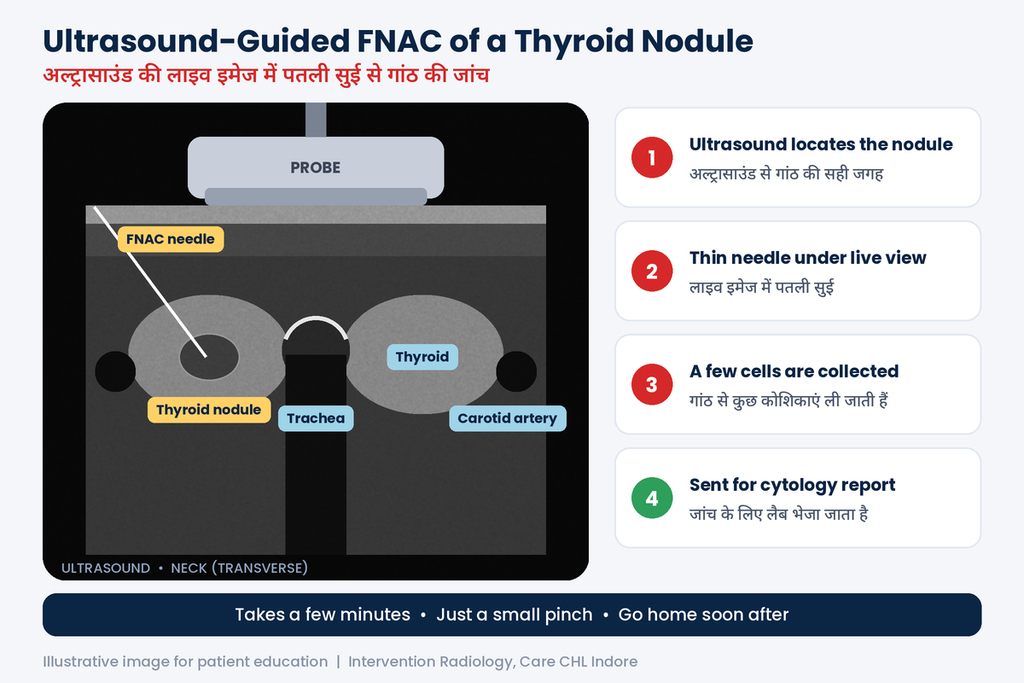
2. Ultrasound-guided FNAC (fine needle aspiration cytology) If the lump has suspicious features or is above a certain size, a few cells are taken with a very thin needle under ultrasound guidance. This is done by an Interventional Radiologist in a few minutes, usually without needing local anaesthesia. The cells are examined to tell whether the lump is benign, suspicious or cancerous.
3. Thyroid scan (only in selected cases) If TSH is low, a scan may be done to see if the nodule is overactive (“hot”).
4. Other tests Occasionally, special blood tests or a CT scan may be advised — for example, if the lump is very large or pressing on the windpipe.
Treatment Options for a Thyroid Lump
Treatment depends on the FNAC result, size and symptoms:
- Watchful monitoring: Most small benign lumps need only periodic ultrasound checks.
- Aspiration of cysts: Fluid-filled lumps can be drained with a needle; sometimes alcohol is injected to stop the fluid from coming back.
- Thermal ablation (radiofrequency or microwave ablation): For benign lumps that cause neck swelling, pressure, swallowing difficulty or cosmetic concern, an Interventional Radiologist can shrink the lump using a thin needle and heat — without surgery, without a scar, and usually as a day-care procedure. Thyroid function is generally preserved.
- Surgery: Advised for cancerous or highly suspicious lumps, very large goitres, or when other options are not suitable.
- Medicines or radioactive iodine: For overactive (“hot”) nodules, as advised by an endocrinologist.
Also Read: Thyroid Cyst Treatment Without Surgery: Safe & Effective Options
How Interventional Radiology Helps
Interventional Radiology plays a key role in thyroid lump care:
- Accurate diagnosis with ultrasound-guided FNAC from the exact suspicious area
- Non-surgical treatment of benign lumps with thermal ablation
- Quick recovery — most patients go home the same day and return to routine work in a day or two
Thyroid Lump Warning Signs: Don’t Ignore These
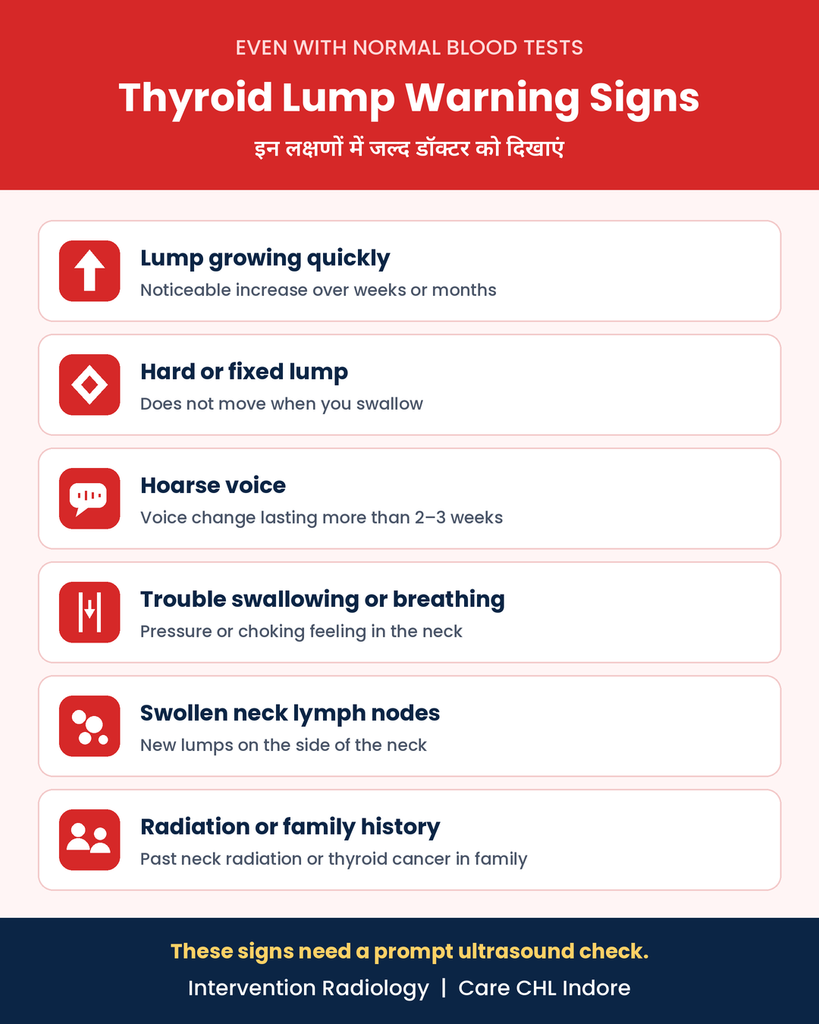
Even with normal thyroid blood tests, see a doctor soon if you notice:
- A lump that is growing quickly
- A lump that feels hard or fixed in place
- Hoarse voice or voice change lasting more than 2–3 weeks
- Difficulty swallowing or breathing
- Swollen lymph nodes in the neck
- Past radiation to the head or neck, or a family history of thyroid cancer
These signs do not always mean cancer, but they need prompt evaluation.
Thyroid Lump Evaluation and Treatment in Indore at Care CHL Indore
If you have a thyroid lump — with normal or abnormal thyroid blood tests — the Intervention Radiology Indore team at Care CHL Indore can help with detailed ultrasound evaluation, ultrasound-guided FNAC, and non-surgical thermal ablation for suitable benign lumps.
Dr. Alok Kumar Udiya, Interventional Radiologist, works closely with endocrinologists, ENT and endocrine surgeons so that each patient gets the right test and the right treatment.
Frequently Asked Questions
Can thyroid blood tests be normal with a thyroid lump? Yes. Most people with a thyroid lump have normal thyroid blood tests, because the rest of the gland keeps producing normal hormone levels.
Does a normal TSH mean my thyroid lump is not cancer? No. Most thyroid cancers also have normal TSH. An ultrasound, and FNAC if needed, is required to check the lump.
Which test is best for a thyroid lump? Thyroid ultrasound is the most important test. If the lump looks suspicious, ultrasound-guided FNAC confirms the diagnosis.
Is FNAC of the thyroid painful? Most people feel only a small pinch, similar to a blood test. It takes a few minutes and you can go home soon after.
Are most thyroid lumps cancerous? No. The large majority of thyroid lumps are benign. But each lump should be evaluated properly.
Can a thyroid lump be treated without surgery? Yes. Benign lumps causing symptoms can often be shrunk with thermal ablation, done by an Interventional Radiologist without surgery or a scar.
Where can I get a thyroid lump checked in Indore? Thyroid lump evaluation and treatment are available at Care CHL Indore through the Intervention Radiology team led by Dr. Alok Kumar Udiya, Interventional Radiologist.
What is the cost of thyroid lump treatment in Indore? Cost depends on the tests and treatment needed and insurance cover. Please contact Care CHL Indore directly for an estimate.
Conclusion
Normal thyroid blood tests are reassuring about how your thyroid is working — but they do not tell you about a thyroid lump. Most lumps are harmless, yet the only way to be sure is with an ultrasound and, when needed, an FNAC.
The good news is that thyroid lumps can be diagnosed quickly and, if benign but troublesome, treated without surgery.
Have a thyroid lump with normal thyroid blood tests? Consult the Intervention Radiology team at Care CHL Indore.
Disclaimer: This article is for general awareness only and is not a substitute for medical advice. Please consult your doctor for advice specific to your condition.