
It is one of the most frightening questions families ask after a loved one has a stroke: can you die from a stroke in your sleep?
The honest answer is yes, it can happen — but it is not the most common outcome. A very large stroke, especially one caused by bleeding in the brain or a blockage in a critical artery, can be fatal if it happens during sleep and no one notices in time. However, most people who have a stroke while sleeping wake up with symptoms, and many of them can be treated successfully if they reach a stroke-ready hospital quickly.
The real danger is not sleep itself. It is the delay — the hours that pass before anyone realises something is wrong.
This guide explains, in simple words, how a stroke during sleep happens, when it can become life-threatening, who is most at risk, the warning signs to look for, and what you can do to protect yourself and your family.
What Is a Stroke?
A stroke happens when blood supply to part of the brain is suddenly cut off or reduced. Without oxygen-rich blood, brain cells begin to die within minutes.
There are two main types:
- Ischemic stroke: A clot blocks an artery that carries blood to the brain. This is the most common type, making up the large majority of all strokes.
- Hemorrhagic stroke: A weak blood vessel in or around the brain bursts and bleeds. This type is less common but is more often severe.
There is also a transient ischemic attack (TIA), often called a “mini stroke”. The blood flow is blocked only for a short time, and symptoms usually go away within minutes to hours. A TIA is a serious warning that a bigger stroke may follow.
Also Read: Can a Stroke That Happens During Sleep Be Treated? (Wake-Up Stroke Explained)
What Is a Stroke in Your Sleep?
A stroke that happens while a person is asleep is often called a wake-up stroke. The person goes to bed feeling normal and wakes up with symptoms such as weakness on one side, slurred speech or a drooping face.
Studies suggest that roughly 1 in 5 ischemic strokes begins during sleep or is noticed only on waking. Because no one knows exactly when it started, doctors use the “last known well” time — usually the time the person went to bed — to plan treatment.
This uncertainty about timing is one of the main reasons a stroke during sleep can be more dangerous than a stroke that happens while awake.
How Can a Stroke in Your Sleep Become Fatal?
Most strokes are not instantly fatal. Death usually happens because of how large the stroke is, where it happens in the brain, and how long it goes untreated. During sleep, several of these risks come together.
1. A very large blockage in a major brain artery When a clot blocks a large artery, such as the main artery supplying one side of the brain, a big area of brain tissue loses blood supply. If not treated, the damaged brain can swell severely. This swelling raises pressure inside the skull and can press on vital areas that control breathing and consciousness.
2. Bleeding in the brain (hemorrhagic stroke) A burst blood vessel can cause bleeding that spreads quickly. Large bleeds raise brain pressure within hours and are among the most dangerous types of stroke. They are often linked to very high blood pressure that is not controlled.
3. Stroke in the brainstem The brainstem, at the base of the brain, controls breathing, heart rate and the ability to stay awake. A stroke in this area — even a small one — can affect breathing and consciousness and can become life-threatening if not treated urgently.
4. Delay in treatment This is the biggest factor during sleep. Many of the most effective stroke treatments work best within the first few hours. When a stroke begins at night and is only noticed in the morning, precious time may already be lost.
5. Complications in the hours that follow A person who has had a stroke may lose the ability to swallow safely or to cough properly. Saliva or vomit can enter the lungs (aspiration), leading to choking or pneumonia. Heart rhythm problems and very high blood pressure can also occur.
| Factor | Why it raises the danger at night |
|---|---|
| Large artery blockage | Big area of brain affected; swelling builds up over hours |
| Brain bleed | Pressure rises fast; often linked to uncontrolled BP |
| Brainstem stroke | Affects breathing and consciousness directly |
| No one is awake to notice | Treatment starts late, after hours of damage |
| Swallowing and breathing problems | Risk of choking and lung infection while lying down |
Is a Wake-Up Stroke More Dangerous?
A wake-up stroke is not always a “worse” stroke in terms of brain damage. Research suggests that many wake-up strokes are similar in severity to strokes that happen during the day.
The main extra danger is lost time. Families may assume the person is just tired, has slept in an odd position or is “not feeling well” — and wait. Every hour of waiting means more brain cells are lost.
The key message: a stroke during sleep is a medical emergency, even if the symptoms look mild in the morning.
Also Read: Blocked Neck Artery: Causes, Symptoms, Stroke Risk & Treatment Explained
Why Do Strokes Happen During Sleep or Early Morning?
Stroke risk is not the same throughout the day. It is naturally higher in the early morning hours, often between about 6 a.m. and noon. Several things happen in the body during the night and at waking:
- Morning blood pressure surge: BP rises sharply as the body prepares to wake up. In people with weak or narrowed arteries, this surge can trigger a bleed or dislodge a clot.
- Thicker blood: After 7–8 hours without water, the blood becomes slightly thicker and more likely to clot.
- Stress hormones: Hormones that rise in the early morning make blood vessels tighten and platelets stickier.
- Irregular heartbeat at night: Atrial fibrillation (AF) can cause clots to form in the heart and travel to the brain.
- Breathing pauses during sleep: Obstructive sleep apnoea causes repeated drops in oxygen and spikes in BP throughout the night.
- Missed evening medicines: Skipping BP, heart or blood-thinner tablets leaves the body unprotected overnight.
Who Is at Higher Risk of Stroke During Sleep?
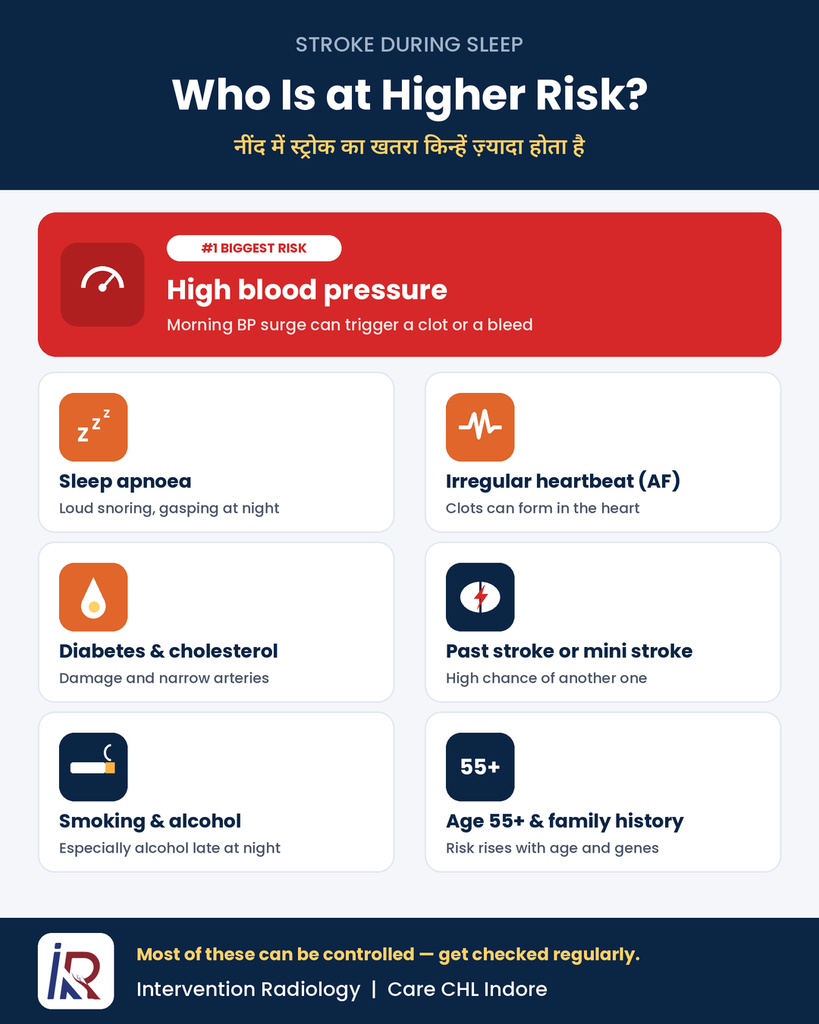
Anyone can have a stroke, but the risk is higher if you have:
- High blood pressure — the single biggest risk factor for stroke
- Diabetes — damages blood vessels over time
- High cholesterol — builds plaque in arteries
- Atrial fibrillation or other heart rhythm problems
- Sleep apnoea — loud snoring, gasping at night, daytime sleepiness
- A previous stroke or TIA (mini stroke)
- Smoking or tobacco use in any form
- Heavy alcohol use, especially in the evening
- Obesity and an inactive lifestyle
- Age above 55, though strokes are increasingly seen in younger adults
- Family history of stroke or heart disease
The more of these factors you have, the higher the risk. The good news is that most of them can be controlled with treatment and lifestyle changes.
Sleep Apnoea and Stroke: A Hidden Link
Obstructive sleep apnoea is one of the most under-recognised risk factors for stroke during sleep. During each pause in breathing, oxygen levels fall and blood pressure jumps. Over months and years, this damages blood vessels and can trigger AF.
If you or your partner notice loud snoring, choking or gasping at night, morning headaches or daytime sleepiness, ask your doctor about a sleep study. Treating sleep apnoea can lower stroke risk.
Symptoms of a Stroke in Your Sleep: What to Check in the Morning
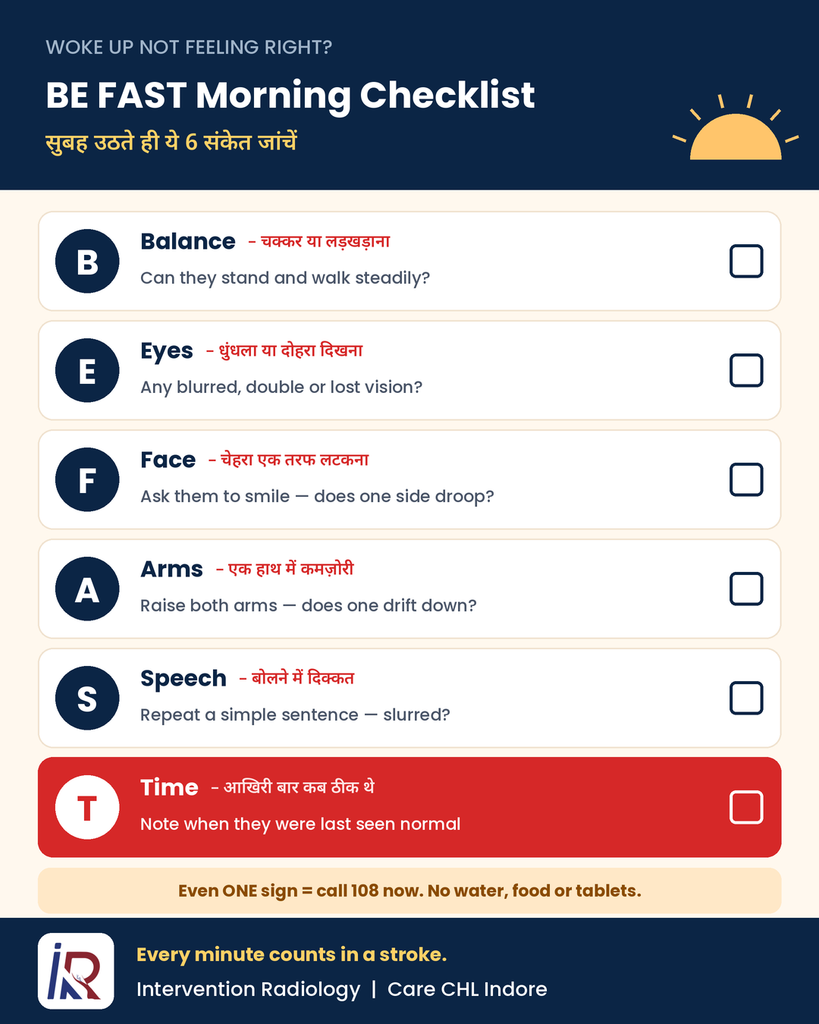
If someone wakes up “not right”, use the BE FAST check:
- B – Balance: Sudden dizziness, trouble standing or walking
- E – Eyes: Blurred, double or lost vision in one or both eyes
- F – Face: One side of the face droops when they smile
- A – Arms: One arm or leg is weak, numb or drifts down
- S – Speech: Slurred speech, wrong words, or cannot understand you
- T – Time: Call for help immediately and note when they were last seen normal
Other signs that can point to a stroke during sleep:
- Difficulty waking up, or being unusually drowsy and confused
- A sudden, severe headache — often described as “the worst headache of my life” (can signal a brain bleed)
- Vomiting with headache or dizziness
- Wetting the bed when this has never happened before
- Unusual, noisy or irregular breathing that a partner notices at night
Even one of these signs is enough to treat it as an emergency.
Also Read: Who is the Best Neuro Doctor for Stroke Treatment | 2026
Can You Have a Stroke in Your Sleep and Not Know It?
Yes. Some strokes are small and affect parts of the brain that do not control obvious functions like movement or speech. These are sometimes called silent strokes. They are often found by chance on a CT or MRI scan done for another reason.
A silent stroke may not cause clear symptoms, but it is still important. It shows that the blood vessels are at risk, and people who have had silent strokes have a higher chance of a bigger stroke later. Over time, several silent strokes can also affect memory and thinking.
Can You Have a Stroke in Your Sleep and Wake Up Fine?
Sometimes, yes — and this is exactly why it is risky to ignore.
- A mini stroke (TIA) during the night may cause brief symptoms that disappear by morning.
- A small stroke may cause only mild symptoms, like slight numbness or clumsiness, that the person brushes off.
Waking up “fine” does not mean nothing happened. A TIA is a warning that a major stroke may follow, often within days. If you notice even brief, mild stroke-like symptoms on waking, get checked the same day.
Mini Stroke in Sleep: Symptoms to Watch
A TIA during sleep may leave clues in the morning, such as:
- Temporary weakness or tingling on one side that improves within minutes or hours
- Brief trouble finding words or understanding speech
- Short-lived blurred or lost vision in one eye
- A feeling of imbalance that settles
Because these symptoms fade, many people do not seek help. This is a missed chance to prevent a major stroke.
What to Do if Someone Wakes Up With Stroke Symptoms
Do this immediately:
- Call 108 or take the person straight to a hospital that can treat stroke 24×7 — one with CT/MRI and a cath lab.
- Note the “last known well” time — when they went to bed, or if anyone saw them normal during the night (for example, a bathroom trip at 3 a.m.). This can change which treatments are possible.
- Lay them on their side if they are drowsy or vomiting, to protect the airway.
- Carry a list of medicines, especially blood thinners, and any old reports.
Do NOT do this:
- Do not wait to “see if it gets better”
- Do not give water, food or tablets — swallowing may be affected
- Do not try home remedies, massage or pricking the fingers
- Do not go to a clinic that has no CT/MRI facility; it wastes time
Can a Stroke That Happens During Sleep Be Treated?
Yes. Modern imaging has changed what is possible for wake-up strokes.
In the past, if the start time of a stroke was unknown, many patients were not offered clot-removing treatment. Today, doctors look at the brain itself, not just the clock.
- MRI can show whether a stroke is likely recent, which can allow clot-dissolving medicine even when the start time is unknown.
- CT perfusion shows which brain tissue is already damaged and which is still at risk but can be saved.
Based on these scans, treatment options include:
| Treatment | How it works | Time window |
|---|---|---|
| Clot-dissolving medicine | Given through a vein to break down the clot | Usually within 4.5 hours, or unknown onset if MRI suggests a recent stroke |
| Mechanical thrombectomy | An Interventional Radiologist removes the clot through a thin catheter | Up to 24 hours in selected patients, based on imaging |
| Supportive care | Controls BP, sugar, breathing and swallowing; prevents complications | All patients |
How Interventional Radiology Helps Save Lives
For strokes caused by a blockage in a large brain artery, mechanical thrombectomy can be life-saving. It is performed by an Interventional Radiologist:
- A tiny puncture is made in the groin or wrist — no opening of the skull.
- A thin catheter is guided through the blood vessels up to the brain using live X-ray.
- A special device grips or sucks out the clot.
- Blood flow to the brain returns, often within minutes of removing the clot.
In selected patients, this can be done up to 24 hours after the person was last seen well — which makes it especially important for strokes that happen during sleep. The sooner it is done, the more brain can be saved.
For some brain bleeds caused by abnormal blood vessels, such as aneurysms, Interventional Radiologists can also seal the vessel from inside using tiny coils or devices, helping to prevent further bleeding.
How to Avoid a Stroke While Sleeping: 8 Practical Tips
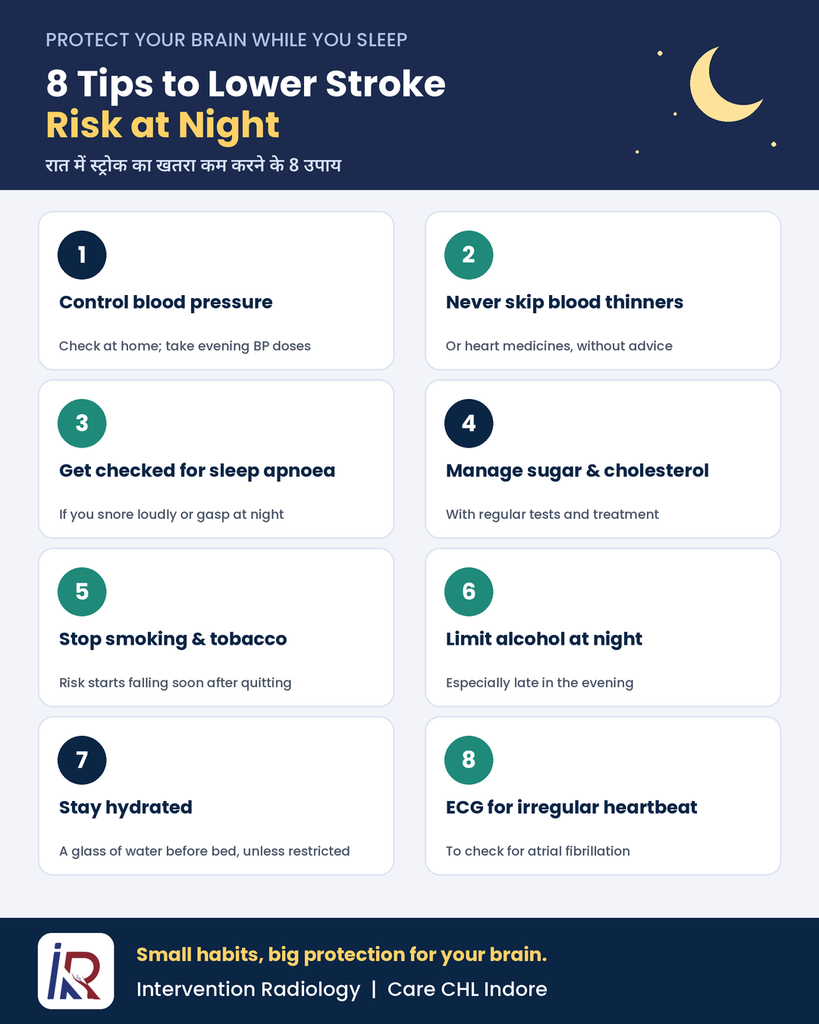
You cannot control every risk, but these steps can lower the chance of a stroke at night:
- Control your blood pressure. Check it regularly at home and take BP medicines exactly as prescribed, including evening doses.
- Never skip blood thinners or heart medicines without your doctor’s advice.
- Get checked for sleep apnoea if you snore loudly, gasp at night or feel sleepy during the day.
- Manage diabetes and cholesterol with regular tests and treatment.
- Stop smoking and all tobacco. The risk starts falling soon after quitting.
- Limit alcohol, especially late in the evening.
- Stay hydrated during the day and have a glass of water before bed unless your doctor has restricted fluids.
- Get an ECG if you feel palpitations or an irregular heartbeat, to check for atrial fibrillation.
If you live alone and have several risk factors, consider asking a family member to check on you each morning, or keep your phone within reach at night.
How Long Does It Take to Recover From a Brain Stroke?
Recovery is different for every person. It depends on how big the stroke was, where it happened and how quickly treatment started.
| Time after stroke | What usually happens |
|---|---|
| First days | Hospital care; preventing complications; early physiotherapy |
| First 3 months | Fastest improvement in movement, speech and daily activities |
| 3–6 months | Continued gains with regular therapy |
| 6–12 months and beyond | Slower but steady progress; adapting to any lasting changes |
Physiotherapy, speech therapy and occupational therapy play a big role. Family support and staying active also make a real difference.
What Happens 2 Years After a Stroke?
Two years after a stroke, many people have reached a stable level of recovery, though small improvements can still continue with practice. The focus shifts to:
- Preventing another stroke — the risk of a second stroke is highest in the first year but continues afterwards
- Regular follow-up for BP, sugar, cholesterol and heart rhythm
- Staying active and continuing home exercises
- Watching mood and memory, as low mood and memory changes are common after stroke and can be treated
The earlier the first stroke was treated, the better the long-term outcome usually is.
Stroke Treatment in Indore at Care CHL Indore
When a stroke happens during sleep, the hospital you reach first can decide the outcome. The Intervention Radiology Indore team at Care CHL Indore provides image-guided stroke care, including mechanical thrombectomy for eligible patients with large artery blockages.
Dr. Alok Kumar Udiya, Interventional Radiologist, works with emergency physicians and neurologists so that patients can be scanned quickly, assessed for clot-removal treatment, and taken to the cath lab without delay when needed.
Frequently Asked Questions
Can you die from a stroke in your sleep? Yes, it can happen, especially with a very large stroke, a brain bleed or a brainstem stroke that goes unnoticed for hours. However, most people who have a stroke during sleep wake up with symptoms and can be treated if they reach hospital quickly.
Can you have a stroke in your sleep and wake up fine? Sometimes. A mini stroke (TIA) or a small stroke may cause symptoms that fade by morning. Even then, it is a warning sign and needs same-day medical attention.
Can you have a stroke in your sleep and not know it? Yes. Some small “silent strokes” cause no obvious symptoms and are found only on scans. They still raise the risk of a bigger stroke later.
What are the symptoms of having a stroke in your sleep? Waking up with face droop, weakness on one side, slurred speech, vision problems, loss of balance, confusion or a sudden severe headache.
Is a wake-up stroke dangerous? Yes. The main danger is delay, because no one knows exactly when it started. With modern scans, many wake-up strokes can still be treated.
How can I avoid a stroke while sleeping? Control blood pressure, take medicines regularly, treat sleep apnoea, manage diabetes and cholesterol, stop smoking, limit alcohol and stay hydrated.
What should I do if someone wakes up with stroke symptoms? Call 108 or go straight to a stroke-ready hospital. Note when they were last seen normal. Do not give food, water or tablets.
Where can I get stroke treatment in Indore? Stroke treatment, including mechanical thrombectomy for eligible patients, is available at Care CHL Indore through the Intervention Radiology team led by Dr. Alok Kumar Udiya, Interventional Radiologist.
Conclusion
So, can you die from a stroke in your sleep? It is possible, but it is not inevitable. Most of the danger comes from lost time — the hours when no one realises a stroke has happened.
Knowing your risk factors, controlling blood pressure, treating sleep apnoea and acting fast on morning warning signs can save lives. Today, even strokes that happen during sleep can often be treated with modern imaging and clot-removal procedures.
Woke up with stroke signs, or worried about your risk? Visit Care CHL Indore and consult the Intervention Radiology team without delay.
Disclaimer: This article is for general awareness only and is not a substitute for medical advice. Stroke is a medical emergency — if you notice stroke symptoms, call 108 or go to the nearest stroke-ready hospital immediately.