
“My feet burn at night.” “My calves hurt when I walk to the market.” “My toes feel cold all the time.”
If you have diabetes, you may have said one of these. Most people assume all foot pain in diabetes is the same. But foot pain in diabetes usually comes from two very different problems: diabetic nerve pain (damaged nerves) and poor blood circulation in the feet (narrowed or blocked arteries).
The difference matters. Nerve pain is mainly managed with sugar control and medicines. Poor circulation, if ignored, can lead to non-healing wounds, gangrene and even amputation — but it can often be treated by opening the blocked arteries.
This guide explains how to tell the two apart, which tests help, and when to see a specialist.
Why Does Diabetes Affect the Feet?
High blood sugar over many years damages the body in two main ways:
- It damages the nerves. The longest nerves in the body — those going to the feet — are affected first. This is called diabetic peripheral neuropathy, or simply diabetic nerve pain.
- It damages the arteries. Fat and calcium build up inside the leg arteries, making them narrow or blocked. This is called peripheral arterial disease (PAD), or poor blood circulation in the feet.
Many people with diabetes have both problems at the same time. And here is the danger: nerve damage can hide the warning pain of poor circulation, so a serious blockage may go unnoticed until a wound appears.
Other things increase the risk of both problems: smoking, high blood pressure, high cholesterol, kidney disease, older age and long duration of diabetes.
Also Read: Save Limb, Save Life: How Diabetic Foot Ulcers Are Treated Without Amputation
Signs of Diabetic Nerve Pain
Diabetic nerve pain usually starts in the toes and slowly moves up, often affecting both feet equally — like wearing invisible socks.
- Burning, tingling or “pins and needles” in the feet
- Numbness — not feeling a stone in the shoe, or hot water while bathing
- Sharp, shooting or electric-shock pains
- Pain that is worse at night or at rest, sometimes eased by walking
- Feet are very sensitive — even a bedsheet can hurt
- Feet usually look normal in colour and feel warm
- Foot pulses are usually present
Also Read: How to Save a Diabetic Foot From Amputation | Modern Minimally Invasive Solutions
Signs of Poor Blood Circulation in the Feet
Poor circulation happens when the arteries cannot carry enough blood to the legs and feet. Signs include:
- Cramping or aching in the calf, thigh or hip while walking that goes away within a few minutes of rest (called claudication)
- Pain in the toes or front of the foot at night, which eases when the leg hangs down from the bed
- Cold feet, especially one foot colder than the other
- Pale, bluish or dark skin on the toes
- Shiny skin, hair loss on legs and toes, thick slow-growing toenails
- Weak or absent pulses in the feet
- Wounds that do not heal in 2–3 weeks
- Blackening of toes (gangrene) in advanced cases
Also Read: Diabetic Foot: Early Signs, Warning Symptoms & When to See a Specialist
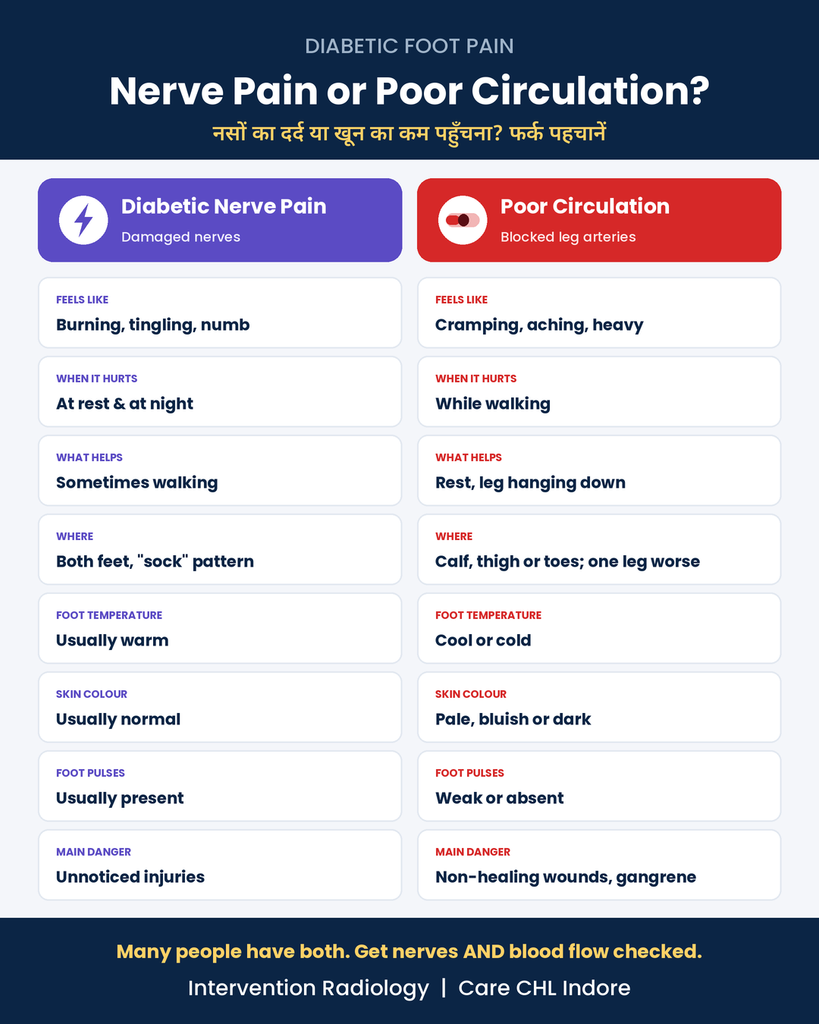
Diabetic Nerve Pain vs Poor Blood Circulation: Key Differences
| Feature | Diabetic nerve pain | Poor blood circulation in the feet |
|---|---|---|
| Main cause | Damaged nerves | Narrowed or blocked arteries |
| Type of pain | Burning, tingling, shooting, numb | Cramping, aching, heavy |
| When it hurts | At rest and at night | While walking; at night in severe cases |
| What helps | Sometimes walking or moving | Rest; hanging the leg down |
| Where | Both feet, toes upwards, in a “sock” pattern | Calf, thigh, buttock or toes; often one leg worse |
| Foot temperature | Usually warm | Cool or cold |
| Skin colour | Usually normal | Pale, bluish or dark |
| Foot pulses | Usually present | Weak or absent |
| Main danger | Unnoticed injuries due to numbness | Non-healing wounds, gangrene, amputation |
Important: Many people have both conditions together. If you have diabetes and foot pain, get both nerves and blood flow checked.
Tests That Help Tell the Difference
For diabetic nerve pain:
- Monofilament test — a thin nylon thread is pressed on the foot to check feeling.
- Vibration test — a tuning fork checks vibration sense.
- Nerve conduction study — measures how well nerves carry signals, if needed.
For poor blood circulation in the feet:
- Pulse check of the feet and ankles.
- Ankle-brachial index (ABI) — compares blood pressure at the ankle and arm. In diabetes, hardened arteries can give a falsely normal reading, so toe pressure may also be checked.
- Arterial Doppler ultrasound — shows where the arteries are narrowed or blocked.
- CT angiography — a detailed map of the leg arteries, useful for planning treatment.
Treatment for Diabetic Nerve Pain
There is no quick fix, but symptoms can be controlled and further damage slowed:
- Good blood sugar control (HbA1c target as advised by your doctor)
- Medicines specifically for nerve pain, prescribed by your doctor
- Control of BP and cholesterol, and stopping smoking and alcohol
- Daily foot checks and protective footwear
Treatment for Poor Blood Circulation in the Feet
Treatment depends on how severe the blockage is:
- Lifestyle and medicines: Quit smoking, control sugar, BP and cholesterol, and take blood-thinning or cholesterol medicines as prescribed.
- Supervised walking: Regular walking can improve symptoms in mild cases.
- Opening the blocked artery: When there is severe pain, a non-healing wound or gangrene, the blocked artery needs to be opened to save the limb.
How Interventional Radiology Helps Save Feet
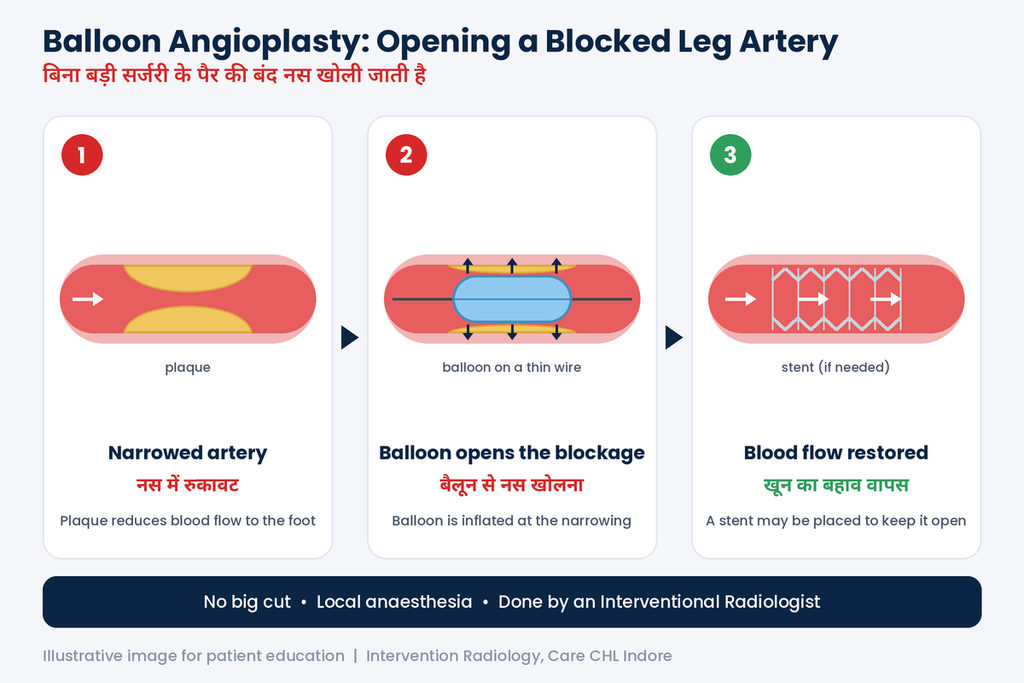
An Interventional Radiologist can open blocked leg arteries from inside — without a big surgical cut. This is called peripheral angioplasty.
Here is how it works, in simple steps:
- A small puncture is made in the groin (or sometimes the foot) under local anaesthesia.
- A thin wire and catheter are guided to the blocked artery using live X-ray.
- A tiny balloon is inflated to open the narrowing. A stent may be placed if needed.
- Blood flow to the foot improves, often helping wounds heal and reducing pain.
In people with diabetes, blockages are often in the small arteries below the knee. Below-the-knee angioplasty can restore flow to the foot and plays an important role in limb salvage — helping avoid major amputation in many patients.
Most patients go home within a day or two. Follow-up with your diabetologist and wound-care team remains important.
Daily Foot Care Tips for People With Diabetes
- Check both feet every day for cuts, blisters, redness or colour change. Use a mirror or ask a family member.
- Wash feet in lukewarm water — test the temperature with your elbow, not your foot.
- Dry well between the toes and apply moisturiser, but not between the toes.
- Never walk barefoot, even at home or in temples.
- Wear soft, well-fitting footwear and check inside shoes before wearing.
- Cut nails straight across. Do not cut corns or calluses yourself.
- Avoid hot water bags or heaters on numb feet.
- Stop smoking — it is one of the biggest causes of blocked leg arteries.
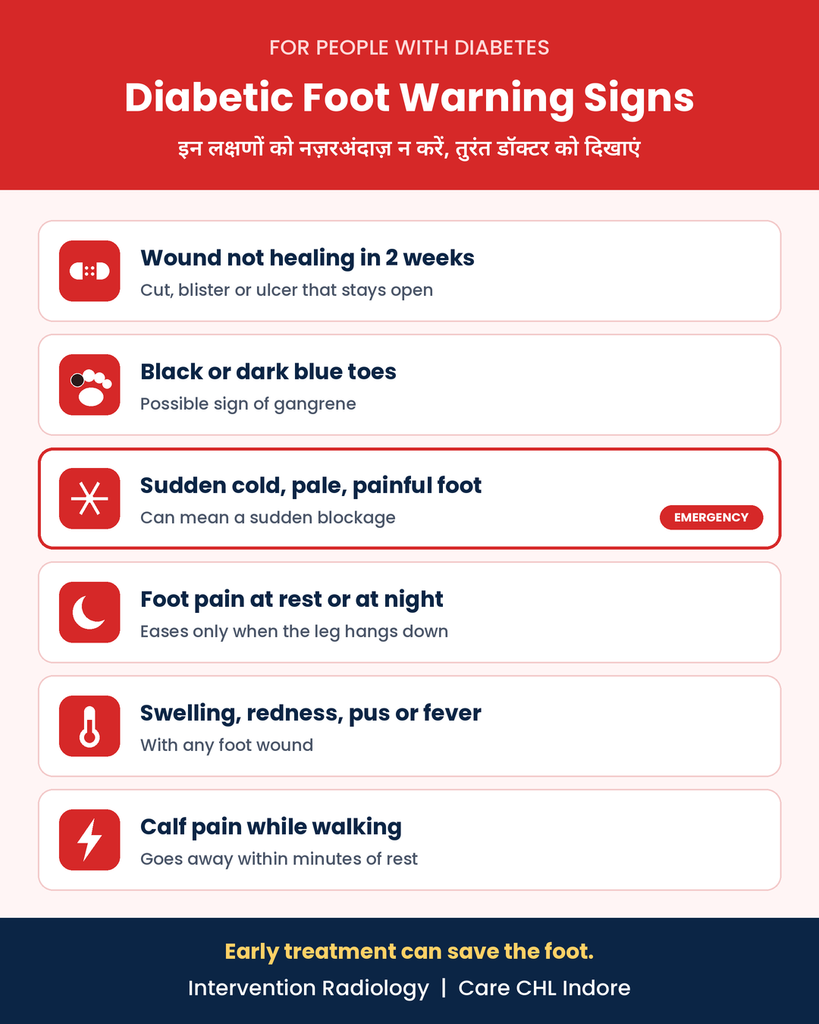
Red Flags: See a Doctor Urgently
- A wound, blister or ulcer that is not healing in 2 weeks
- Black or dark blue toes
- Sudden cold, pale, painful or numb foot — this is an emergency
- Pain in the foot at rest or at night that improves only when the leg hangs down
- Swelling, redness, pus or fever with a foot wound
Early treatment can save the foot. Delay can lead to amputation.
Poor Blood Circulation Treatment in Indore at Care CHL Indore
If you have diabetes and signs of poor blood circulation in the feet, the Intervention Radiology Indore team at Care CHL Indore can help assess and treat blocked leg arteries.
Dr. Alok Kumar Udiya, Interventional Radiologist, performs image-guided procedures such as peripheral angioplasty to restore blood flow, working with diabetologists, vascular and wound-care teams to give each patient the best chance of saving the limb.
Frequently Asked Questions
How do I know if my foot pain is nerve pain or poor circulation? Nerve pain usually burns or tingles at rest and at night in both feet. Poor circulation usually causes cramping while walking that eases with rest, along with cold feet and weak pulses. A doctor can confirm with simple tests.
Can I have both diabetic nerve pain and poor circulation? Yes. Many people with diabetes have both. Nerve damage can also hide the pain of poor circulation, so check-ups are important.
Is poor blood circulation in the feet dangerous? Yes, if untreated. It can cause non-healing wounds, infection and gangrene. Early treatment can prevent serious complications.
Can blocked leg arteries be opened without surgery? In many cases, yes. Angioplasty, done by an Interventional Radiologist through a small puncture, can open blocked arteries without a large surgical cut.
Can diabetic nerve pain be cured? Nerve damage is usually long-term, but good sugar control, medicines and foot care can reduce pain and slow further damage.
Where can I get treatment for poor blood circulation in the feet in Indore? Treatment is available at Care CHL Indore through the Intervention Radiology team led by Dr. Alok Kumar Udiya, Interventional Radiologist.
What is the cost of angioplasty for leg arteries in Indore? Cost depends on the number and location of blockages, devices used, hospital stay and insurance cover. Please contact Care CHL Indore directly for an estimate.
Conclusion
Burning, tingling feet usually point to diabetic nerve pain. Cramping calves while walking, cold feet and slow-healing wounds point to poor blood circulation in the feet. Many people have both.
Knowing the difference helps you get the right treatment at the right time. Nerve pain needs careful control. Poor circulation may need its blocked arteries opened to save the foot.
Diabetic with foot pain, cold feet or a wound that won’t heal? Consult the Intervention Radiology team at Care CHL Indore.
Disclaimer: This article is for general awareness only and is not a substitute for medical advice. Please consult your doctor for advice specific to your condition.