
For years, your periods may have controlled your life. Heavy bleeding, clots, changing pads every hour, painful cramps, and constant tiredness.
If fibroids are the cause, fibroid embolisation can help. But one of the most common questions women ask is: “What will happen to my periods after the procedure?”
For most women, periods become lighter, shorter and less painful after fibroid embolisation — usually within the first few cycles, with steady improvement over 3 to 6 months. The first one or two periods can be a little unpredictable, and that is normal.
This guide explains, month by month, how your periods may change after fibroid embolisation, what is normal, and when to call your doctor.
What Is Fibroid Embolisation?
Fibroids are non-cancerous growths in the uterus. They can cause heavy periods, long periods, pelvic pain, pressure on the bladder and a swollen tummy.
Fibroid embolisation, also called uterine fibroid embolisation (UFE) or uterine artery embolisation (UAE), is a minimally invasive procedure done by an Interventional Radiologist.
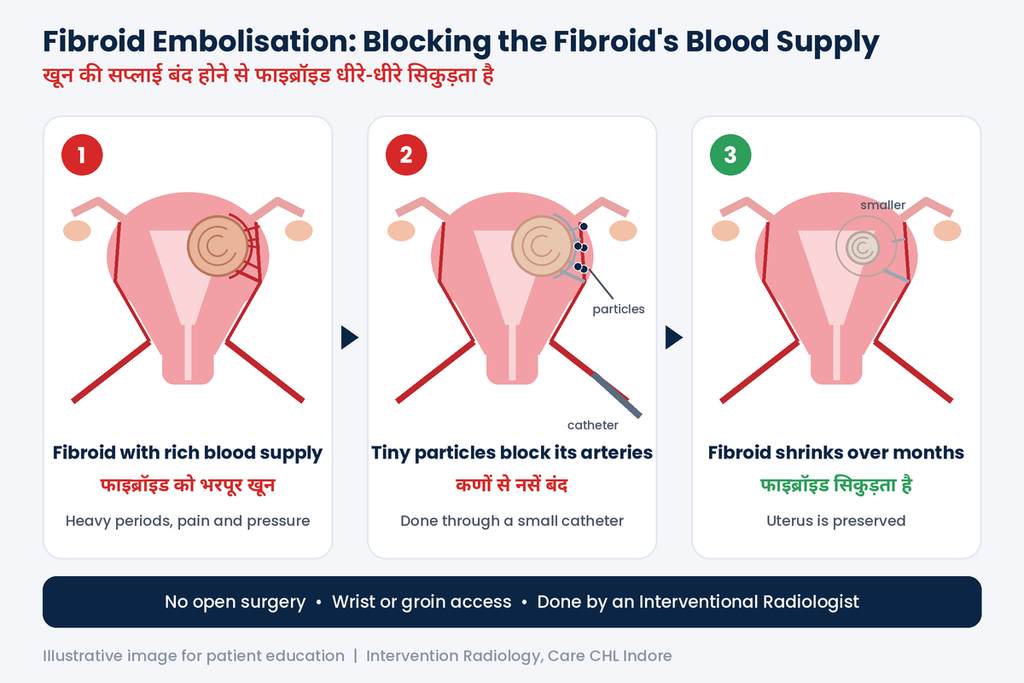
Here is how it works in simple steps:
- A tiny puncture is made at the wrist or groin under local anaesthesia.
- A thin catheter is guided to the arteries that supply the uterus.
- Tiny particles are injected to block the blood supply to the fibroids.
- Without blood supply, the fibroids shrink and soften over the following months.
There is no cut on the tummy, the uterus is preserved, and most women go home within a day.
Also Read: Varicocele Specialists in India: Who to Consult and Why
Why Do Periods Change After Fibroid Embolisation?
Fibroids increase the size of the uterus and the surface area of its lining. They also have a rich blood supply. Both of these make periods heavier and longer.
After embolisation, the fibroids lose their blood supply and start shrinking. As they shrink, the uterus becomes smaller and the lining bleeds less. This is why heavy periods usually improve.
The healthy part of the uterus keeps its blood supply through small natural connections, so it continues to work normally.
Also Read: Pre-Operative Embolization of Tumors: A Safe Way to Make Surgery Easier and Safer
How Your Periods May Change: Month by Month
Every woman is different, but most follow a similar pattern.
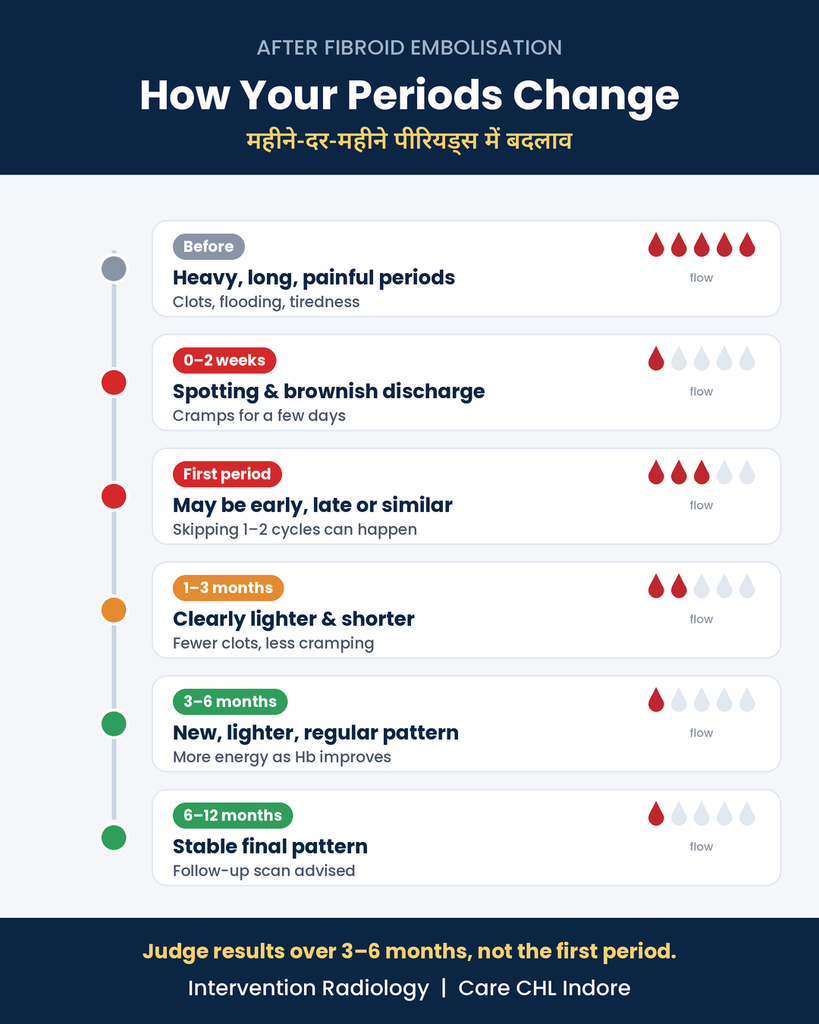
First 2 weeks after the procedure
- Light spotting or a brownish discharge is common.
- Some women get a period-like bleed a few days after the procedure, even if their period is not due.
- Cramping pain is usually strongest in the first few days and is managed with medicines.
Your first period (usually within 4–6 weeks)
- The first period may come on time, early or late.
- It may be lighter — or sometimes similar to before. Do not worry if the first period is not much different.
- A few women skip one or two cycles. This is usually temporary.
1 to 3 months
- Most women notice clearly lighter and shorter periods.
- Fewer clots and less flooding.
- Period cramps often reduce.
- A watery or brownish discharge may continue on and off.
3 to 6 months
- Periods usually settle into a new, more regular and lighter pattern.
- Energy levels improve as anaemia (low haemoglobin) gets better.
- Pressure symptoms such as frequent urination and bloating also start to ease as fibroids shrink.
6 to 12 months
- Fibroids continue to shrink.
- Most women have their final, stable period pattern by now.
- A follow-up scan is usually done to check how much the fibroids have reduced.
| Time after procedure | What you may notice | Is it normal? |
|---|---|---|
| 0–2 weeks | Spotting, brownish discharge, cramps | Yes, expected |
| First period | Early, late, or not much change | Yes, usually settles |
| 1–3 months | Lighter, shorter periods; fewer clots | Yes, typical improvement |
| 3–6 months | Stable, lighter periods; more energy | Yes, main benefit seen |
| 6–12 months | Final period pattern; fibroids smaller | Yes, follow-up scan advised |
Key takeaway: Judge the result over 3 to 6 months, not by the first period alone.
Also Read: Getting a CT-Guided Lung Biopsy in Indore: A Complete Patient Guide
Other Changes You May Notice
Vaginal discharge A watery, pinkish or brownish discharge can continue for a few weeks. This is part of normal healing. If it becomes foul-smelling or comes with fever, contact your doctor.
Passing fibroid tissue If a fibroid is close to the inner lining of the uterus, small pieces may come out with a period. This can feel like a heavy period with cramps. Inform your doctor if this happens, as a check-up may be needed.
Less period pain Many women find that period cramps and pelvic heaviness reduce once the fibroids shrink.
Better energy With less blood loss every month, haemoglobin levels often improve, and tiredness, breathlessness and dizziness get better.
Can Fibroid Embolisation Stop Periods or Cause Early Menopause?
For most women, periods continue normally after fibroid embolisation. The procedure targets the fibroids, not the ovaries.
However, there is a small risk that periods may stop permanently because of reduced ovarian function. This risk is low in younger women and higher in women who are already close to natural menopause, usually in their mid-to-late 40s.
Your Interventional Radiologist will discuss your personal risk before the procedure.
What About Pregnancy?
Pregnancy is possible after fibroid embolisation, and many women have had healthy pregnancies after it. However, if you are planning a pregnancy soon, discuss all your options in detail with your doctor before choosing a treatment, as another approach may suit you better.
When Should You Call Your Doctor?
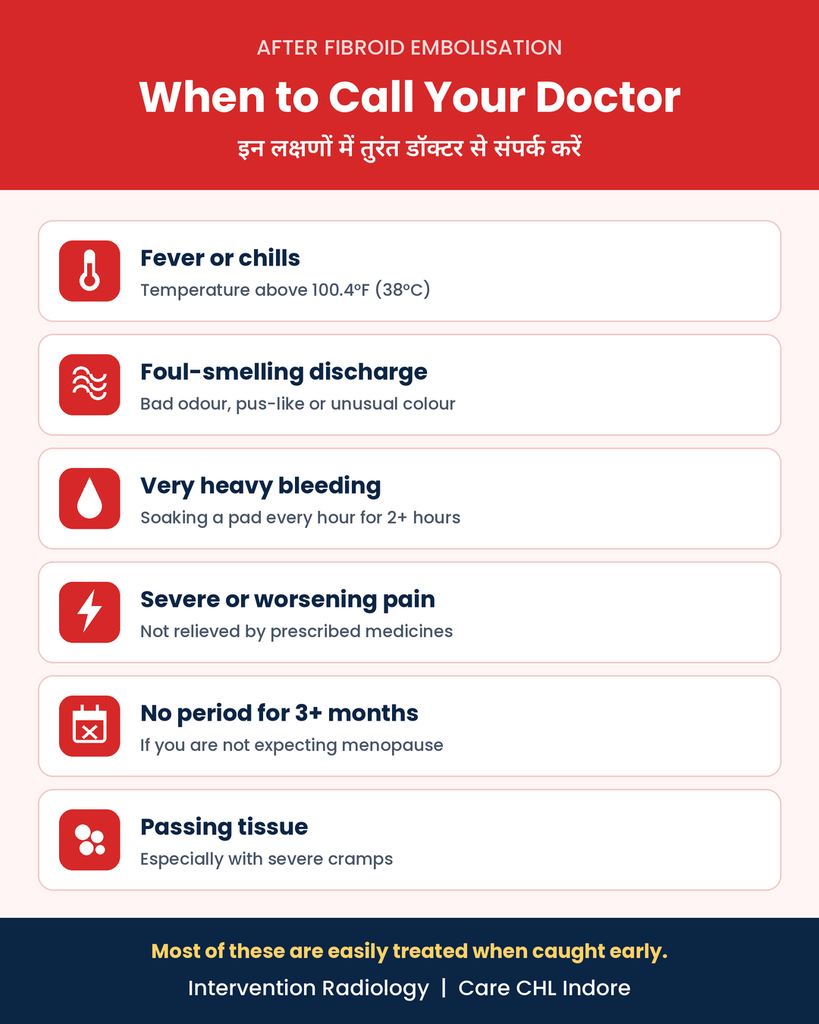
Contact your doctor or the hospital promptly if you have:
- Fever above 100.4°F (38°C) or chills
- Foul-smelling vaginal discharge
- Very heavy bleeding — soaking a pad every hour for two hours or more
- Severe or worsening pain not controlled by prescribed medicines
- No period for 3 months or more, if you are not expecting menopause
- Passing tissue with severe cramps
Most of these can be treated easily when caught early.
Tips for a Smooth Recovery
- Take your pain medicines on time in the first few days.
- Drink plenty of water and eat fibre-rich food to avoid constipation.
- Use sanitary pads, not tampons or menstrual cups, until your doctor says it is fine.
- Avoid sexual intercourse until your doctor advises, usually for a few weeks.
- Keep a simple period diary — date, flow and pain level — to share at follow-up.
- Go for your follow-up visits and scans as advised.
Fibroid Embolisation in Indore at Care CHL Indore
If heavy periods caused by fibroids are affecting your daily life, fibroid embolisation in Indore offers a uterus-preserving option without open surgery.
At Care CHL Indore, the Intervention Radiology Indore team, led by Dr. Alok Kumar Udiya, Interventional Radiologist, performs fibroid embolisation for suitable patients. The team works closely with gynaecologists to check whether embolisation is the right choice for you and to guide you through recovery and follow-up.
Frequently Asked Questions
Will my periods become lighter after fibroid embolisation? For most women, yes. Periods usually become lighter and shorter within the first few cycles, with the full benefit seen over 3 to 6 months.
Why is my first period after fibroid embolisation heavy? The first one or two periods can be unpredictable while the uterus heals. This is usually temporary. Contact your doctor if bleeding is very heavy.
Is it normal to miss a period after fibroid embolisation? Skipping one or two cycles can happen and is usually temporary. If you miss periods for 3 months or more, talk to your doctor.
How long does discharge last after fibroid embolisation? A watery or brownish discharge may continue on and off for a few weeks. Foul-smelling discharge or fever needs a check-up.
Can fibroid embolisation cause menopause? The risk is small. It is higher in women who are already close to natural menopause. Your doctor will explain your personal risk.
Will period pain reduce after fibroid embolisation? Many women notice less cramping and pelvic heaviness as the fibroids shrink.
Where can I get fibroid embolisation in Indore? Fibroid embolisation is available at Care CHL Indore through the Intervention Radiology team led by Dr. Alok Kumar Udiya, Interventional Radiologist.
What is the cost of fibroid embolisation in Indore? Cost depends on the number and size of fibroids, materials used, hospital stay and insurance cover. Please contact Care CHL Indore directly for an estimate.
Conclusion
Changes in your periods after fibroid embolisation are expected — and for most women, they are changes for the better. Lighter flow, fewer clots, less pain and more energy usually follow within a few months.
The first period or two may be unpredictable, so be patient and keep track of your cycles. If something does not feel right, contact your care team.
Struggling with heavy periods due to fibroids? Consult the Intervention Radiology team at Care CHL Indore to see if fibroid embolisation in Indore is right for you.
Disclaimer: This article is for general awareness only and is not a substitute for medical advice. Please consult your doctor for advice specific to your condition.