
By Dr. Alok Kumar Udiya, Interventional Neuro Radiologist, Indore
A small cut on the foot does not sound like something that could end in the loss of a leg. Yet for a person living with diabetes, that is exactly what can happen if the wound is ignored. Every year, thousands of diabetic patients lose a toe, a foot, or a leg, not because their diabetes was impossible to treat, but because a small, painless wound was noticed too late.
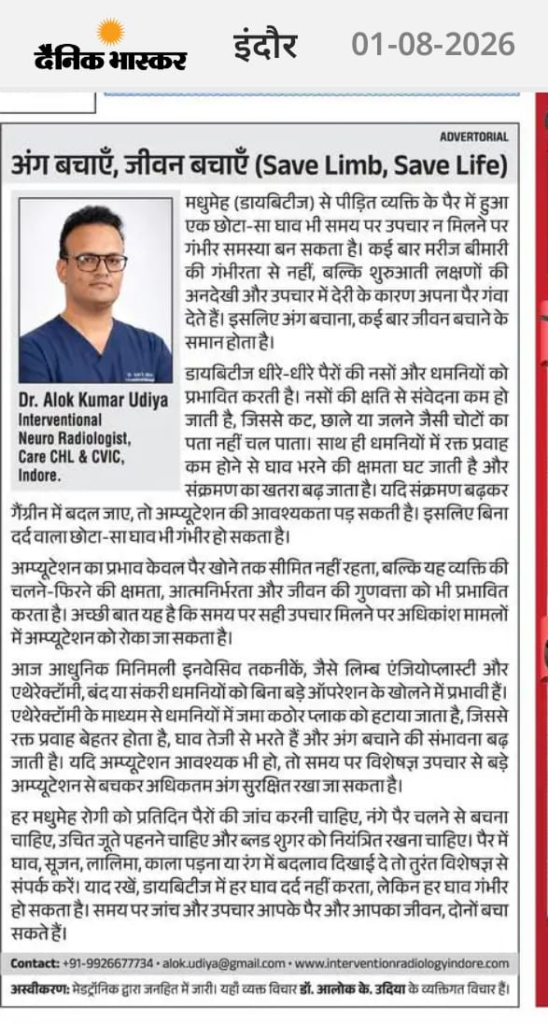
This is the message behind a recent public awareness article published in Dainik Bhaskar, Indore, titled “Save Limb, Save Life.” The article explains a truth that every diabetic patient and their family needs to understand: saving a limb is, in many cases, the same as saving a life. This blog expands on that message in simple, easy-to-understand language, covering why diabetic foot ulcers happen, why they turn dangerous so quickly, and how modern, minimally invasive treatments like limb angioplasty and atherectomy are now helping doctors save feet and legs that, in the past, may have been amputated.
What Is a Diabetic Foot Ulcer, and Why Does It Happen?
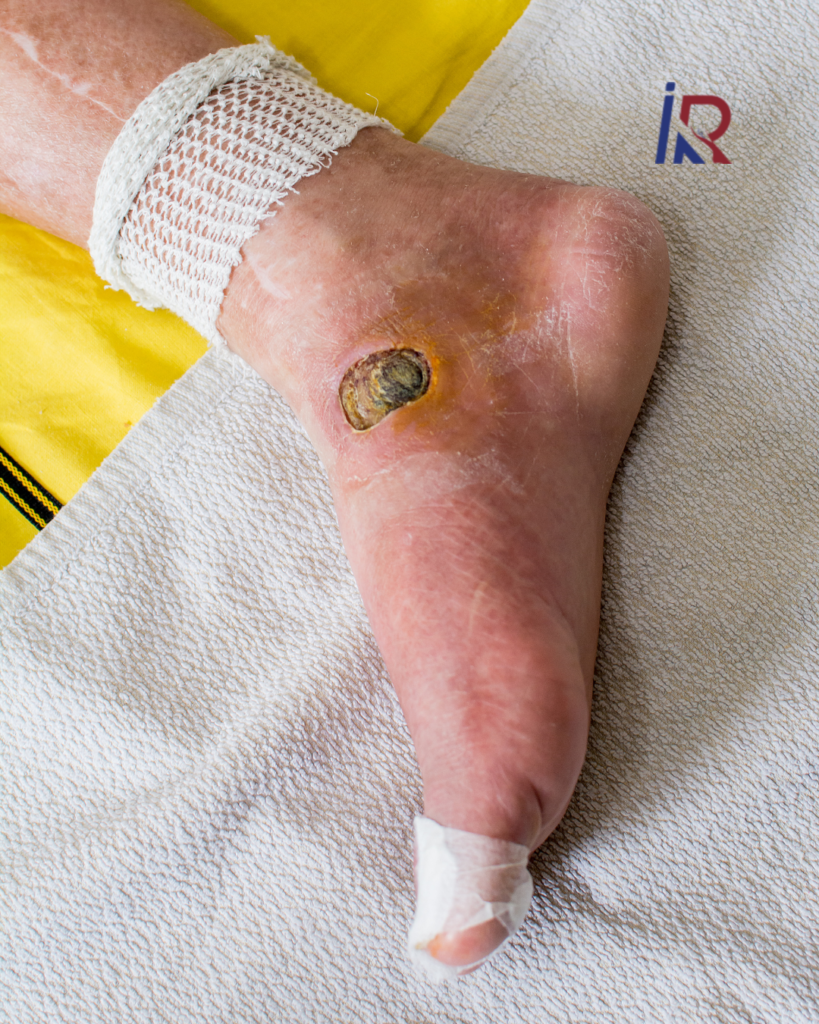
A diabetic foot ulcer is an open wound or sore that develops, most often on the sole, toes, or sides of the foot, in a person with diabetes. It may start as something as small as a blister, a crack in dry skin, a corn, or a minor cut from an ill-fitting shoe. In a person without diabetes, such a wound would usually heal within days. In a person with poorly controlled diabetes, it can linger for weeks, become infected, and in severe cases, threaten the limb itself.
There are two main reasons this happens, and both are direct effects of long-term high blood sugar on the body.
The first is nerve damage, known as diabetic neuropathy. Over time, high blood sugar damages the small nerves in the feet, reducing sensation. A patient may step on a nail, wear a shoe that rubs a blister, or burn their foot on a hot surface, and feel little or nothing. Without pain to serve as a warning sign, the injury often goes unnoticed until it has already become infected.
The second is damage to blood vessels, known as peripheral artery disease, or PAD. Diabetes causes the arteries supplying the legs and feet to gradually narrow and harden. With less blood reaching the foot, the tissue receives less oxygen and fewer of the nutrients needed for healing. Even a minor wound can then take far longer than normal to close, and the reduced blood flow also makes it harder for the body to fight off infection.
When neuropathy and poor circulation occur together, which is common in long-standing diabetes, a small, painless wound can quietly progress into a large, infected ulcer before the patient even realises something is wrong.
Also Read: How to Save a Diabetic Foot From Amputation | Modern Minimally Invasive Solutions
How Common Is This Problem, Really?
Diabetic foot ulcers are far more common than most people assume, and the statistics make it clear why this deserves serious attention.
Research shows that a person with type 1 or type 2 diabetes has a lifetime risk of developing a foot ulcer of up to 25 percent, meaning roughly one in every four diabetic patients may face this problem at some point. [EXTERNAL LINK: American Diabetes Association guidance on diabetic foot care] Once an ulcer forms, the risk does not stop there. Studies show that around one in five patients with a diabetic foot ulcer will eventually require some form of amputation, and in certain hospital-based studies of more severe, admitted cases, this figure has been reported to be as high as 31 percent.
Perhaps the most striking statistic is this: the age-adjusted rate of lower-limb amputation is estimated to be about 15 times greater in people with diabetes than in the general population. Diabetic foot ulcers are also responsible for nearly two-thirds of all non-traumatic lower limb amputations performed across Europe and the United States. In other words, most leg amputations that are not caused by accidents or trauma can be traced back to a diabetic foot wound that was not treated in time.
These numbers are not meant to frighten anyone. They are meant to explain exactly why the message “save limb, save life” matters so much, and why early attention to foot health is one of the most powerful things a diabetic patient can do for themselves.
Also Read: Diabetic Foot: Early Signs, Warning Symptoms & When to See a Specialist
Why a Painless Wound Can Still Be Dangerous
One of the most important things every diabetic patient should understand is this: in diabetes, a wound does not need to hurt to be serious.
Because diabetic neuropathy reduces sensation in the feet, many patients simply do not feel pain from a wound that would be quite painful for someone else. This creates a dangerous illusion of safety. A patient may look at a small sore, feel no discomfort, and assume it is nothing to worry about. Meanwhile, underneath the skin, poor circulation is slowing down healing, and bacteria may already be multiplying.
This is precisely why regular, deliberate foot inspection matters so much for diabetic patients, rather than waiting for pain to act as a warning signal. The foot must be checked with the eyes, not just trusted to send a pain signal when something is wrong.
From Small Wound to Big Problem: How Infection Progresses
Understanding how a minor wound can turn into a limb-threatening emergency helps explain why timely treatment matters so much.
It typically begins with a break in the skin, whether from a cut, blister, pressure point, or crack caused by dry skin. Because of reduced sensation, this injury often goes unnoticed and untreated in its early days. With poor blood flow limiting the delivery of oxygen, nutrients, and infection-fighting white blood cells to the area, the wound heals slowly, if at all.
Bacteria can then take hold in the wound, leading to a local infection. If this infection is not brought under control, it can spread deeper into the tissue and, in some cases, to the bone itself, a serious condition called osteomyelitis. In the most severe cases, the tissue supplied by the blocked artery can die completely, a condition known as gangrene. Once gangrene sets in, amputation of the affected toe, foot, or leg often becomes the only way to stop the infection from spreading further and threatening the patient’s life.
The encouraging part of this story is that this progression can be interrupted at almost any stage, provided the patient seeks help in time and receives the right treatment for both the wound and the underlying poor circulation.
Also Read: Top Diabetic Foot Ulcer Treatment Options: Effective Solutions for Healing and Prevention
Why Amputation Is Not Just About Losing a Foot
It is worth pausing to consider what amputation really costs a person, beyond the visible loss of a limb.
Losing a foot or leg significantly affects a person’s ability to walk, work, and care for themselves independently. It can lead to a loss of confidence, depression, and a heavy reliance on family members for daily tasks. Studies consistently show that quality of life drops sharply after a major amputation, and sadly, the risk of further health complications, including the loss of the other limb over time, also increases.
This is exactly why modern medicine has shifted its focus so strongly toward limb salvage, treatments aimed at healing the wound and restoring blood flow, so amputation can be avoided altogether, or at least minimised.
The Modern Solution: Minimally Invasive Limb Salvage
For many years, when poor circulation in the leg reached a critical stage, open bypass surgery, a major operation to reroute blood flow around a blocked artery, was often the only option. This surgery is effective, but it involves general anaesthesia, a large incision, a significant hospital stay, and a long recovery, which is not always suitable for older diabetic patients who often also have heart or kidney conditions.
Today, interventional radiology offers a gentler alternative. Using X-ray and ultrasound imaging for guidance, specialists can reach the blocked or narrowed arteries in the leg through a tiny puncture, usually in the groin or wrist, without any large surgical cut. Two techniques in particular, limb angioplasty and atherectomy, are now central to this approach.
What Is Limb Angioplasty?
Limb angioplasty is a procedure that widens a narrowed or blocked artery in the leg to restore blood flow to the foot. A thin catheter, a small flexible tube, is guided through the blood vessels, under imaging guidance, to the site of the blockage. At the tip of this catheter is a small balloon. Once positioned correctly, the balloon is gently inflated, pressing the blockage outward against the artery wall and widening the passage so blood can flow through more freely. In some cases, a small mesh tube called a stent is left in place afterward to help hold the artery open.
What Is Atherectomy?
Atherectomy takes a different approach to the same problem. Rather than pushing the blockage aside, as angioplasty does, atherectomy physically removes it. A specialised catheter, fitted with a rotating blade, a laser tip, or another cutting mechanism depending on the device used, shaves away or vaporises the hardened plaque that has built up inside the artery wall. This is particularly useful for the kind of heavily calcified, hardened blockages that are common in long-standing diabetic patients, which do not always respond well to balloon angioplasty alone.
In current practice, many specialists use atherectomy first to clear the hardened plaque, followed by a drug-coated balloon angioplasty to further widen the vessel and help keep it open, reserving a stent for cases where it is truly needed.
How These Procedures Help Save the Limb
Both procedures share the same goal: restoring blood flow to the foot. Once circulation improves, several things happen. Oxygen and nutrients reach the wound in far greater supply, allowing it to heal faster. Infection-fighting cells reach the area more effectively, lowering the risk of the infection spreading. And because the tissue is better nourished, the risk of the wound progressing to gangrene drops significantly.
The results seen with this approach are genuinely encouraging. Research on limb-threatening ischemia shows successful limb salvage in more than 80 percent of patients treated with modern revascularisation techniques. Even in the most advanced, “no option” cases of critical limb ischemia, where traditional treatments were not possible, newer minimally invasive endovascular techniques have achieved amputation-free survival in roughly two-thirds of patients within six months, a remarkable improvement over outcomes from just a decade ago.
Just as importantly, these procedures are usually done through a puncture of five millimetres or less, under local anaesthesia, on an outpatient or short-stay basis. Most patients go home within a day or two, compared to the much longer recovery associated with open bypass surgery.
If Amputation Cannot Be Fully Avoided
It is important to be honest: not every case can be saved from amputation entirely, especially if a patient reaches the hospital very late, with an infection that has already spread deep into the bone or tissue. But even here, timely treatment with limb angioplasty or atherectomy makes a real difference.
By restoring as much blood flow as possible before any surgery, specialists can often limit the amputation to a smaller area, for example, a single toe instead of the whole foot, or the foot instead of the leg above the knee. This is sometimes called minor amputation instead of major amputation, and it preserves far more of the patient’s mobility, independence, and quality of life. This is precisely the idea behind the phrase “save limb, save life”: even when the entire limb cannot be saved, saving as much of it as possible is still a meaningful, life-changing victory.
Daily Foot Care Every Diabetic Patient Should Follow
Prevention remains the most powerful tool against diabetic foot complications. The following daily habits are strongly recommended for anyone living with diabetes:
- Check both feet every single day, including the soles and the spaces between the toes, using a mirror if needed to see the bottom of the foot clearly.
- Never walk barefoot, indoors or outdoors, since minor injuries from stepping on small objects often go completely unfelt.
- Wear proper, well-fitting, cushioned footwear, and avoid tight shoes or high heels that create pressure points.
- Keep blood sugar levels well controlled, since stable blood sugar directly supports better wound healing and nerve health.
- Moisturise dry skin on the feet to prevent cracks, but avoid applying moisturiser between the toes, where excess moisture can encourage infection.
- Trim toenails carefully and straight across, and avoid cutting corns or calluses at home; have these managed by a professional instead.
- Avoid smoking, since it further narrows blood vessels and significantly worsens circulation problems in the legs.
- Schedule regular foot check-ups with a diabetes specialist or vascular specialist, even if nothing seems wrong.
Warning Signs That Need Immediate Medical Attention
Certain changes in the foot should never be watched and waited on. Contact a specialist immediately if you notice any wound or sore that is not healing within a few days, new swelling, redness, or warmth in the foot, blackening or a change in skin colour, a foul smell coming from a wound, pus or discharge, or a fever alongside a foot problem. Persistent coldness of the foot, or cramping pain in the calf while walking that eases with rest, can also be an early sign of poor circulation and is worth discussing with a specialist even before a wound appears.
Angioplasty, Atherectomy, and Bypass Surgery: A Quick Comparison
| Factor | Limb Angioplasty / Atherectomy | Open Bypass Surgery |
|---|---|---|
| Incision | Tiny puncture (5 mm or less) | Large surgical incision |
| Anaesthesia | Usually local | General anaesthesia |
| Hospital stay | Often same day or overnight | Several days |
| Recovery time | About 1 to 2 days | Several weeks |
| Best suited for | Most blocked or narrowed arteries, including calcified blockages | Very long or complex blockages not suitable for endovascular treatment |
Frequently Asked Questions
Is limb angioplasty painful?
The procedure is done under local anaesthesia, so patients typically feel only mild discomfort at the puncture site. Most describe it as far less painful than open surgery.
How long does recovery take after atherectomy or angioplasty?
Most patients go home the same day or after one night in the hospital, and are back to light routine activity within one to two days, though full wound healing can take longer depending on the severity of the ulcer.
Will the artery block again after treatment?
Re-narrowing can happen over time in some patients, which is why follow-up visits and continued control of blood sugar, blood pressure, and cholesterol are important. If it does happen, the procedure can often be repeated.
Can these procedures be done in older patients or those with heart problems?
Yes, this is actually one of their biggest advantages. Because they avoid general anaesthesia and major surgical trauma, limb angioplasty and atherectomy are often suitable for elderly patients or those with heart and kidney conditions who may not be fit for open bypass surgery.
Is every diabetic foot ulcer treatable without amputation?
Not every case, especially if treatment is delayed until infection has spread deep into the bone. However, with early diagnosis and prompt treatment of the underlying circulation problem, a large proportion of amputations can be prevented or minimised.
How can I find out if I have poor circulation in my legs?
A vascular or interventional radiology specialist can assess this with a simple, painless test called an ankle-brachial index, along with a Doppler ultrasound, to check blood flow in the legs before any wound even develops.
Conclusion: Do Not Wait for Pain to Act
Diabetic foot ulcers are common, but they are not something to fear helplessly. They are, in most cases, preventable, and even when they do occur, they are increasingly treatable without resorting to amputation. The key lies in three simple habits: daily foot checks, tight blood sugar control, and prompt medical attention at the very first sign of trouble.
Modern interventional radiology techniques, particularly limb angioplasty and atherectomy, have genuinely changed what is possible for patients with diabetic foot ulcers and poor leg circulation. What once may have led to the loss of a limb can now, in many cases, be treated through a tiny puncture, with a short recovery and a real chance of keeping the foot intact.
If you or a family member is living with diabetes, do not wait for a wound to become painful before seeking help, because in diabetes, pain is often the last warning sign, not the first. A timely visit to a specialist could be the difference between a short treatment and a lifelong loss.
About the Author
Dr. Alok Kumar Udiya is an Interventional Neuro Radiologist practising at Care CHL Indore, specialising in minimally invasive, image-guided treatments for vascular and neurological conditions, including limb salvage procedures for diabetic foot disease.
Contact for consultation: Phone: +91-9926677734 Email: alok.udiya@gmail.com Website: www.interventionradiologyindore.com
This article is for general health awareness and is based on a public-interest advertorial originally published in Dainik Bhaskar, Indore. It does not replace professional medical advice. The views expressed are the personal views of Dr. Alok K. Udiya. Every case is different, and treatment decisions should always be made in consultation with a qualified specialist after a proper clinical and vascular examination.