
Chronic knee pain is one of the most common problems affecting adults and seniors worldwide. It can slowly take away your mobility, independence, and quality of life. Simple activities like walking, climbing stairs, or even standing for a few minutes can become painful. Many people live with this pain for years because they are either not fit for surgery or want to avoid major operations.
Thanks to advances in medical science, there is now a modern, non-surgical treatment for chronic knee pain called Genicular Artery Embolization (GAE). This treatment offers long-lasting pain relief without cuts, stitches, or joint replacement.
At CARE CHL Hospital Indore, this advanced procedure is performed by Dr. ALOK KUMAR UDIYA, an experienced Interventional Radiologist, using world-class imaging technology and minimally invasive techniques.
Understanding Chronic Knee Pain
Chronic knee pain is pain that lasts for more than three months and does not improve with rest or basic treatment. The most common cause is knee osteoarthritis, a condition in which the cartilage inside the knee joint gradually wears away.
Common causes of chronic knee pain
- Osteoarthritis (most common)
- Old knee injuries
- Age-related joint degeneration
- Obesity and excess load on joints
- Inflammation of knee tissues
- Post-surgical knee pain
Common symptoms
- Persistent pain while walking or standing
- Swelling and stiffness
- Reduced range of motion
- Pain that worsens with activity
- Difficulty in climbing stairs or sitting on the floor
For many patients, painkillers, physiotherapy, and injections give only temporary relief. When surgery is suggested, fear, age, medical conditions, or cost often become barriers.
This is where Genicular Artery Embolization becomes a game-changing solution.
What is Genicular Artery Embolization (GAE)?
Genicular Artery Embolization (GAE) is a minimally invasive, non-surgical treatment for chronic knee pain caused mainly by osteoarthritis.
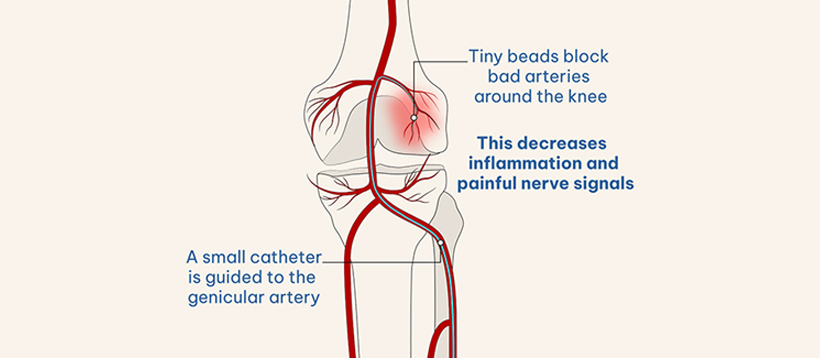
Instead of replacing the knee joint, GAE targets the abnormal blood vessels around the knee that cause inflammation and pain. By reducing this abnormal blood flow, inflammation decreases and pain significantly reduces.
In simple words:
- Knee pain is linked to inflammation
- Inflammation is supported by extra blood flow
- GAE blocks this abnormal blood supply
- Less blood flow = less inflammation = less pain
How Does GAE Work?
GAE works at the root cause of knee pain rather than just masking symptoms.
Step-by-step explanation:
- In osteoarthritis, new abnormal blood vessels develop around the knee
- These vessels release inflammatory substances
- Inflammation leads to chronic pain and swelling
- During GAE, these abnormal vessels are identified using imaging
- Tiny particles are injected to block them
- Blood flow reduces, inflammation settles, and pain improves
The knee joint itself is not damaged during the procedure.
Who is an Ideal Candidate for GAE?
GAE is especially suitable for patients who:
- Have chronic knee pain due to osteoarthritis
- Want to avoid knee replacement surgery
- Are not fit for surgery due to age or medical conditions
- Have not received relief from medicines or physiotherapy
- Want a quick recovery and minimal downtime
It is commonly recommended for mild to moderate osteoarthritis, but even some advanced cases can benefit after proper evaluation.
Who Should Avoid GAE?
GAE may not be suitable if:
- There is active knee infection
- There is severe joint deformity
- There are certain blood clotting disorders
A detailed consultation and imaging evaluation is always done before suggesting treatment.
The GAE Procedure: What to Expect
Before the procedure
- Clinical examination of the knee
- MRI or X-ray review
- Blood tests
- Discussion of medical history
During the procedure
- Done under local anesthesia
- A small puncture is made, usually in the wrist or groin
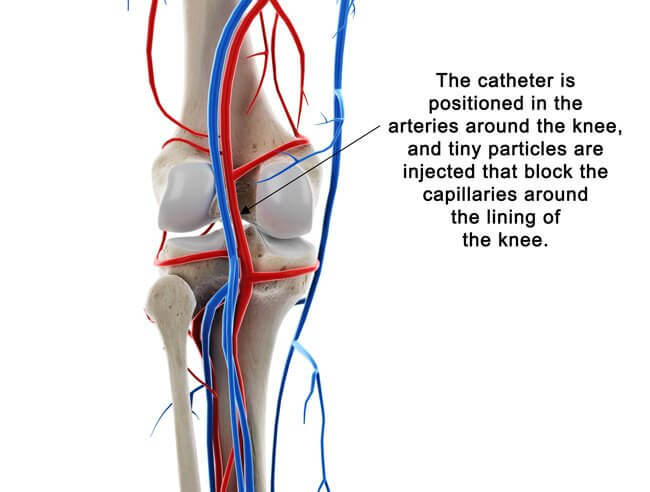
- A thin catheter is guided to knee blood vessels
- Abnormal vessels are blocked using microscopic particles
- Procedure time: 45–90 minutes
After the procedure
- No stitches required
- Observation for a few hours
- Same-day or next-day discharge
- Mild soreness may occur for a few days
Benefits of Genicular Artery Embolization
GAE offers multiple advantages over traditional treatments.
Key benefits:
- Non-surgical treatment
- No cutting, stitches, or scars
- Minimal pain and quick recovery
- Same-day discharge
- Preserves natural knee joint
- Long-lasting pain relief
- Suitable for elderly patients
Many patients experience significant pain relief within weeks, with continued improvement over months.
Recovery After GAE
Recovery is usually fast and smooth.
What patients can expect:
- Walking the same day or next day
- Resume daily activities within 2–3 days
- Gradual improvement in knee pain
- Reduced dependence on painkillers
- Improved mobility and quality of life
Physiotherapy may be advised to enhance results.
How Effective is GAE for Chronic Knee Pain?
Clinical studies and real-world experience show that:
- Most patients report 50–80% pain reduction
- Improvement continues for several months
- Results can last for years
- Repeat procedure is possible if required
GAE does not stop future treatments. Knee replacement remains an option if needed later.
GAE vs Knee Replacement Surgery
| Feature | Genicular Artery Embolization | Knee Replacement |
|---|---|---|
| Type | Non-surgical | Major surgery |
| Anesthesia | Local | General / spinal |
| Hospital stay | Same day | 5–7 days |
| Recovery time | Few days | Months |
| Risk level | Low | Higher |
| Joint preservation | Yes | No |
For many patients, GAE acts as a bridge or alternative to surgery.
Role of Interventional Radiology in Knee Pain
GAE is performed by a specialist called an Interventional Radiologist. This field uses imaging guidance to treat diseases from inside the body without open surgery.
At CARE CHL Hospital Indore, advanced interventional radiology facilities allow safe and precise procedures.
Dr. Alok Kumar Udiya, an experienced Interventional Radiologist, specializes in image-guided treatments that reduce pain, hospital stay, and recovery time.
Why Choose CARE CHL Hospital Indore for GAE?
Patients choose CARE CHL Hospital Indore because of:
- Advanced angiography and imaging systems
- Experienced interventional radiology team
- Personalized patient evaluation
- High safety standards
- Comprehensive pain management approach
The focus is always on patient comfort, safety, and long-term relief.
FAQs
1. Is Genicular Artery Embolization painful?
No. The procedure is done under local anesthesia. Patients may feel mild discomfort, but severe pain is uncommon.
2. How long does GAE pain relief last?
Pain relief can last for several years. Results vary depending on disease severity and lifestyle.
3. Is GAE safe?
Yes. When performed by an experienced Interventional Radiologist, GAE is a safe and well-established procedure.
4. Can GAE replace knee surgery?
GAE is an alternative or delay to surgery, especially for patients not ready or fit for knee replacement.
5. When can I walk after GAE?
Most patients can walk the same day or the next day after the procedure.
Final Thoughts
Chronic knee pain does not have to control your life. With advancements like Genicular Artery Embolization, patients now have access to a safe, effective, non-surgical treatment for chronic knee pain.
If you or your loved one is suffering from knee pain due to osteoarthritis and wants to avoid surgery, GAE may be the right solution.
A consultation with Dr. Alok Kumar Udiya (Interventional Radiologist) at CARE CHL Hospital Indore can help you understand whether this advanced treatment is suitable for your condition and guide you toward a pain-free, active life.