
Living with liver cirrhosis can be exhausting. Repeated hospital visits to drain fluid from the tummy, sudden episodes of vomiting blood, and constant worry about the next emergency can affect the whole family.
For some patients, a minimally invasive procedure called TIPS can make a real difference.
The TIPS procedure for liver cirrhosis creates a new pathway for blood inside the liver, lowering the high pressure that causes dangerous bleeding and repeated fluid build-up. It is done by an Interventional Radiologist through a small puncture in the neck — without open surgery.
This guide explains what TIPS is, who may benefit, how it is done, the risks, and what recovery looks like.
What Is Liver Cirrhosis?
Liver cirrhosis is long-term scarring of the liver. Healthy liver tissue is slowly replaced by hard scar tissue, so the liver cannot work properly.
Common causes include:
- Long-term alcohol use
- Hepatitis B or hepatitis C infection
- Fatty liver disease, often linked to obesity and diabetes
- Autoimmune and inherited liver diseases
Also Read: Understanding Liver Tumors: Types, Causes, Symptoms, Diagnosis, and Treatment
What Is Portal Hypertension?
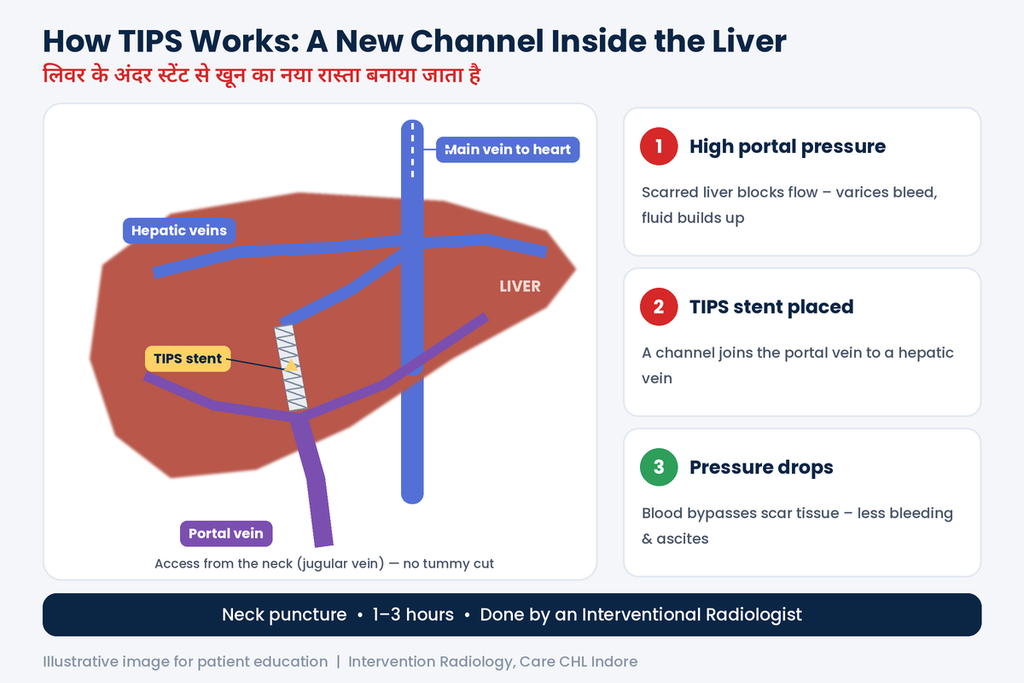
The portal vein carries blood from the stomach and intestines to the liver. In cirrhosis, the scarred liver blocks this flow. Pressure builds up in the portal vein — this is called portal hypertension.
This high pressure causes many of the most serious problems in cirrhosis:
- Varices: Blood finds detours through swollen veins in the food pipe (oesophagus) and stomach. These can burst and cause life-threatening bleeding — vomiting blood or passing black stools.
- Ascites: Fluid collects in the abdomen, making it swollen, tight and uncomfortable. Some patients need it drained again and again.
- Hepatic hydrothorax: Fluid collects around the lungs, causing breathlessness.
TIPS works by directly lowering this pressure.
What Is the TIPS Procedure?
TIPS stands for Transjugular Intrahepatic Portosystemic Shunt. In simple words:
- Transjugular: Done through the jugular vein in the neck
- Intrahepatic: The new channel is made inside the liver
- Portosystemic shunt: It connects the high-pressure portal vein to a low-pressure liver (hepatic) vein
A small metal mesh tube called a stent keeps this new channel open. Blood can now bypass the scarred liver tissue, so the pressure in the portal vein drops. With lower pressure, varices are less likely to bleed and fluid build-up reduces.
Important: TIPS treats the complications of cirrhosis caused by high pressure. It does not cure cirrhosis itself.
Who May Benefit From TIPS?
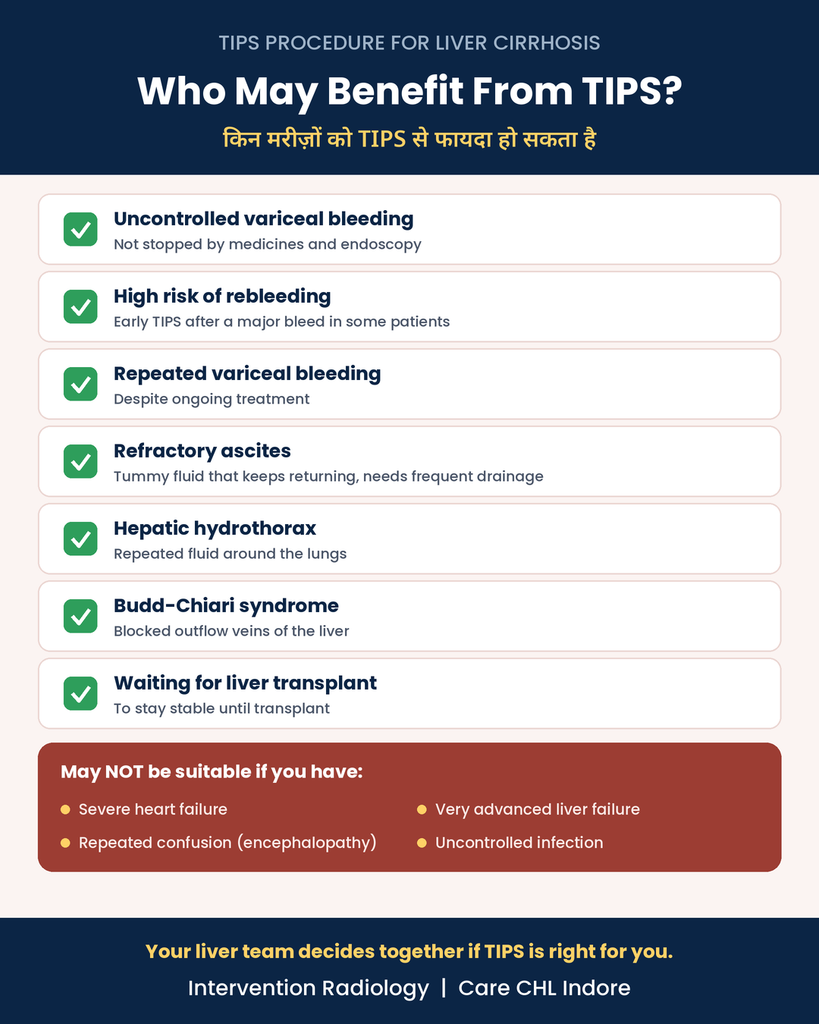
Your liver specialist and Interventional Radiologist may consider TIPS if you have:
- Variceal bleeding that cannot be controlled with medicines and endoscopy treatment
- High risk of rebleeding after a major bleed — in some patients, TIPS is done early to prevent another bleed
- Repeated bleeding from varices despite treatment
- Refractory ascites — fluid that keeps coming back despite medicines and needs frequent drainage
- Hepatic hydrothorax — repeated fluid around the lungs
- Budd-Chiari syndrome — blockage of the liver’s outflow veins
- Selected cases of portal vein clots
TIPS may also help some patients stay stable while waiting for a liver transplant.
Also Read: Understanding Gastrointestinal Interventions: A Comprehensive Guide
Who May Not Be Suitable for TIPS?
TIPS is not right for everyone. It may be unsafe or less helpful if you have:
- Severe heart failure or serious lung pressure problems
- Very advanced liver failure (very high bilirubin or severe liver dysfunction)
- Repeated or severe confusion due to liver disease (hepatic encephalopathy)
- An uncontrolled infection
- A blocked bile duct that has not been treated
- Certain liver tumours or many large liver cysts in the path of the shunt
Before TIPS, you will have blood tests, a heart check (often an echocardiogram) and imaging such as ultrasound or CT to make sure the procedure is safe for you.
How Is the TIPS Procedure Done?
TIPS is performed in a cath lab by an Interventional Radiologist, usually under general anaesthesia or deep sedation.
- Neck access: A small puncture is made in the jugular vein on the right side of the neck.
- Reaching the liver: A thin catheter is guided down to a hepatic vein inside the liver using live X-ray.
- Measuring pressure: The pressure difference between the portal vein and the body’s veins is measured.
- Creating the channel: A special needle is passed through the liver tissue from the hepatic vein into the portal vein, guided by imaging.
- Placing the stent: The new channel is widened with a balloon and a covered stent is placed to keep it open.
- Checking the result: Pressures are measured again to confirm that portal pressure has dropped to a safer level. Bleeding varices may also be blocked during the same procedure.
The procedure usually takes 1 to 3 hours. There is no cut on the tummy — only a small puncture in the neck.
Recovery After TIPS
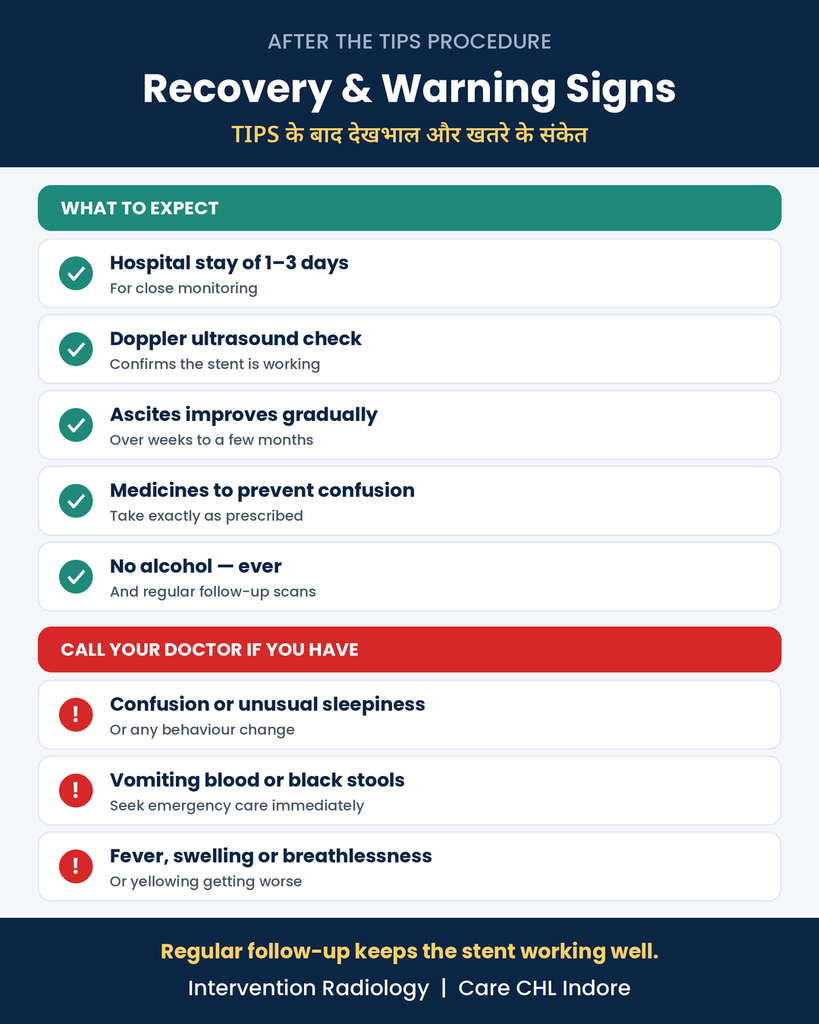
- Most patients stay in hospital for 1 to 3 days for monitoring.
- A Doppler ultrasound is done to check that the stent is working well.
- Ascites usually improves gradually over weeks to a few months, and the need for repeated drainage often reduces.
- You may be given medicines to prevent confusion (hepatic encephalopathy).
- Regular follow-up scans are needed to make sure the stent stays open.
- Avoid alcohol completely and follow your liver specialist’s advice on diet and medicines.
Also Read: 10 Diabetic Foot Problems & Expert Tips to Manage Them
Benefits and Risks of TIPS
| Benefits | Possible risks |
|---|---|
| Controls or prevents dangerous variceal bleeding | Hepatic encephalopathy (confusion, drowsiness) — the most important risk |
| Reduces fluid build-up in the abdomen and chest | Stent narrowing or blockage over time |
| Fewer hospital visits for fluid drainage | Bleeding or injury during the procedure |
| Can improve quality of life | Strain on the heart in some patients |
| May help as a bridge to liver transplant | Worsening liver function in some cases |
About hepatic encephalopathy: Because some blood now bypasses the liver, toxins can reach the brain more easily. This can cause confusion, sleepiness or behaviour changes. It can usually be controlled with medicines, and the stent size can sometimes be adjusted if needed.
When to Contact Your Doctor After TIPS
- Confusion, unusual sleepiness or behaviour change
- Vomiting blood or black stools
- Fever or chills
- Increasing tummy swelling or breathlessness
- Yellowing of eyes or skin getting worse
TIPS Procedure in Indore at Care CHL Indore
For patients with liver cirrhosis facing repeated bleeding or fluid build-up, the Intervention Radiology Indore team at Care CHL Indore evaluates whether TIPS is the right option.
Dr. Alok Kumar Udiya, Interventional Radiologist, works closely with gastroenterologists, hepatologists and critical care teams to plan each TIPS procedure carefully, from pre-procedure assessment to long-term follow-up.
Frequently Asked Questions
What is the TIPS procedure for liver cirrhosis? It is a minimally invasive procedure that creates a channel inside the liver to lower high pressure in the portal vein, reducing bleeding and fluid build-up.
Is TIPS a major surgery? No. It is done through a small puncture in the neck using imaging guidance, without cutting open the abdomen.
How long does the TIPS procedure take? Usually 1 to 3 hours, followed by a hospital stay of about 1 to 3 days.
Does TIPS cure liver cirrhosis? No. TIPS treats complications caused by high portal pressure, such as bleeding and ascites. The underlying cirrhosis still needs ongoing care.
What is the main side effect of TIPS? Hepatic encephalopathy — confusion or drowsiness — is the most important side effect. It can usually be managed with medicines.
How long does a TIPS stent last? Modern covered stents usually stay open for a long time, but regular Doppler checks are needed to catch any narrowing early.
Can TIPS help before a liver transplant? Yes. In some patients, TIPS helps control complications and keeps them stable while waiting for a transplant.
Where can I get the TIPS procedure in Indore? TIPS is available at Care CHL Indore through the Intervention Radiology team led by Dr. Alok Kumar Udiya, Interventional Radiologist.
What is the cost of TIPS in Indore? Cost depends on the patient’s condition, stent and materials used, hospital stay and insurance cover. Please contact Care CHL Indore directly for an estimate.
Conclusion
Liver cirrhosis can lead to serious problems like variceal bleeding and repeated fluid build-up. For selected patients, the TIPS procedure for liver cirrhosis offers a way to lower the pressure behind these problems — without open surgery.
The decision to have TIPS should be made carefully, with a team that includes your liver specialist and an experienced Interventional Radiologist.
Struggling with repeated bleeding or fluid build-up from liver cirrhosis? Consult the Intervention Radiology team at Care CHL Indore.
Disclaimer: This article is for general awareness only and is not a substitute for medical advice. If you are vomiting blood or passing black stools, seek emergency care immediately.