
Thyroid problems are very common today. Many people suffer from thyroid nodules, enlarged thyroid (goiter), or pressure symptoms in the neck. When doctors suggest a modern treatment like Thyroid Embolization, one of the first questions patients ask is:
“Is Thyroid Embolization painful?”
This is a very natural question. Nobody wants unnecessary pain. The good news is that Thyroid Embolization is a minimally invasive and usually well-tolerated procedure. In most cases, patients experience only mild discomfort, not severe pain.
In this detailed guide, we will explain everything in simple English so that you clearly understand what to expect. This blog also includes insights related to treatment under DR. ALOK KUMAR UDIYA at Care CHL Hospital Indore, where advanced interventional procedures are performed with modern technology and patient safety protocols.
What is Thyroid Embolization?
Before understanding pain, let us first understand what Thyroid Embolization actually is.
Thyroid Embolization (also called Thyroid Artery Embolization) is a non-surgical treatment for:
- Benign thyroid nodules
- Large goiter
- Hypervascular thyroid swelling
- Patients who cannot undergo surgery
In this procedure:
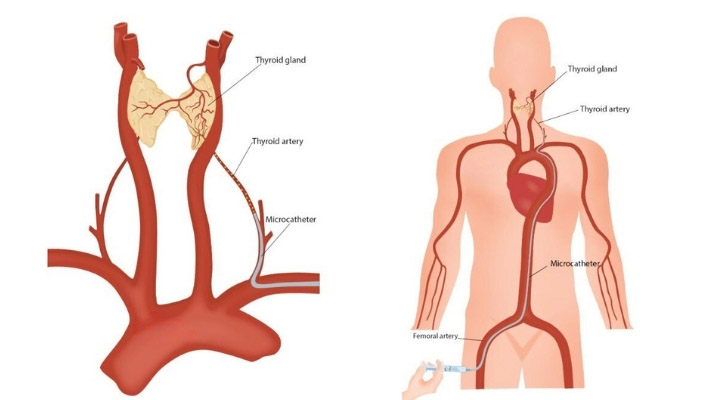
- A very thin catheter (small tube) is inserted through a small puncture in the groin or wrist.
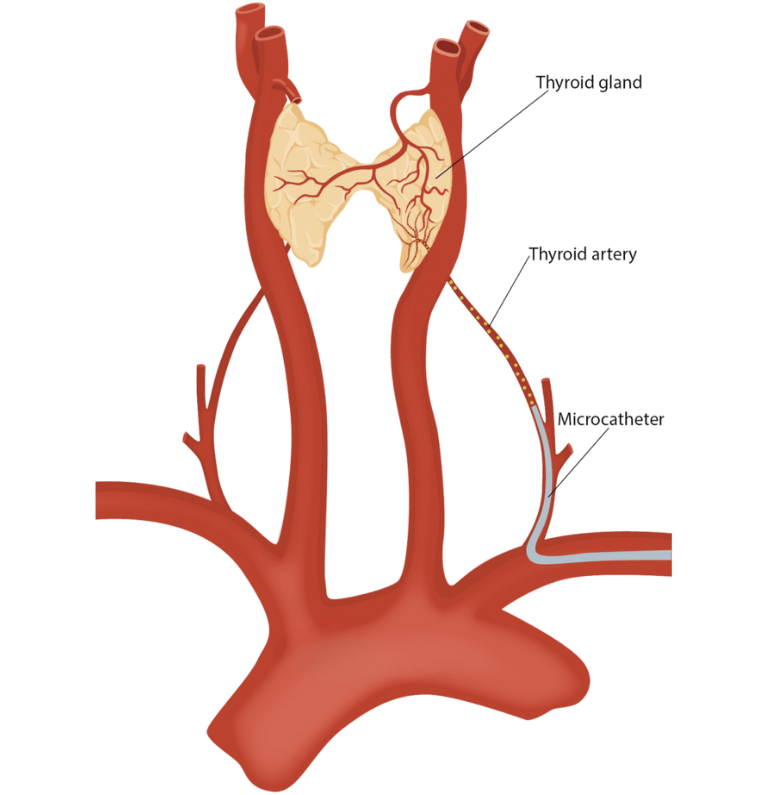
- The doctor guides it to the thyroid artery using imaging guidance.
- Tiny particles are injected to block blood flow to the abnormal thyroid tissue.
- The nodule gradually shrinks over weeks to months.
No big cuts. No stitches. No removal of the entire thyroid gland.
At Care CHL Hospital Indore, this procedure is performed in a specialized angiography lab by experienced interventional specialists like DR. ALOK KUMAR UDIYA.
Also Read: Image-guided Biopsy: Accurate Diagnosis with Advanced Technology
Why Do Patients Worry About Pain?
Whenever someone hears:
- “Catheter”
- “Injection in artery”
- “Blocking blood supply”
They imagine severe pain.
But modern interventional radiology procedures are designed to reduce pain and discomfort as much as possible.
Let’s break it down step by step.
Is Thyroid Embolization Painful During the Procedure?
Short Answer:
Most patients feel very little pain.
Here’s why:
1. Local Anesthesia is Given
Before inserting the catheter:
- The doctor injects local anesthesia at the puncture site.
- This numbs the area completely.
- You may feel a small pinch from the injection (like a routine injection).
After that, you usually feel pressure but not sharp pain.
2. No Neck Cutting
Unlike thyroid surgery:
- There is no incision in the neck.
- No stitches.
- No large wound.
This reduces post-procedure pain significantly.
3. You Are Awake but Comfortable
Most Thyroid Embolization procedures are done under:
- Local anesthesia
- Mild sedation
You are relaxed and comfortable during the process.
At Care CHL Hospital Indore, patient comfort is carefully monitored throughout the procedure.
Also Read: Interventional Radiology in Breast Cancer: A Modern, Minimally Invasive Approach to Treatment
What About Pain After Thyroid Embolization?
This is where patients are most concerned.
After the procedure, some patients may experience:
- Mild neck discomfort
- Slight swelling
- A feeling of pressure in the throat
- Low-grade fever (in some cases)
But this is usually temporary.
Why Does This Happen?
After blood supply is blocked:
- The thyroid nodule begins to shrink.
- The body reacts to the treated tissue.
- Mild inflammation may occur.
This is called Post-Embolization Syndrome, and it is generally mild.
How Long Does the Discomfort Last?
In most cases:
- Mild discomfort lasts 2–5 days.
- Pain is manageable with simple medications.
- Normal routine can resume within a few days.
Compared to surgery:
- Surgical pain may last weeks.
- There is neck incision pain.
- There may be swallowing discomfort.
Thyroid Embolization is usually much easier.
Also Read: A Non-Surgical Treatment for Chronic Knee Pain: Genicular Artery Embolization (GAE)
Comparing Pain: Thyroid Embolization vs Surgery
| Feature | Thyroid Embolization | Thyroid Surgery |
|---|---|---|
| Neck incision | No | Yes |
| General anesthesia | Usually No | Yes |
| Stitches | No | Yes |
| Hospital stay | Short | Longer |
| Pain level | Mild to moderate | Moderate to severe |
| Recovery time | Few days | Weeks |
Because Thyroid Embolization is minimally invasive, pain levels are usually much lower.
Realistic Pain Expectations
Let us be honest.
No medical procedure is 100% pain-free.
But the level of pain in Thyroid Embolization is usually:
- Mild
- Temporary
- Manageable
Most patients rate pain between 2 to 4 on a scale of 10.
Very rarely, some patients may feel stronger discomfort, but proper medication controls it.
Who Might Feel More Discomfort?
Some factors that may increase mild pain:
- Very large nodules
- Highly vascular goiter
- Sensitive pain tolerance
- Pre-existing neck inflammation
An experienced specialist like DR. ALOK KUMAR UDIYA carefully evaluates each case before the procedure to minimize risks.
What Pain Control Measures Are Used?
At advanced centers like Care CHL Hospital Indore, several safety steps are taken:
1. Local anesthesia
2. Mild sedation if required
3. Pain medications after procedure
4. Anti-inflammatory drugs
5. Close monitoring
Patients are never left in uncontrolled pain.
What Do Patients Usually Say?
Most patients report:
- “It was easier than I expected.”
- “Discomfort was manageable.”
- “Much better than surgery.”
Fear is often bigger than reality.
Does Thyroid Embolization Cause Long-Term Pain?
No.
Once healing is complete:
- There is no permanent pain.
- No neck scar.
- No stiffness from surgery.
- No muscle damage.
The thyroid gradually shrinks without causing long-term discomfort.
What About Swallowing Pain?
Some patients may feel:
- Mild throat tightness
- Slight discomfort while swallowing
This usually improves within a few days.
It is significantly less than post-surgical swallowing pain.
Is There Severe Pain Risk?
Severe pain is rare.
Possible reasons (very uncommon):
- Large inflammatory reaction
- Infection (rare)
- Individual sensitivity
But with proper care, complications are uncommon.
Choosing an experienced center like Care CHL Hospital Indore significantly reduces risk.
Emotional Pain vs Physical Pain
Sometimes anxiety increases perceived pain.
Patients who are:
- Very anxious
- Fearful
- Overthinking
May feel more discomfort.
Proper counselling by experienced doctors helps reduce anxiety before the procedure.
How to Prepare to Reduce Pain?
Before Thyroid Embolization:
- Follow doctor instructions
- Stay hydrated
- Avoid blood thinners (if advised)
- Eat light meal (if permitted)
- Ask questions to clear doubts
When you are mentally prepared, pain perception reduces.
Recovery Tips After Thyroid Embolization
To reduce discomfort:
- Take prescribed medicines on time
- Rest for 2–3 days
- Avoid heavy lifting
- Drink enough fluids
- Follow-up as advised
Most patients return to normal life quickly.
Why Choose an Experienced Specialist?
Pain control and comfort depend on:
- Technique
- Experience
- Proper imaging guidance
- Careful particle selection
- Patient monitoring
Under experienced specialists like DR. ALOK KUMAR UDIYA, procedures are performed with precision and safety focus.
FAQs
1. Is Thyroid Embolization more painful than biopsy?
No. It is similar or slightly more uncomfortable than biopsy, but manageable.
2. Will I need strong painkillers?
Usually mild to moderate painkillers are enough.
3. Can I go home the same day?
Many patients are discharged within a short period, depending on condition.
4. Will my neck be swollen?
Mild temporary swelling is possible.
5. Is it safer than surgery?
For selected patients, it is a safe minimally invasive alternative.
Final Conclusion
So, is Thyroid Embolization painful?
- It is not severely painful.
- It causes mild and temporary discomfort.
- It is much less painful than thyroid surgery.
- Recovery is faster and easier.
With proper evaluation and care at centers like Care CHL Hospital Indore, under experienced specialists such as DR. ALOK KUMAR UDIYA, patients can undergo Thyroid Embolization safely and comfortably.
If you are suffering from thyroid nodules or goiter and are worried about surgery pain, discussing minimally invasive options like Thyroid Embolization may help you make an informed decision.