
You have had fibroid embolisation. The first few days of cramping are behind you, and now you are waiting — and wondering. Did it work? How will I know?
This is one of the most common questions women ask after the procedure. The good news is that there are clear signs to look for.
You can tell fibroid embolisation was successful when your periods become lighter and shorter, pain and pressure symptoms ease, your energy and haemoglobin improve, and a follow-up scan — usually an MRI — shows that the fibroids are no longer getting blood supply and have started to shrink. Most women notice clear improvement within the first three months, with the full benefit seen by about six to twelve months.
This guide explains what “success” really means, the signs to watch for, a month-by-month timeline, the tests that confirm the result, and what to do if things are not improving as expected.
A Quick Recap: What Does Fibroid Embolisation Do?
Fibroid embolisation, also called uterine fibroid embolisation (UFE) or uterine artery embolisation (UAE), is a minimally invasive procedure done by an Interventional Radiologist.
- A thin catheter is passed through a tiny puncture at the wrist or groin.
- It is guided into the arteries that supply the uterus.
- Tiny particles are injected to block blood flow to the fibroids.
- Without blood supply, the fibroids die off, soften and gradually shrink over the following months.
The uterus itself is preserved and continues to get blood through small natural connections.
What Does “Successful” Actually Mean?
Many women expect the fibroids to disappear completely. That is usually not how success is measured.
Fibroid embolisation is considered successful when:
- Your symptoms improve — this is the most important goal.
- The fibroids lose their blood supply — confirmed on a follow-up scan.
- The fibroids and uterus shrink — enough to relieve pressure and bulk symptoms.
Treated fibroids often shrink by a large amount over the first year, but they rarely vanish completely. What remains is usually a smaller, softer, “dead” fibroid that no longer causes problems. A fibroid that is still visible on a scan does not mean the treatment failed.
Also Read: Uterine Fibroid Embolisation Cost in Indore: What You Pay For and Why
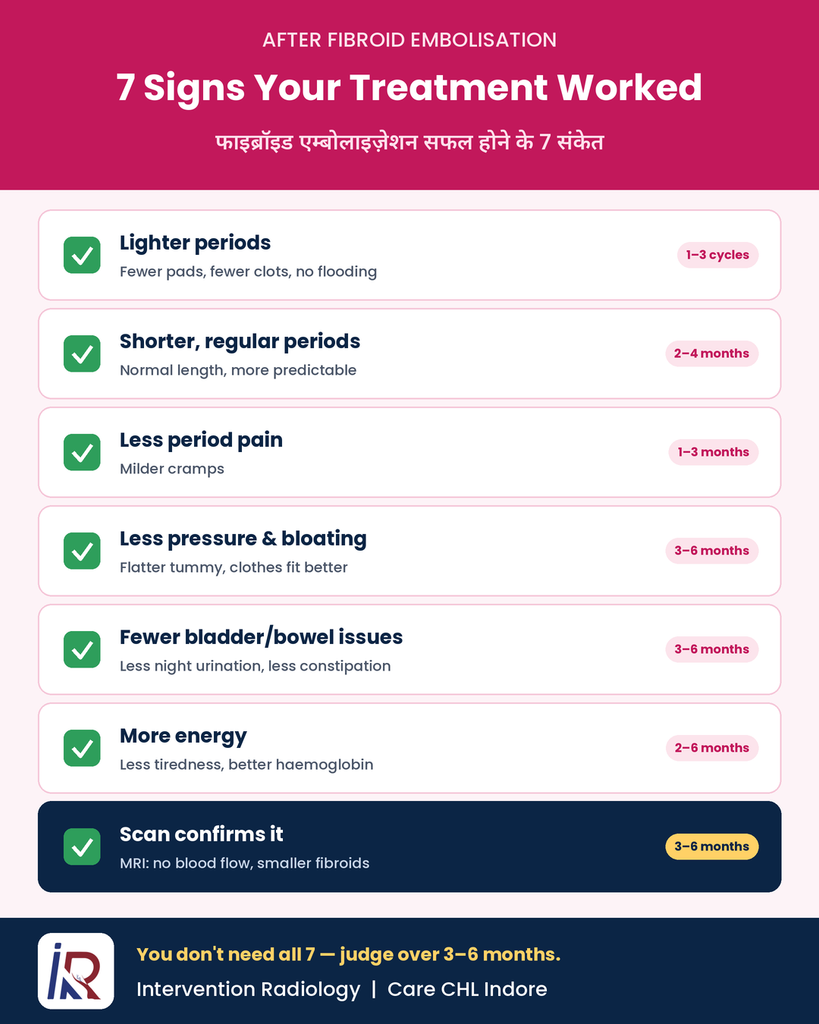
7 Signs Your Fibroid Embolisation Was Successful
1. Your periods are lighter This is usually the first and clearest sign. You need fewer pads, change them less often, and no longer have flooding or “accidents”. Clots become smaller or stop.
2. Your periods are shorter and more regular Periods that used to last 8–10 days often settle to a more normal length. The cycle also tends to become more predictable after the first one or two periods.
3. Less period pain and cramping As the fibroids shrink and soften, the heavy, dragging pain during periods often reduces.
4. Less pelvic pressure and bloating If your fibroids were large, you may notice your tummy looks flatter, clothes fit better, and the feeling of heaviness or fullness in the pelvis eases.
5. Fewer bladder and bowel problems Fibroids pressing on the bladder can cause frequent urination, especially at night. Those pressing backwards can cause constipation or back pain. As they shrink, these symptoms usually improve.
6. More energy and better haemoglobin Heavy bleeding often causes anaemia — tiredness, breathlessness, dizziness and pale skin. With less blood loss every month, haemoglobin rises and energy returns. Many women say this is the change they notice most in daily life.
7. A follow-up scan confirms it The most reliable confirmation is a follow-up MRI showing that the fibroids are no longer receiving blood supply and have reduced in size.
| Sign | What you notice | When it usually appears |
|---|---|---|
| Lighter periods | Fewer pads, fewer clots, no flooding | First 1–3 cycles |
| Shorter, regular periods | Normal length, more predictable | 2–4 months |
| Less period pain | Milder cramps | 1–3 months |
| Less pressure and bloating | Flatter tummy, clothes fit better | 3–6 months |
| Fewer bladder/bowel issues | Less night urination, less constipation | 3–6 months |
| More energy | Less tiredness, better haemoglobin | 2–6 months |
| Scan confirmation | No blood flow in fibroids, smaller size | Follow-up MRI at 3–6 months |
You do not need all seven signs. If your main problem was heavy bleeding, lighter periods alone may mean the treatment has done its job. If your main problem was pressure, shrinkage matters more.
Also Read: How Your Periods May Change After Fibroid Embolisation
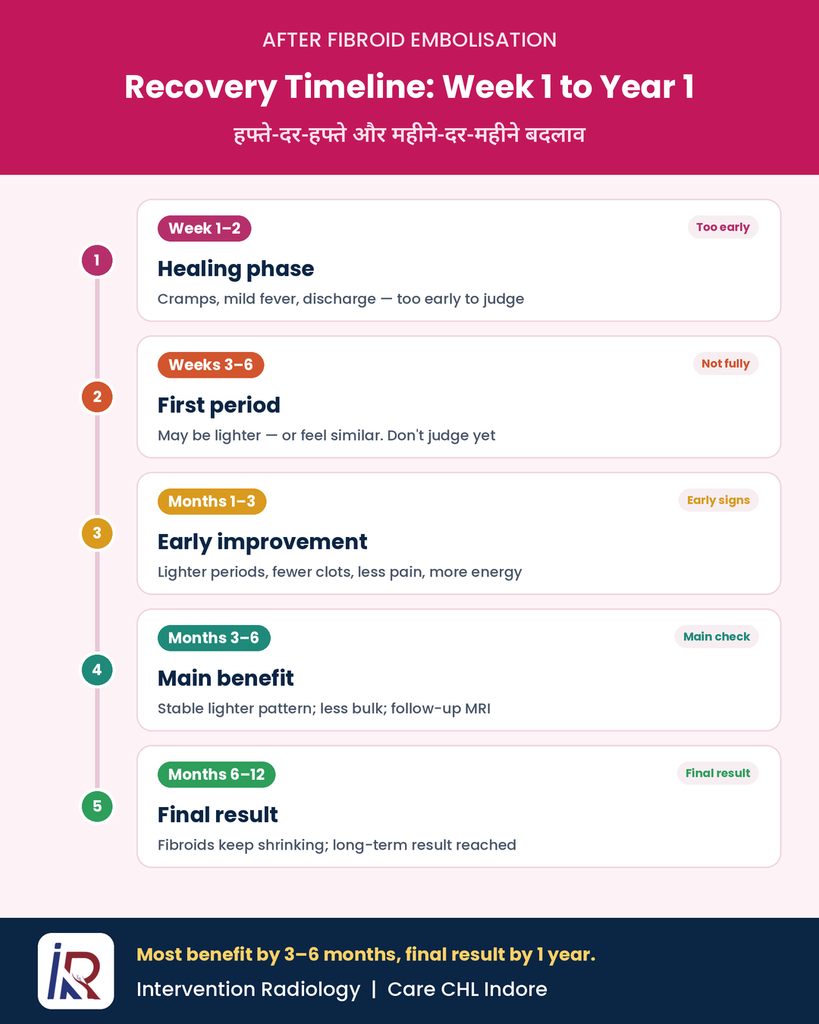
Fibroid Embolisation Results Timeline: Week 1 to Year 1
Results do not appear overnight. Knowing what to expect at each stage helps you judge progress fairly.
Week 1–2: Healing phase
- Cramping pain, mild fever, nausea and tiredness are common for a few days. This is called post-embolisation syndrome and is a sign the fibroids are responding.
- Light spotting or watery, brownish discharge may start.
- You cannot judge success yet — this phase is about rest and recovery.
Weeks 3–6: First period
- Your first period may come on time, early or late.
- It may already be lighter — or it may feel similar to before. Do not judge the result by the first period alone.
Months 1–3: Early improvement
- Most women notice clearly lighter, shorter periods.
- Fewer clots and less period pain.
- Energy starts to return as blood loss reduces.
Months 3–6: Main benefit
- Periods usually settle into a new, lighter pattern.
- Bloating and pressure symptoms ease as fibroids shrink.
- A follow-up MRI or ultrasound is commonly done around this time.
Months 6–12: Final result
- Fibroids continue to shrink and soften.
- Most women reach their stable, long-term result by this stage.
| Time after UFE | What is happening | Can you judge success? |
|---|---|---|
| Week 1–2 | Healing; cramps, mild fever, discharge | No — too early |
| Weeks 3–6 | First period; may or may not be lighter | Not fully |
| Months 1–3 | Periods lighter, less pain, more energy | Early signs |
| Months 3–6 | Stable pattern; less bulk; follow-up scan | Yes — main assessment |
| Months 6–12 | Continued shrinkage; final result | Yes — long-term result |
How Long Does It Take for the Uterus to Shrink After Fibroid Embolisation?
Shrinkage is gradual:
- Fibroids usually begin to soften and shrink within the first few weeks.
- Noticeable reduction in size is often seen by 3 months.
- Shrinkage continues for up to 6–12 months, and sometimes a little beyond.
- On average, treated fibroids and the uterus become significantly smaller over the first year, though the exact amount varies from woman to woman.
Large fibroids may shrink a lot in volume but still remain visible. What matters most is whether your symptoms have improved.
3 Months After UFE: A Quick Self-Check
At about three months, ask yourself:
- Are my periods lighter than before the procedure?
- Are they shorter?
- Do I have fewer clots or no flooding?
- Is my period pain milder?
- Do I feel less tired?
- Is my tummy less bloated or heavy?
If you answer “yes” to most of these, the treatment is very likely working. Share your answers at your follow-up visit.
Also Read: Varicocele Specialists in India: Who to Consult and Why
Tests That Confirm Fibroid Embolisation Was Successful
How you feel is the most important measure, but tests give objective proof.
1. Contrast-enhanced MRI of the pelvis (most reliable) An MRI with contrast dye shows whether the fibroids are still receiving blood. After a successful embolisation, the treated fibroids appear dark (non-enhancing) — meaning they no longer have blood supply. This is called complete infarction and is the best predictor of long-lasting results.
MRI also measures the size of each fibroid and the uterus, so the doctor can compare it with your scan from before the procedure.
2. Pelvic ultrasound with Doppler Ultrasound can show reduction in size and, with Doppler, whether there is any blood flow inside the fibroids. It is quick and widely available, though MRI gives a more complete picture.
3. Haemoglobin blood test A rise in haemoglobin over a few months confirms that blood loss has reduced and anaemia is improving.
4. Your symptom diary A simple record of each period — start date, number of days, number of pads per day, clots and pain level — is surprisingly useful. Comparing it with how things were before the procedure shows real progress.
| Test | What it shows | When it is usually done |
|---|---|---|
| Contrast MRI | Blood supply to fibroids; size of fibroids and uterus | Around 3–6 months |
| Ultrasound with Doppler | Size reduction; blood flow | 3–6 months, or as advised |
| Haemoglobin | Improvement in anaemia | 1–3 months, then as needed |
| Symptom diary | Real-life change in periods and pain | Every cycle |
What the Doctor Looks for on Your Follow-Up Scan
- No blood flow in the fibroids — the key sign of success
- Reduction in fibroid size, often seen as a percentage compared with before
- Reduction in overall uterine size
- Any fibroid that still has blood supply, which might need attention later
- New fibroids, if any
Even if the fibroids are still present, a scan showing they are fully cut off from blood supply is very reassuring for long-term results.
Normal After-Effects That Do NOT Mean Failure
Some things that worry women in the early weeks are actually part of normal healing:
- Cramping and mild fever in the first week
- Watery, pinkish or brownish discharge for a few weeks
- A first period that feels similar to before
- Skipping one or two periods temporarily
- Passing small pieces of tissue if a fibroid was close to the inner lining of the uterus (tell your doctor if this happens)
- Fibroids still visible on a scan, but without blood supply
None of these on their own mean the treatment did not work.
Signs Fibroid Embolisation May Not Have Worked as Expected
In most women, fibroid embolisation works well. But in a small number, the improvement may be less than hoped. Speak to your doctor if:
- Periods are still as heavy after 3–6 months
- Pressure or bulk symptoms have not improved by 6 months
- Haemoglobin is not rising despite treatment
- Symptoms improve and then return after some months or years
- The follow-up scan shows one or more fibroids still receiving blood supply
This is called incomplete infarction or recurrence, and it can often be treated.
Why Might the Result Be Less Than Expected?
- Incomplete blockage of a fibroid’s blood supply, sometimes because of extra feeding vessels
- Very large fibroids that shrink but still cause pressure
- Another condition causing symptoms, such as adenomyosis, polyps or hormonal causes
- New fibroids developing over time, especially in younger women
What Happens Next if It Didn’t Fully Work?
You still have options:
- Detailed review of your MRI to find exactly which fibroid or vessel is responsible.
- Repeat embolisation in selected cases, if a fibroid still has blood supply.
- Hysteroscopic removal if a fibroid is inside the uterine cavity.
- Myomectomy or hysterectomy in a small number of women, decided together with a gynaecologist.
- Medicines to control bleeding while a decision is made.
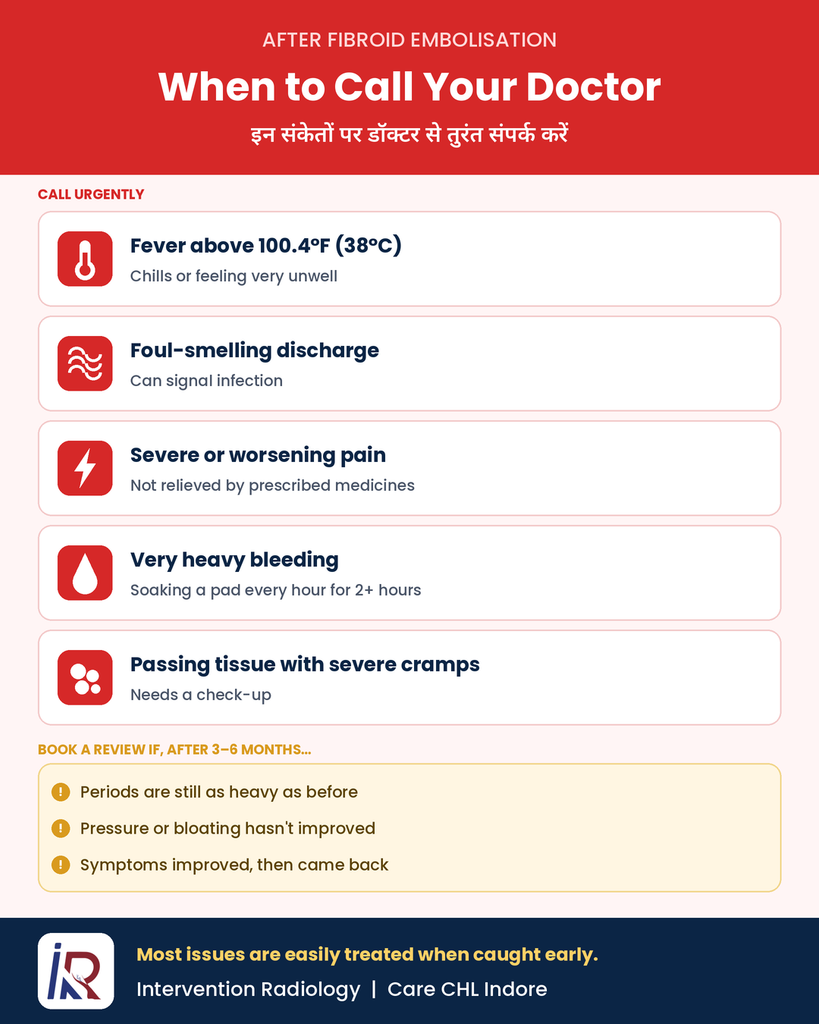
When to Call Your Doctor Urgently
- Fever above 100.4°F (38°C), chills or feeling very unwell
- Foul-smelling discharge
- Severe or worsening pelvic pain not relieved by prescribed medicines
- Very heavy bleeding — soaking a pad every hour for two hours or more
- Passing tissue with severe cramps
These can signal infection or other problems that need prompt attention.
1 Year After UFE: What Long-Term Success Looks Like
By one year, most women who have had successful fibroid embolisation:
- Have lighter, more manageable periods and a predictable cycle
- Are no longer anaemic or have much better haemoglobin
- Feel less pressure, bloating and pelvic heaviness
- Have fibroids that are much smaller and softer on scans
- Are back to normal routines, work and exercise without fibroid-related limits
Treated fibroids rarely grow back. However, new fibroids can sometimes develop over time, especially in women who are many years away from menopause. As women reach natural menopause, fibroids usually shrink further on their own, so the need for further treatment becomes less likely.
Does Success Depend on My Fibroids?
Results can vary depending on:
- Size and number of fibroids — very large fibroids may shrink a lot but still remain visible
- Location — fibroids inside the cavity or on a stalk may behave differently
- Blood supply pattern — complete blockage gives the most lasting results
- Other conditions such as adenomyosis, which can also cause heavy, painful periods
- Age — women closer to menopause are less likely to develop new fibroids
This is why a careful MRI before the procedure, and a follow-up MRI after it, are so important.
How to Track Your Recovery at Home
A little tracking makes it much easier to tell whether fibroid embolisation was successful:
- Keep a period diary — date, number of days, pads per day, clots and pain score (0–10).
- Note energy levels — can you climb stairs or work through the day without exhaustion?
- Track bladder and bowel symptoms — night-time urination, constipation.
- Measure your waist once a month if bloating was a problem.
- Keep all scan and blood reports in one folder.
- Take photos of your diary to show at follow-up visits.
Tips for the Best Possible Result
- Attend every follow-up visit and get the recommended scans.
- Take iron supplements if prescribed, until haemoglobin is normal.
- Eat a balanced diet with iron-rich foods such as green leafy vegetables, pulses and jaggery (if advised).
- Stay active with light exercise once your doctor allows.
- Report any unusual symptoms early rather than waiting.
Fibroid Embolisation and Follow-Up Care in Indore at Care CHL Indore
A successful result does not end on the procedure day — follow-up matters just as much. At Care CHL Indore, the Intervention Radiology Indore team led by Dr. Alok Kumar Udiya, Interventional Radiologist, provides fibroid embolisation along with structured follow-up:
- Pre-procedure MRI review to plan treatment carefully
- Clear guidance on what to expect at each stage of recovery
- Follow-up imaging to confirm that the fibroids have lost their blood supply
- Close coordination with gynaecologists if further treatment is ever needed
If you had fibroid embolisation elsewhere and are unsure whether it worked, the team can also review your symptoms and scans.
[ADD VERIFIED DETAILS: qualifications, years of experience, procedures performed, and facilities such as cath lab, MRI and day-care recovery. Do not add numbers or claims that are not verified.]
Frequently Asked Questions
How do I know if my fibroid embolisation was successful? Lighter and shorter periods, less pain and pressure, better energy and haemoglobin, and a follow-up MRI showing no blood supply to the fibroids are the main signs of success.
How soon after fibroid embolisation will I see results? Most women notice lighter periods within the first 1–3 cycles. The main benefit is usually seen by 3–6 months, and the final result by 6–12 months.
How long does it take for the uterus to shrink after fibroid embolisation? Shrinkage starts within weeks, is often noticeable by 3 months, and continues for 6–12 months.
Is it normal for my first period after UFE to be heavy? Yes, it can be. The first one or two periods may be unpredictable. Judge the result over 3–6 months, not by the first period.
My fibroids are still visible on the scan. Did the treatment fail? Not necessarily. Treated fibroids rarely disappear completely. If they have no blood supply and your symptoms have improved, the treatment has worked.
Which test best confirms success after fibroid embolisation? A contrast-enhanced MRI is the most reliable test, because it shows whether the fibroids still receive blood supply.
What if my symptoms come back after fibroid embolisation? See your doctor for a scan. Options include repeat embolisation, hysteroscopic removal or surgery, depending on the cause.
Where can I get fibroid embolisation and follow-up in Indore? Fibroid embolisation and follow-up care are available at Care CHL Indore through the Intervention Radiology team led by Dr. Alok Kumar Udiya, Interventional Radiologist.
Conclusion
So, how to tell if fibroid embolisation was successful? Look at your symptoms first — lighter, shorter periods, less pain, less pressure and more energy are the clearest signs. Then confirm it with a follow-up scan that shows the fibroids have lost their blood supply and are shrinking.
Give your body time: most of the benefit appears within three to six months, and the final result by about a year. Keep a simple period diary, attend your follow-ups, and speak to your doctor if something does not feel right.
Had fibroid embolisation and unsure about the result? Or considering fibroid embolisation in Indore? Consult the Intervention Radiology team at Care CHL Indore.
Disclaimer: This article is for general awareness only and is not a substitute for medical advice. Recovery and results vary from person to person. Please consult your doctor for advice specific to your condition.