
By Dr. Alok Kumar Udiya, Interventional Radiologist
Over the last few years, more and more women have been walking into clinics with the same complaint: a lump in the front of the neck. Doctors call this a thyroid nodule, and it is one of the most common health problems seen today. If you or someone in your family has recently been told “you have a nodule in your thyroid,” the news can feel frightening, and the mind often jumps straight to the word cancer.
Here is the good news. Most thyroid nodules are not cancer. And even when a nodule needs treatment, it no longer always means a big operation with a long scar on the neck. Thanks to newer techniques in interventional radiology, many patients can now be treated through a tiny puncture in the skin, without a large surgical cut, without a long hospital stay, and with a much faster return to normal life.
This blog explains, in plain and simple language, what a thyroid nodule is, why it happens, how doctors find it, and how modern treatments like microwave ablation and thyroid artery embolization are changing the way we manage this condition, so you can have an informed conversation with your doctor, without fear or confusion.
What Is the Thyroid Gland?
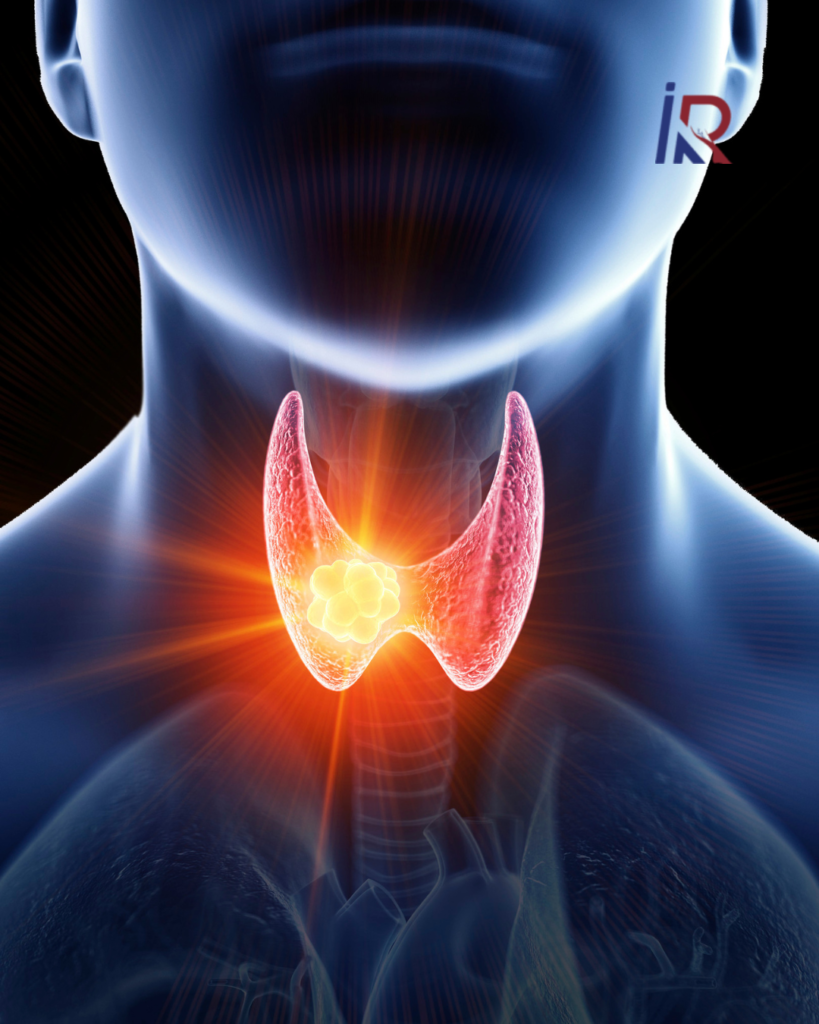
Before understanding a thyroid nodule, it helps to know what the thyroid gland actually does. The thyroid is a small, butterfly-shaped gland that sits low in the front of the neck, just below the Adam’s apple. Even though it is small, it plays a huge role in the body. It produces hormones that control how fast the body uses energy, how the heart beats, how warm or cold the body feels, and even how the skin, hair, and digestion behave. Because the thyroid controls so many functions, any change in this small gland can affect the whole body. When the gland develops an abnormal lump of tissue, doctors call it a thyroid nodule.
What Exactly Is a Thyroid Nodule?
A thyroid nodule is simply a lump or growth that forms inside the thyroid gland. It can be solid, filled with fluid like a small water-filled sac called a cyst, or a mix of both. Some nodules are so small that they can only be seen on an ultrasound scan. Others grow large enough to be felt with a hand, or even large enough to be seen as a visible swelling on the neck. A person can have just one nodule, or several nodules at the same time, a condition sometimes called a multinodular goitre. Nodules can appear at any age, but they become far more common as people grow older, and they are noticed far more often in women than in men.
How Common Are Thyroid Nodules?
Thyroid nodules are far more common than most people realise. When a doctor simply feels the neck by hand, nodules are found in only about 2 to 6 percent of people. But when an ultrasound scan is used, that number jumps to roughly 19 to 35 percent of people scanned, and some detailed studies have found even higher numbers, suggesting that a large share of adults are walking around with small, silent nodules they do not even know about.
Women are affected roughly four times more often than men. Age also plays a big role: one large study found nodules in about 39 percent of adults aged 30 or younger, climbing to nearly 88 percent in adults older than 70. In women over 40, nodules larger than one centimetre can be felt in roughly one out of every six. These numbers explain why thyroid ultrasounds and thyroid nodules have become such a common topic in clinics today.

Is a Thyroid Nodule Cancer?
This is usually the first question that comes to mind, and it is completely natural to worry about it. The reassuring truth is that the vast majority of thyroid nodules, roughly nine out of every ten, turn out to be non-cancerous, or what doctors call benign. Only a small percentage of nodules are found to be cancerous after proper testing.
That said, every nodule deserves a proper check-up. The size of the nodule, its shape on ultrasound, whether its edges are smooth or irregular, whether it contains calcium deposits, and whether nearby lymph nodes look abnormal, all give doctors clues about whether a nodule needs closer attention. This is why ignoring a lump is never a good idea. A short visit to a doctor and a simple scan can bring enormous peace of mind.
Also Read: Worst Headache of Your Life? Brain Bleed Signs | Dr. Udiya
Symptoms That Bring Patients to the Clinic
Many thyroid nodules cause no symptoms at all and are found only by chance, during a routine health check or a scan done for some other reason. However, when a nodule grows larger, it can start causing real, noticeable problems. The most obvious symptom is a swelling or lump that can be seen or felt in the front of the neck. As the nodule grows, it may press against the food pipe, causing difficulty in swallowing food or even water, or press against the windpipe, leading to tightness in the throat or mild breathlessness, especially while lying flat. If the nodule affects the nerves near the voice box, it can cause hoarseness or a change in the voice.
Beyond the physical symptoms, there is an emotional side to this condition that does not get talked about enough. A visible lump on the neck, an area of the body that is almost always uncovered, can cause real embarrassment and anxiety. Many patients say they avoid certain clothes, avoid photographs, or feel constantly conscious of people noticing their neck. This ongoing mental stress is a genuine and valid reason to seek treatment, even when the nodule itself is not dangerous.
In a smaller number of cases, a nodule can also become “overactive,” producing extra thyroid hormone on its own. This can lead to a fast heartbeat, unexplained weight loss, sweating, tremors, and anxiety, a condition known as toxic nodular disease.
How Doctors Diagnose a Thyroid Nodule
If a nodule is suspected or found, the first and most important test is an ultrasound scan of the neck. This painless, radiation-free scan shows the exact size, shape, and internal features of the nodule. Radiologists often use a scoring system, sometimes called TI-RADS, to estimate how likely a nodule is to be benign or suspicious, based on its appearance.
If the ultrasound shows features that need a closer look, the next step is usually a fine needle aspiration, often shortened to FNAC. This simple procedure uses a very thin needle to take a tiny sample of cells from the nodule, which is then examined under a microscope. It is done in the clinic itself, takes only a few minutes, and needs no cuts or stitches. Alongside this, doctors usually order blood tests to check thyroid function, mainly a hormone called TSH, to see whether the gland is working normally, is underactive, or is overactive. Together, these tests give a complete picture that helps decide the best path forward.
The Traditional Treatment: Surgery
For many decades, surgery has been the standard treatment for thyroid nodules that needed to be removed. This operation, called a thyroidectomy, involves removing part of the thyroid gland, called a lobectomy, or the entire gland, called a total thyroidectomy.
Surgery is, and remains, an excellent and necessary option in many situations, especially when a nodule is confirmed or strongly suspected to be cancerous, or when it has grown extremely large. However, it comes with certain realities that patients should understand. It is done under general anaesthesia, requires a hospital stay of a day or more, and leaves a scar across the front of the neck. There is also a small but real risk of affecting the nerve that controls the voice box, changing the voice, and a risk of disturbing the tiny parathyroid glands nearby that control calcium levels in the body. If the entire thyroid is removed, the patient will need to take thyroid hormone tablets every day for life.
None of this is meant to create fear around surgery, which remains safe and well-established. But it is exactly these factors, the anaesthesia, the scar, and the recovery time, that have pushed doctors to look for gentler alternatives for patients whose nodules are confirmed benign.
A New Option: Interventional Radiology
This is where interventional radiology enters the picture. This branch of medicine uses imaging tools, such as ultrasound, X-ray, or CT scans, to guide very thin instruments, needles, or tubes called catheters, through the skin and directly to the exact spot that needs treatment. Because these procedures work through a tiny puncture rather than a surgical cut, they are often described as minimally invasive.
Interventional radiology is already widely used to treat conditions in the liver, kidneys, uterus, and blood vessels without open surgery. In recent years, the same principles have been applied successfully to the thyroid gland, giving patients with certain nodules a genuine alternative to the operating table. Two procedures in particular are now used with encouraging results: microwave ablation and thyroid artery embolization.
Also Read: Thyroid Surgery vs. Radiofrequency Ablation: A Scar-Free Alternative Explained
Microwave Ablation: Treating the Nodule Directly
Microwave ablation, or MWA, treats the nodule directly using heat, without a surgical cut. The skin over the neck is numbed with local anaesthesia, so there is no need for general anaesthesia. Using real-time ultrasound guidance, the doctor inserts a very thin, needle-like probe through the numbed skin and positions its tip precisely inside the nodule. This probe delivers controlled microwave energy that heats and destroys the nodule tissue, while carefully sparing the healthy thyroid tissue around it and nearby structures such as the voice box nerve.
The procedure usually takes fifteen minutes to about an hour, depending on nodule size, and the patient stays awake throughout. There is no surgical cut, only a tiny puncture mark, so no stitches are needed, and most patients go home the same day. The treated tissue does not disappear immediately; the body gradually absorbs it over the following months, so the nodule shrinks slowly and steadily.
Recent clinical data is genuinely encouraging. Nodules shrink by roughly 60 to 65 percent in volume within three months, improving further to around 88 percent by one year, and in nearly 95 percent of treated nodules, the shrinkage is enough to be considered a successful outcome. Patients also report a noticeable improvement in the cosmetic appearance of the neck and less discomfort while swallowing. Safety data is reassuring too: serious complications are rare, and only about 3 in 100 patients experience temporary hoarseness that typically resolves on its own.
Thyroid Artery Embolization: Cutting Off the Blood Supply
Thyroid artery embolization, or TAE, works differently. Instead of treating the nodule directly, it reduces the blood supply feeding the nodule or the enlarged gland, causing it to gradually shrink from lack of nourishment. The procedure begins with a tiny puncture, usually in the wrist or groin, through which a thin, flexible catheter is gently guided, under X-ray imaging, through the blood vessels until it reaches the small arteries supplying the thyroid. Tiny particles are then injected through the catheter to block these vessels and cut down blood flow to the nodule or the overactive part of the gland.
This approach is particularly useful for larger nodules or goitres, including those that have grown down towards the collarbone or into the upper chest, a situation that can otherwise need more extensive surgery. It is also being used for certain overactive, or toxic, nodules producing excess thyroid hormone.
Results are promising. In one study of 56 patients, average nodule volume dropped from about 80 millilitres before treatment to around 25 millilitres just six months after the procedure, alongside a significant reduction in overall thyroid size. Some patients experience minor, short-term side effects afterwards, such as mild neck discomfort, low-grade fever, or temporary difficulty swallowing, which usually settle within a few days, while serious complications remain uncommon.
Why These Procedures Are Gaining Popularity
Placed side by side with traditional surgery, it is easy to see why patients and doctors are showing interest in these newer techniques. There is no large incision and therefore no visible scar on the neck, which matters greatly to many patients, especially younger women. Local anaesthesia is generally enough, avoiding the risks of general anaesthesia, and the procedure is usually completed within an hour, with most patients going home the same day instead of staying overnight.
Recovery is noticeably faster: while surgical recovery can take a couple of weeks, many patients treated with ablation or embolization return to work within a day or two. Because these techniques target only the nodule or its blood supply, rather than removing the entire gland, they help preserve healthy thyroid function, lowering the chances of needing lifelong hormone tablets. There is also less risk to the nerve controlling the voice box and to the parathyroid glands, since healthy surrounding tissue is left largely undisturbed.
Who Is a Good Candidate, and Who Still Needs Surgery
These modern techniques are not suitable for every patient or every nodule, which is exactly why proper evaluation matters so much before any decision is made. Good candidates are usually patients with a nodule already confirmed as benign through biopsy, who have symptoms such as visible swelling, pressure on the food pipe or windpipe, or significant cosmetic and psychological distress, and who wish to avoid surgery where the nodule’s size, number, and location make that reasonable.
Surgery generally remains the preferred and safest path for nodules confirmed or strongly suspected to be cancerous, since removing the area of concern is still the most reliable cancer treatment. Extremely large goitres and cases where the diagnosis is still unclear may also be better suited to surgery, sometimes combined with a procedure like embolization to shrink a very large gland beforehand. The right treatment depends entirely on the individual patient, guided by a careful ultrasound, a biopsy report where needed, and an honest discussion with a specialist, not a one-size-fits-all approach.
What to Expect: Your Treatment Journey
For a newly diagnosed patient, the journey usually begins with a consultation, either with an endocrinologist or an interventional radiologist, followed by an ultrasound scan and, if needed, a fine needle biopsy to confirm the nodule is benign, along with blood tests to check thyroid function. Once results are available, the doctor discusses all suitable options, explaining the benefits and limitations of surgery versus a minimally invasive procedure, so the patient can make an informed choice.
On the day of the procedure, the patient is usually asked to avoid heavy meals for a few hours beforehand. The procedure itself, done under local anaesthesia and image guidance, is generally completed within an hour, after which the patient rests briefly before going home the same day. Recovery in the following days is usually mild, with only slight soreness at the puncture site. Follow-up ultrasound scans are then scheduled, typically at one, three, six, and twelve months, to track how much the nodule has shrunk and confirm healing is on track.
Frequently Asked Questions
Many patients ask similar questions once they learn about these treatments.
Is the procedure painful?
Because it is done under local anaesthesia, most patients feel only a mild pricking sensation from the anaesthesia itself, with little to no pain during the procedure, and some mild soreness for a day or two afterwards.
How many sessions are needed?
For most benign nodules treated with microwave ablation, a single session is enough, though very large nodules occasionally need a second session for the best result.
Can the nodule come back?
The treated tissue does not regenerate, but regrowth or new nodules can appear over time in a small number of cases, which is why regular follow-up scans are recommended.
Will I need lifelong thyroid medicine?
Unlike a total thyroidectomy, these procedures aim to preserve healthy thyroid tissue, so most patients do not end up needing lifelong hormone replacement, though this depends on the individual case.
How soon can normal activities resume?
Most patients return to routine work within one to two days, a sharp contrast to the couple of weeks typically needed after open surgery.
When Should You See a Doctor?
Any new lump or swelling in the neck deserves proper medical evaluation, even if it seems small or painless. It is especially important to see a doctor if the swelling grows larger over time, if you have difficulty swallowing or breathing, if your voice becomes hoarse without an obvious cause such as a cold, or if you notice unexplained weight changes, a racing heartbeat, or unusual tiredness. A family history of thyroid disease or cancer, or past radiation exposure to the neck, are also good reasons for a thyroid check-up, even without symptoms. The most important message is not to ignore a neck lump out of fear, and equally, not to panic and assume the worst. A short consultation and a simple ultrasound are usually all it takes to understand what you are dealing with.
Conclusion
Thyroid nodules are extremely common, especially among women, and in the vast majority of cases, they are not cancerous. Yet even benign nodules can affect a person’s comfort, confidence, and quality of life. For a long time, surgery was seen as the only real solution, but that is no longer the complete picture.
Modern interventional radiology techniques, particularly microwave ablation and thyroid artery embolization, now offer many patients a way to treat thyroid nodules without a large surgical cut, without general anaesthesia, and with a much quicker return to everyday life. These techniques are not meant to replace surgery altogether, and they are not right for every patient, but for those with suitable, confirmed benign nodules, they represent a genuine and welcome advance in care.
If you or a loved one has been living with the worry of a thyroid lump, the most useful next step is simple: get a proper ultrasound evaluation and have an open conversation with a specialist about which option, whether observation, minimally invasive treatment, or surgery, is right for your specific case. With timely diagnosis and the right treatment approach, thyroid nodules can be managed effectively, allowing patients to move forward without constant worry.
This article is for general health awareness and does not replace professional medical advice. Every case is different, and treatment decisions should always be made in consultation with a qualified specialist after a proper clinical examination, ultrasound, and any other tests that may be required.